Every few months a new blog post promises a secret formula to “cheat” Facebook and unlock free viral reach. The truth is less exciting but more useful: Facebook’s ranking system in 2025 is transparent enough that you don’t need to trick it — you need to feed it exactly what it’s designed to reward. This guide breaks down what actually works, what used to work but now gets you penalized, and how to build a distribution strategy that doesn’t depend on gaming anything.
How Facebook’s Algorithm Actually Ranks Content in 2025
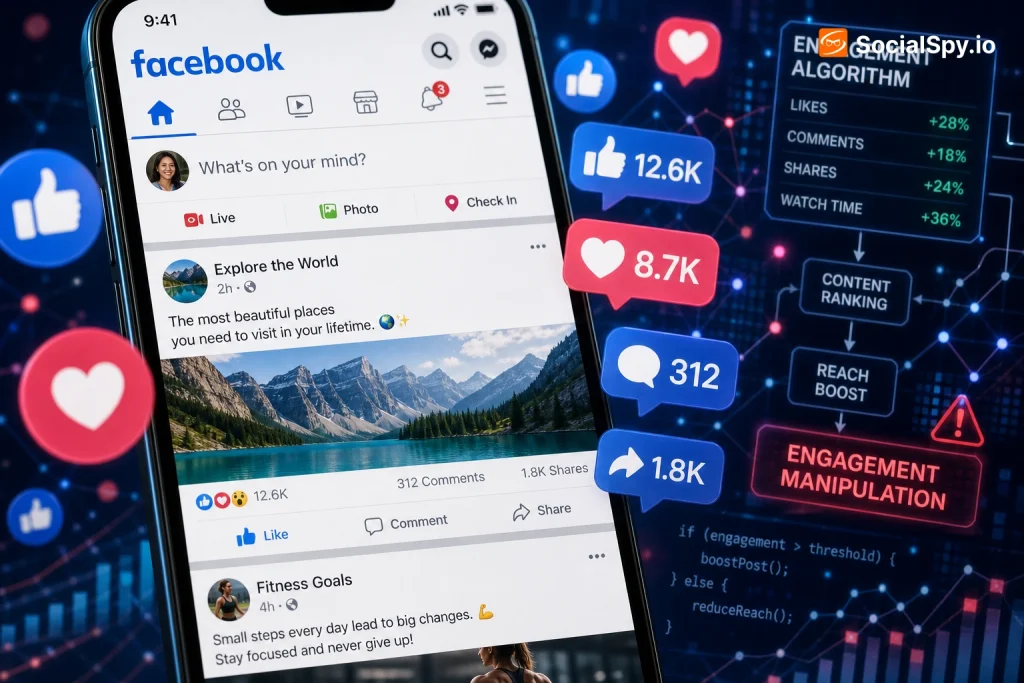
Meta doesn’t run one algorithm — it runs a stack of predictive models that score every piece of content in a user’s inventory before deciding what shows up in their feed. Engineers at Meta have described this publicly as a multi-stage process: inventory retrieval, signal extraction, relevance prediction, and a final ranking pass that weighs hundreds of features per post.
What matters most has shifted noticeably over the past two years. Meta has said openly that more than 50% of time spent on both Facebook and Instagram now goes to video, and Reels-style short-form content is the single biggest lever affecting a page’s overall reach.
Here’s a simplified breakdown of the signals that carry the most weight right now:
| Signal Category | What It Measures | Why It Matters |
|---|---|---|
| Meaningful Social Interactions (MSI) | Comments, shares, replies between friends/followers | Prioritized over passive likes since the 2018 MSI update, still core today |
| Watch time & retention | % of a video watched, replays, loop rate | Reels and native video get amplified based on completion rate, not just views |
| Click-gap | Whether a link gets disproportionate clicks vs. its domain’s normal engagement | Flags clickbait and low-quality link farms for demotion |
| Engagement bait detection | “Tag a friend,” “Like if you agree,” vote-baiting | Actively penalized since a 2017-2018 policy update still enforced today |
| Content diversity/originality | Reused, watermarked, or reposted content from TikTok/IG | Down-ranked in favor of platform-native uploads |
Industry analysts tracking organic reach across thousands of Pages consistently report average organic reach between 2% and 6% of a Page’s total followers per post — a number that’s stayed roughly flat for years regardless of Page size.
That last stat is the real reason people go looking for “cheats” in the first place. Organic reach has been structurally low since Facebook prioritized paid ads and friends-and-family content around 2016-2018, and no legitimate tactic reverses that trend — it only works around it.
The Tactics That Actually Move the Needle
Forget hacks. These are the levers Meta itself has confirmed matter, based on Creator Studio documentation, Meta’s Newsroom posts, and repeated statements from Meta’s own product teams.
- Post native Reels, not re-uploaded TikToks. Content with a visible TikTok watermark is measurably suppressed; Meta has confirmed this directly as part of its push for “original” video.
- Get engagement in the first 30-60 minutes. Facebook uses early velocity as a predictor signal — a post that gets fast comments and shares gets tested with a wider audience before the algorithm decides whether to keep pushing it.
- Drive comments with real questions, not bait. A genuine question (“What’s one tool that changed how you work?”) outperforms “Comment YES if you agree” because the system can distinguish authentic replies from bait-triggered one-word spam.
- Post consistently, not constantly. Pages posting 3-5 times a week see steadier reach than accounts that post twice a day; over-posting triggers a mild self-competition effect where new posts cannibalize each other’s distribution.
- Use Facebook Groups strategically. Group posts from members still reach a meaningfully higher share of the group’s active members than Page posts reach followers, because group content is treated as closer to a “friend” signal.
- Keep viewers on-platform. Posts with external links get a measurable reach penalty relative to native photo/video/text posts — this is the click-gap signal at work, not random bad luck.
None of this is secret. It’s published in Meta’s own transparency reports and creator resources — most people just never read past a headline that says “algorithm hack.”
The “Cheats” People Actually Try — and Why They Backfire
This is the part most “grow fast” guides skip. There’s a whole underground economy of Facebook growth tactics, and almost all of them either stopped working years ago or actively damage a Page today.
Engagement Pods and Comment Groups
These are private Groups or Telegram/Discord chats where members agree to like and comment on each other’s posts within minutes of publishing. They were genuinely effective around 2016-2017.
- Meta’s spam-detection models now cluster accounts that repeatedly engage with the same small circle of unrelated pages.
- Coordinated engagement from a fixed group of accounts is a textbook fake-engagement pattern the integrity systems are trained to catch.
- Pages caught in these clusters often see engagement scored as low-quality, which can suppress reach on unrelated future posts too.
Buying Likes, Followers, or Comments
Cheap follower and engagement packages still circulate on freelance marketplaces, usually sourced from low-quality or bot-driven accounts overseas.
- Purchased followers rarely engage, which tanks a Page’s engagement rate — a metric brands, influencers, and the algorithm itself all use to judge quality.
- Meta periodically runs mass purges of fake accounts; Pages built on purchased followers have historically seen sudden drops of 20-40% of their following overnight during these sweeps.
- A bloated, inactive follower base makes future organic reach worse, not better, because the ratio of engaged-to-total followers goes down.
Engagement Bait (“Like if…”, “Tag someone who…”)
This was a legitimate growth tactic until Meta explicitly targeted it in a 2017-2018 News Feed update.
Meta’s own engineering blog described engagement bait as content that “artificially inflates engagement using explicit and repetitive requests,” and confirmed posts using these patterns are demoted in distribution.
- Posts using bait phrasing get down-ranked algorithmically, not just penalized by user annoyance.
- Repeated use trains the classifier to flag an entire Page as a bait-prone source, hurting future posts too.
Clickbait Headlines and Fake News-Style Framing
“You won’t believe what happened next” style hooks still show up, but click-gap detection specifically targets this pattern.
- If a link gets far more clicks than its underlying domain typically earns in engagement, the system treats it as a red flag.
- Pages that repeatedly trigger click-gap penalties see their entire domain’s links suppressed platform-wide, not just the individual post.
Tools and Data That Give You a Legitimate Edge
Instead of manipulation, the highest-leverage move most Page admins skip is simply using the analytics Meta already gives away for free.
- Meta Business Suite Insights — shows reach, reactions, and audience retention per post, including a breakdown of organic vs. paid reach that most admins never check post-by-post.
- Reels analytics (plays, average watch time, shares to Stories) — the single best predictor of whether Meta will keep pushing a Reel past its initial test audience.
- Audience Insights tab — shows when your specific followers are online, which matters more than generic “best time to post” charts that ignore your actual audience.
- Third-party schedulers (Hootsuite, Sprout Social, Metricool, Buffer) — useful less for scheduling and more for their cross-Page benchmarking, which shows how your engagement rate compares to similar accounts.
- Meta Ads Manager “boost” data — even a $20-50 micro-boost on a top-performing organic post can reveal which audience segments respond best, informing future organic content for free.
A practical workflow: publish, wait two hours, check whether comments-per-1,000-reach is trending above your Page average, and only then decide whether to put ad spend behind it. That single habit outperforms almost every “algorithm hack” article in terms of actual reach gained.
Building a Distribution Strategy That Doesn’t Depend on the Algorithm
The most durable answer to “how do I beat the algorithm” is to need it less. Pages and creators who diversify their distribution are far less exposed when Meta inevitably tweaks ranking weights again — something that’s happened at least eight to ten times at a major scale since 2012.
- Build an email list or SMS list from Facebook traffic. Owned channels aren’t subject to ranking changes at all.
- Push high-intent followers into a Group. Group content consistently reaches a higher share of active members than Page posts.
- Repurpose top Reels into TikTok, YouTube Shorts, and Instagram natively (removing watermarks) rather than relying on Facebook alone.
- Use small always-on ad budgets ($5-10/day) to guarantee baseline reach for cornerstone content instead of hoping organic distribution shows up.
- Track engagement rate, not follower count, as the core health metric — a Page with 5,000 highly engaged followers regularly outperforms one with 50,000 disengaged ones.
Conclusion
The phrase “cheat the algorithm” survives because it sells clicks, but the mechanics behind Facebook’s ranking system make actual cheating a losing bet. Meta’s integrity and spam-detection systems are specifically built to catch coordinated engagement, bought followers, and bait-style posts, and getting caught costs more reach than it ever generates. The accounts genuinely winning distribution right now are the ones treating Reels, real comments, and early engagement velocity as the whole game — because, according to Meta’s own disclosures, that’s exactly what the ranking models are optimized for. The smartest move isn’t finding a workaround; it’s building a content and data habit that makes the algorithm irrelevant to your long-term growth.
FAQ
It can, especially if the accounts are traced back to bot farms or fake-account networks that Meta periodically purges. Even short of a ban, purchased engagement tanks your real engagement rate, which then suppresses reach on all your future organic posts.
No — posting too frequently can cause your own posts to compete with each other for the same audience attention window. Most analytics tools show Pages posting 3 to 5 times a week with strong content sustain better average reach than accounts posting multiple times daily with weaker content.
Yes, Meta has explicitly targeted this pattern in ranking updates going back to 2017-2018, and it remains an active demotion signal today. Posts using bait-style prompts get algorithmically suppressed rather than boosted, even though they often generate a short-term spike in comments.