Choosing a wireless carrier in 2026 usually comes down to a simple tension: do you want the biggest, fastest network money can buy, or the lowest possible bill with coverage that’s “good enough”? Consumer Cellular and Verizon Wireless sit on opposite ends of that spectrum, and the right pick depends heavily on how much data you actually use, whether you travel to rural areas, and whether you’re paying for one line or a whole family plan.
What These Two Carriers Actually Are
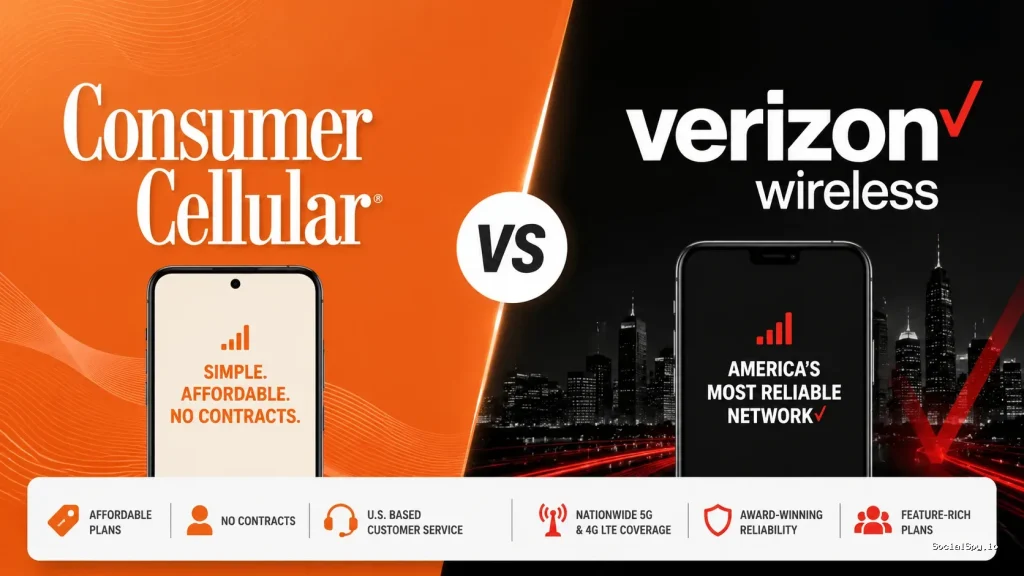
This comparison isn’t really “carrier vs. carrier” in the traditional sense — it’s a network owner vs. a network renter. Verizon Wireless built and operates its own nationwide cellular infrastructure, one of the three major U.S. networks alongside AT&T and T-Mobile. Consumer Cellular, by contrast, is a mobile virtual network operator (MVNO) that leases capacity on AT&T’s and T-Mobile’s towers and resells it under its own brand and pricing.
That structural difference explains almost everything else in this article.
- Verizon Wireless: Owns its towers, spectrum, and core network; controls its own 5G rollout schedule.
- Consumer Cellular: No towers of its own; routes traffic through AT&T and T-Mobile depending on your device and SIM.
- Practical effect: Consumer Cellular customers get roughly the same physical coverage map as AT&T/T-Mobile, but with lower speed priority during network congestion.
Industry analysts who track MVNO performance consistently note that “network deprioritization” — where host carriers slow down MVNO traffic first during peak congestion — is the single biggest real-world difference between owning and renting a network.
Consumer Cellular has carved out a specific niche since its founding in the late 1990s: it’s the carrier AARP has endorsed for years, and it markets almost exclusively to adults 50 and older who want simple plans, real human customer service, and no contracts. Verizon, meanwhile, markets to everyone, from teenagers streaming TikTok to enterprise fleets managing thousands of connected devices.
Network Coverage and Speed
If you live in a major metro area, both carriers will feel similar day to day, because Consumer Cellular is riding on the same towers Verizon’s two biggest rivals use. The gap widens once you leave cities.
| Factor | Verizon Wireless | Consumer Cellular |
|---|---|---|
| Network ownership | Own nationwide network | Leases AT&T + T-Mobile towers |
| Rural coverage | Strongest of the big three | Depends on host network in that region |
| 5G Ultra Wideband (mmWave) | Available in dense urban areas | Not accessible |
| Network prioritization | Full priority | Lower priority during congestion |
| Typical real-world speeds | Fastest average nationwide | Comparable off-peak, slower at peak times |
Verizon has historically topped independent network-performance studies from firms like Ookla and Opensignal for reliability and median download speeds, particularly in suburban and rural pockets where its rivals have historically underinvested. Consumer Cellular can’t beat that because it isn’t competing on infrastructure — it’s essentially reselling a slice of AT&T or T-Mobile’s coverage at a steep discount.
One underrated detail: Consumer Cellular lets you choose which network your SIM connects to (AT&T-based or T-Mobile-based) when you sign up, so it’s worth checking coverage maps for both before committing, since performance can vary significantly by ZIP code.
Pricing and Plan Structure
This is where Consumer Cellular’s entire business model shines. Its plans are built around flat, predictable pricing with no long-term contract, and the company has resisted the bloated multi-tier plan structures common at the major carriers.
Consumer Cellular Pricing Snapshot
- Talk & text plans starting around $20/month for single lines with minimal data.
- Unlimited data plans typically landing between $30 and $50/month per line.
- Multi-line discounts that stack additional lines for roughly $15-$20 each.
- AARP member discount of 5% off monthly service and 30% off accessories.
- No device financing markup games — phones are sold outright or at simple installment pricing.
Verizon Wireless Pricing Snapshot
- Unlimited plans ranging from about $65 to $90/month for a single line, depending on tier (Welcome, Plus, Ultimate).
- Multi-line family plans that bring per-line cost down to roughly $30-$45/month with 4-5 lines.
- Frequent promotional device deals (trade-in credits, “on us” iPhone or Galaxy offers) that require multi-year commitments to fully vest.
- Add-on perks bundled into higher tiers: Disney+, Hulu, Apple Music, or Walmart+ subscriptions.
- Autopay and paperless billing discounts of roughly $10/line.
A single retiree using under 5GB a month and making occasional calls will almost always pay less on Consumer Cellular than on any Verizon tier — the math simply isn’t close for low-usage lines.
Where Verizon claws back value is for families and heavy data users. Once you’re financing multiple flagship phones and streaming video daily across four or five lines, Verizon’s bundled perks and device promotions can offset its higher base price, something Consumer Cellular’s stripped-down model doesn’t attempt to match.
Devices, Compatibility, and the BYOD Question
Both carriers support bring-your-own-device (BYOD), but the experience differs a lot depending on what phone you’re bringing.
Verizon maintains an aggressive device lineup with the newest iPhones, Samsung Galaxy S-series, and Google Pixel phones available on day-one release with trade-in and promotional financing. Consumer Cellular sells a smaller, more conservative catalog — think reliable mid-range Android phones, a handful of flip phones for customers who want minimal complexity, and compatible iPhones — but it doesn’t chase flagship exclusivity.
- Verizon: Best for people who want the newest flagship phone subsidized through a multi-year plan.
- Consumer Cellular: Best for people who already own a phone or want something simple and affordable, including basic flip phones with large buttons and readable screens.
- Shared trait: Both support eSIM activation on modern phones, making the physical switch faster than it used to be.
If you’re bringing your own device to either carrier, it’s worth double-checking your phone actually supports the features you rely on daily — Bluetooth codec support for wireless earbuds, for instance, can vary by phone model and matters if you’ve invested in a pair recommended in is Sony worth it for wireless earbuds in 2026. Carrier switching rarely breaks Bluetooth pairing, but a factory reset during setup sometimes clears saved device connections, so it helps to know how to factory reset wireless earbuds if your headphones act up after activating a new SIM.
Customer Service and Target Audience
This is arguably Consumer Cellular’s biggest competitive advantage, and it’s not about price at all — it’s about who picks up the phone.
Consumer Cellular routes customer service through U.S.-based call centers and has built its entire brand identity around patient, human support for people who don’t want to navigate app-based troubleshooting or chatbots. Verizon has invested heavily in AI-driven support tools, a robust app, and in-store Genius Bar-style tech support at its retail locations, which suits a tech-comfortable, younger customer base better.
| Support Factor | Verizon Wireless | Consumer Cellular |
|---|---|---|
| Retail store footprint | Thousands of corporate + authorized stores | Primarily phone/online + limited retail partners (Target, etc.) |
| App sophistication | Advanced self-service app | Basic account management app |
| Contract requirement | Optional financing agreements | No contracts, cancel anytime |
| Senior-specific support | Not specialized | Built around 50+ demographic |
| AARP partnership | None | Official AARP-endorsed provider |
Consumer Cellular’s no-contract policy is genuinely rare in the industry — you can leave the same day you sign up with no early termination fee, which appeals to snowbirds, seasonal travelers, and anyone testing service quality before committing long-term.
International Travel and Data Roaming
If you travel internationally with any regularity, this category matters more than most people realize before they get hit with a roaming bill.
Verizon offers TravelPass, letting customers use their existing plan’s data, talk, and text abroad for a daily fee (around $10/day in most countries), plus dedicated international plans for frequent travelers. Consumer Cellular’s international options are far more limited — it offers add-on international talk and text packages, but data roaming support is thin and inconsistent depending on the destination country.
- Frequent international travelers: Verizon is the clear choice.
- Occasional domestic-only travelers: Consumer Cellular’s savings outweigh the roaming gap.
- Cruise or remote-area travelers: Verizon’s satellite-assisted emergency messaging (available on newer iPhones/Pixels through its network) adds a safety net Consumer Cellular doesn’t offer at the network level.
Verizon has also continued expanding satellite SOS-style connectivity partnerships, giving it an edge for anyone hiking, boating, or driving through dead zones where even its strong terrestrial network doesn’t reach.
Conclusion
The decision really splits along two lines: usage intensity and priorities. If you’re a single-line user who mostly calls, texts, and browses lightly, Consumer Cellular will almost certainly save you $360 to $600 a year compared to Verizon, with no meaningful coverage penalty in populated areas. If you’re a heavy data user, a family with four-plus lines, someone who travels internationally often, or someone who wants the newest flagship phone financed into a plan, Verizon’s network muscle and bundled perks justify the higher price.
There’s no wrong answer here so much as a mismatched one — putting a heavy Netflix-streaming teenager on Consumer Cellular’s network will frustrate everyone, just as putting a budget-conscious retiree on Verizon’s premium tier wastes money on features they’ll never use. Match the carrier to the actual usage pattern, not the brand reputation, and the choice becomes obvious fast.
FAQ
Consumer Cellular runs on the same physical towers as AT&T and T-Mobile since it’s an MVNO leasing their networks, so coverage maps look nearly identical in most areas. The difference shows up mainly during network congestion, when host-carrier customers like Verizon, AT&T, and T-Mobile subscribers get speed priority over MVNO traffic.
Yes, both carriers support standard number porting, and Consumer Cellular’s activation process typically takes under an hour once you provide your account number and PIN from Verizon. Just make sure your specific phone model is compatible with Consumer Cellular’s network option (AT&T-based or T-Mobile-based) before finalizing the switch to avoid feature loss like VoLTE or 5G access.
Consumer Cellular is notably more transparent, generally avoiding the monthly “administrative” and “regulatory recovery” line-item fees that add several dollars to nearly every Verizon bill. That said, always check the current rate plan details before signing up, since carrier fee structures on both sides can shift as plans get updated throughout the year.