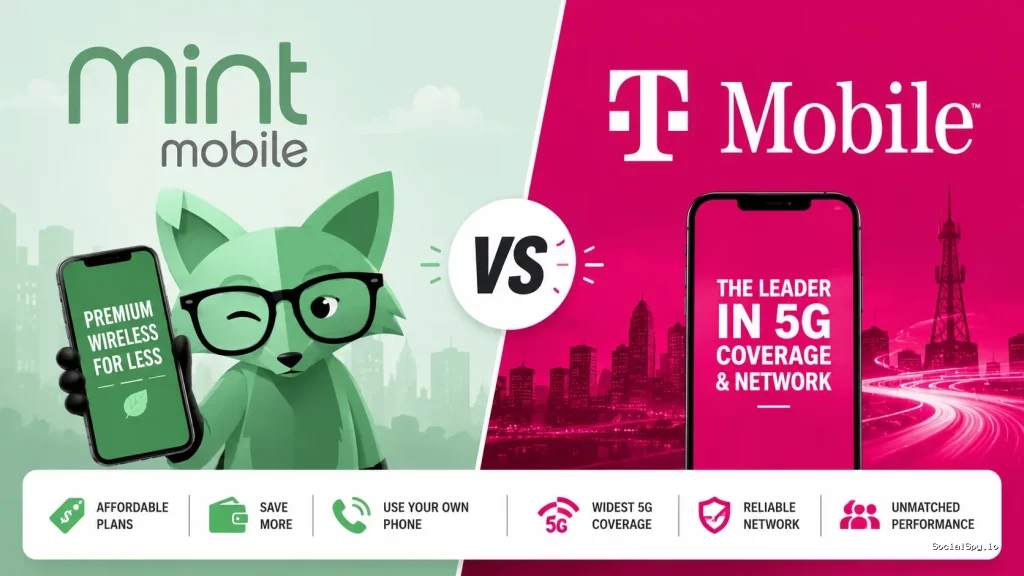
Mint Mobile and T-Mobile share the same underlying network, yet the price difference between them can run over $50 a month for a single line. That gap confuses a lot of shoppers who assume “same towers” means “same deal” – it doesn’t, and understanding why is the key to picking the right one for your situation.
How Mint Mobile and T-Mobile Are Actually Related
Mint Mobile isn’t a separate wireless network – it’s a mobile virtual network operator (MVNO) that leases capacity on T-Mobile’s towers. T-Mobile acquired Mint Mobile in a deal that closed in 2023, valued at up to $1.35 billion including performance-based earnouts, so the two companies are now technically under the same corporate umbrella.
That ownership doesn’t mean identical service, though. Mint traffic gets deprioritized behind T-Mobile’s own postpaid customers during network congestion, which matters most in crowded areas like stadiums, airports, or downtown cores during peak hours.
- T-Mobile: Runs its own 5G network, roughly 330 million people covered by mid-band Ultra Capacity 5G as of 2026.
- Mint Mobile: Rides that same physical network via MVNO agreements, but with lower priority during congestion.
- Ownership: Both brands are part of T-Mobile US, alongside Metro by T-Mobile.
- Coverage maps: Nearly identical in most suburban and rural areas since it’s the same towers.
Industry analysts covering the prepaid market note that the T-Mobile acquisition of Mint was largely about capturing budget-conscious customers without cannibalizing T-Mobile’s own postpaid brand – a strategy similar to how cable companies run MVNO deals like Spectrum Mobile to keep price-sensitive customers in the ecosystem.
Pricing Breakdown: Where the Real Difference Lives
This is where the two brands diverge sharply. Mint Mobile’s entire pitch is built around bulk prepaid discounts – you pay upfront for 3, 6, or 12 months at once, and the per-month price drops the longer you commit.
Mint Mobile Pricing (2026)
- 5GB plan: around $15/month with a 12-month prepay
- 15GB plan: around $20/month with a 12-month prepay
- Unlimited plan: around $25/month with a 12-month prepay, capped at reduced speeds after roughly 35GB of high-speed data
- Introductory new-customer rates are often lower for the first term, then renew at standard pricing
T-Mobile Postpaid Pricing (2026)
- Essentials Saver: around $50/month for one line (multi-line discounts apply)
- Experience More: around $85/month for one line, includes Netflix and Apple TV+ bundled in
- Experience Beyond: around $100/month for one line, includes premium perks, international data, and top-tier network prioritization
- Family plans of 4 lines can bring per-line costs down to roughly $25-30/month depending on the tier
The catch with Mint is that upfront cost. A 12-month unlimited plan means paying around $300 at checkout, not $25 spread across the year. T-Mobile bills monthly with no lump-sum requirement, which matters if cash flow is tight.
| Factor | Mint Mobile | T-Mobile |
|---|---|---|
| Billing style | Prepaid, upfront terms | Monthly postpaid |
| Starting price (single line) | ~$15-25/mo (prepaid) | ~$50-100/mo |
| Contract required | No, but prepay locks in term | No, but financing ties you in |
| Network priority | Deprioritized (MVNO) | Full priority |
| Phone financing | Not offered | Yes, 0% APR options |
Network Performance: Same Towers, Different Experience
Because Mint runs on T-Mobile’s actual radio infrastructure, coverage maps look nearly identical on paper. Real-world speed and reliability tell a slightly different story once you factor in network prioritization.
During normal conditions – a weekday afternoon in a suburban neighborhood – most Mint users won’t notice any difference from T-Mobile postpaid customers. The gap shows up specifically during network congestion events:
- Large concerts, sporting events, or festivals where thousands of devices hit the same cell tower simultaneously.
- Major holidays like New Year’s Eve when texting and calling volume spikes citywide.
- Dense urban cores during rush hour where tower capacity gets stretched thin.
In those scenarios, T-Mobile’s own postpaid subscribers get routed ahead of Mint traffic, which can mean slower load times or dropped connections for Mint users while T-Mobile customers stay smooth. For most people who aren’t regularly in packed venues, this distinction is largely theoretical rather than a daily annoyance.
Data caps also shape the experience differently. T-Mobile’s higher-tier postpaid plans include unlimited premium data with no hard throttling threshold in typical use, while Mint’s unlimited plan slows speeds noticeably once you cross the 35GB mark in a billing cycle – a real constraint for heavy streamers or people who use their phone as a mobile hotspot.
Phones, Devices, and Financing
This is one of the starkest differences between the two brands, and it’s often the deciding factor for people who don’t already own a paid-off phone.
T-Mobile operates like a traditional carrier when it comes to devices:
- 0% APR financing on new iPhones, Samsung Galaxy, and Google Pixel devices over 24 months
- Trade-in credits that can knock hundreds of dollars off a new phone with an eligible trade
- Promotional deals tied to switching from a competitor, sometimes covering an entire device cost via bill credits
- In-store support at thousands of retail locations for hands-on troubleshooting or upgrades
Mint Mobile takes the opposite approach – it’s essentially a BYOD (bring your own device) carrier:
- No financing plans; you either buy a phone outright elsewhere or bring an existing unlocked one
- Sells a limited selection of phones for one-time purchase, but no installment billing
- No physical retail stores – everything is handled online or through the app
- Works with most unlocked GSM phones, but you’ll want to check eSIM/APN compatibility before switching
If someone’s phone is aging and they want to upgrade without paying full price upfront, T-Mobile’s financing structure is a genuine advantage that Mint simply can’t match. If someone already owns a compatible unlocked phone and just wants cheap service, that gap doesn’t matter at all.
Perks, Extras, and the Hidden Value Layer
Beyond raw price and network specs, T-Mobile bundles in extras that push the value proposition well past “just phone service.” These perks are baked into the higher-tier plans rather than sold separately.
- Netflix and Apple TV+ included free on Experience More and above
- T-Mobile Tuesdays app offering weekly freebies and discounts from partner brands
- In-flight Wi-Fi on select airlines included at no extra charge on premium tiers
- International roaming in over 210 countries and destinations included on higher plans
- 5G home internet discounts when bundling with a T-Mobile phone line
Mint Mobile strips almost all of this away in exchange for the lower base price. There’s no streaming bundle, no loyalty app rewards program, and international roaming requires purchasing add-on passes separately rather than getting them baked in.
The tradeoff is straightforward: T-Mobile sells a lifestyle bundle with wireless service as one piece of it, while Mint sells wireless service as the entire product, stripped to its essentials.
For someone who already pays separately for Netflix and doesn’t travel internationally often, those T-Mobile perks amount to paying for things they won’t use. For a frequent traveler or streaming household, the bundled value can genuinely offset the higher monthly price.
Who Should Actually Choose Which
The decision really comes down to a handful of concrete usage patterns rather than brand loyalty. Here’s a practical way to sort it out.
Mint Mobile makes sense if:
- You already own an unlocked, compatible phone outright
- You’re comfortable prepaying a lump sum for 3-12 months of service
- Your monthly data usage stays under roughly 20-30GB
- You rarely find yourself in congested venues like stadiums or festivals
- You want the lowest possible monthly cost and don’t need bundled perks
T-Mobile makes sense if:
- You need to finance a new phone without paying full price upfront
- You want guaranteed network priority, especially in busy urban areas
- You value bundled extras like Netflix, international roaming, or in-flight Wi-Fi
- You’re adding multiple lines and want family-plan per-line discounts
- You want in-person retail support for troubleshooting or upgrades
There’s also a middle path worth mentioning: some households actually run both. A parent might keep a T-Mobile line with financing for a growing teenager who needs an upgrade path, while putting an older, paid-off device on Mint for a secondary line or a low-usage family member. Mixing carriers within a family isn’t unusual anymore, especially since both technically ride the same network anyway.
It’s also worth zooming out to the broader MVNO landscape before committing. Cable-affiliated options like Spectrum Mobile run on a mix of Verizon’s network and their own Wi-Fi hotspots, which creates a genuinely different tradeoff profile than a T-Mobile-based MVNO like Mint – worth comparing if you’re already a cable internet subscriber who could bundle in mobile lines for a discount.
Conclusion
The Mint Mobile versus T-Mobile decision isn’t really a battle between two competing networks – it’s a choice between two different business models sitting on top of the same physical infrastructure. Mint wins decisively on raw monthly price for anyone willing to prepay and who already owns their phone, often landing at $15-25 a month versus T-Mobile’s $50-100 range for comparable data.
T-Mobile wins on flexibility, financing, prioritized network access, and bundled perks that add real value for streaming households and frequent travelers. Neither answer is universally correct, and the honest recommendation is to run the math on your own actual data usage, phone situation, and tolerance for prepaying a lump sum before assuming the cheaper sticker price is automatically the better deal.
FAQ
Yes, Mint Mobile is a T-Mobile-owned MVNO that operates entirely on T-Mobile’s physical network infrastructure, so coverage maps are nearly identical in most areas. The difference is that Mint traffic gets deprioritized behind T-Mobile’s own postpaid customers during network congestion.
Yes, significantly cheaper on a per-month basis – Mint’s unlimited plan runs around $25/month with a 12-month prepay versus T-Mobile’s postpaid unlimited plans starting around $50-100/month. The tradeoff is that Mint requires paying that amount upfront for the full term rather than billing monthly.
No, Mint Mobile doesn’t offer phone financing or installment plans at all – it’s a bring-your-own-device carrier where you either buy a phone outright or bring an existing unlocked one. T-Mobile offers 0% APR financing over 24 months plus trade-in credits, which is a major advantage for anyone needing to upgrade without paying full price upfront.