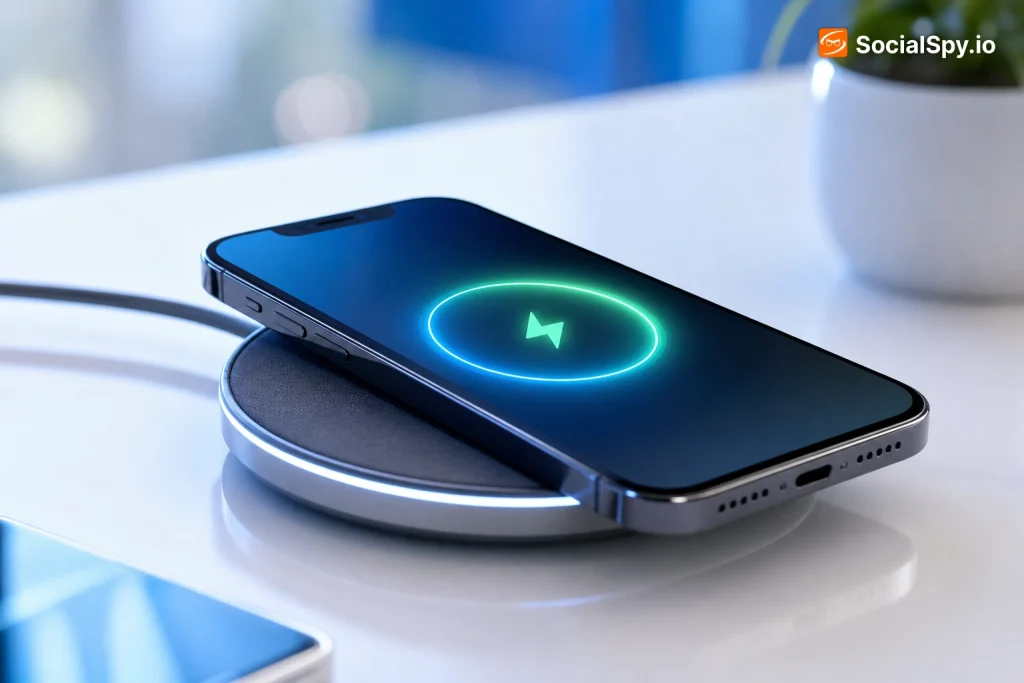
Wireless charging pads sit on nearly every nightstand in 2026, but the rumor that they’re secretly cooking your battery refuses to die. The truth is more nuanced than “yes” or “no” — it depends on heat, charging speed, and habits most people never think about.
Why Wireless Charging Gets Blamed for Battery Wear
Every lithium-ion battery degrades through chemical aging, and heat is the single biggest accelerant of that process. Wireless charging uses electromagnetic induction — a coil in the charger creates a magnetic field that induces current in a coil inside your phone — and that conversion process is inherently less efficient than a direct wired connection.
Efficiency losses show up as heat. Wired charging typically runs at 85-95% efficiency, while wireless charging often lands in the 65-80% range depending on coil alignment and charger quality.
- Wired USB-C charging: minimal energy lost as heat, direct current transfer
- Qi/Qi2 wireless charging: energy converted twice (electrical to magnetic to electrical), losing 15-35% as heat
- Misaligned phone on a pad: efficiency drops further, heat rises
- Thick or metal-lined phone case: traps heat against the battery
Battery scientists have long pointed to 30-35°C (86-95°F) as the threshold where lithium-ion degradation accelerates noticeably. A phone charging wirelessly under a warm case on a summer nightstand can creep into that zone far more easily than one plugged into a cable.
The Actual Science: How Much Degradation Are We Talking About
Independent battery testing labs and phone manufacturers’ own engineering teams generally agree the wear difference is real but modest. Most lithium-ion batteries are rated for roughly 500 full charge cycles before dropping to about 80% of original capacity, and that number shifts based on temperature and charge speed, not the presence or absence of a cable.
A battery kept consistently under 35°C during charging will typically retain noticeably more capacity after two years than one that regularly charges above 40°C — regardless of whether that heat comes from a wired fast charger or a wireless pad.
Here’s a rough comparison of how different charging methods stack up on the factors that actually matter for long-term battery health:
| Charging Method | Typical Heat Generated | Efficiency | Long-Term Battery Impact |
|---|---|---|---|
| Standard wired (18-30W) | Low-moderate | 85-95% | Minimal |
| Wired fast charging (45W+) | Moderate-high | 80-90% | Moderate if used constantly |
| Standard Qi wireless (7.5-15W) | Moderate | 65-80% | Slightly higher than wired |
| Qi2 with magnetic alignment | Lower than old Qi | 75-85% | Improved, closer to wired |
| Overnight wireless (8+ hrs) | Low but sustained | N/A | Low, thanks to trickle charging |
The overnight scenario is actually the least damaging use case. Modern phones cut power once they hit 100% and use smart trickle-charging or optimized charging algorithms that pause and resume overnight, so the battery isn’t sitting at full voltage under heat for eight straight hours like it would have a decade ago.
Qi2 and MagSafe Changed the Equation
The wireless charging landscape in 2026 looks very different from the sloppy, misaligned pads of 2019. Qi2, the standard built on Apple’s MagSafe magnetic alignment system, has become the dominant wireless charging spec across flagship Android phones and iPhones alike.
The magnet ring in Qi2 forces the phone’s coil to sit in the exact same spot every time, which matters more than people realize.
- Perfect alignment means less energy wasted searching for the coil position
- Less wasted energy means less heat generated per charging session
- Lower heat means charging speeds can be pushed higher without extra battery stress
- Manufacturers have used this headroom to bump wireless speeds toward 15-25W on newer devices
Samsung, Google, and Apple have all converged on magnetic-aligned wireless standards partly because the old “place it anywhere on the pad” approach was genuinely worse for both charging speed and battery temperature. If you’re shopping for a charger today, prioritizing a Qi2-certified pad over a cheap off-brand Qi 1.0 model is one of the easiest ways to reduce heat-related wear.
Habits That Matter More Than the Charging Method Itself
Fixating on wired-versus-wireless misses the bigger picture. Battery longevity researchers consistently point to a handful of habits that swamp whatever small penalty wireless charging carries.
Case thickness and material
A thick case, especially one with metal components or a built-in battery pack, traps heat against the phone during any charging method. Wireless charging makes this worse because the phone is already generating more heat, so a case that can’t dissipate it compounds the problem.
Charging environment
Charging in direct sunlight, inside a hot car, or under a pillow (yes, people do this) raises ambient temperature well above the danger threshold regardless of charger type. This is arguably a bigger factor than the wireless-vs-wired debate itself.
Keeping the battery between 20% and 80%
Both Apple and Samsung now build “optimized charging” or “protect battery” toggles into their software that intentionally slow the last 10-20% of a charge to reduce time spent at high voltage. Enabling this setting does more for long-term battery health than switching away from wireless charging entirely.
- Avoid letting the phone sit at 100% for hours in a hot car
- Remove thick cases before wireless charging when possible
- Use manufacturer-certified Qi2 chargers rather than cheap third-party pads
- Enable optimized/adaptive charging in phone settings
- Avoid charging wirelessly while actively gaming or streaming video, which adds processor heat on top of charging heat
Real-World Numbers: What Two Years of Wireless Charging Actually Does
Third-party repair shops and battery health tracking apps have generated a decent body of real-world data over the past few years. The consensus pattern looks something like this for a phone charged predominantly one way for roughly 24 months of daily use:
- Wired charging only, moderate use: battery health typically lands around 88-92%
- Mixed wired and wireless, moderate use: around 85-90%
- Wireless-only with cheap non-Qi2 pads and thick cases: as low as 80-85%
- Wireless-only with Qi2 and optimized charging enabled: 86-91%, nearly matching wired
The spread between the best-case and worst-case wireless scenarios is larger than the spread between wired and well-managed wireless charging. In other words, how you wireless charge matters more than whether you wireless charge.
This matters practically because battery replacement isn’t free. Anyone who’s priced out a swap recently knows the numbers — whether it’s an iPhone 16 battery replacement, an iPhone 16 Plus battery replacement, or the newer iPhone 17 Air battery replacement, costs generally run $89 to $129 depending on model and whether you’re in or out of warranty coverage. Stretching the years between replacements by even 10-15% through smarter charging habits is worth real money.
Where Wireless Charging Actually Shines
It’s worth acknowledging what wireless charging gets right, because the battery-wear conversation often drowns out genuine advantages. The convenience factor is real: no port wear, no cable fraying, and a lower barrier to actually plugging in (or rather, setting down) your phone consistently, which itself supports healthier partial-charge habits.
Port longevity is an underrated benefit. USB-C ports on phones degrade after thousands of insertions, and wireless charging eliminates that mechanical wear entirely. For anyone who’s dealt with a loose-feeling charging port after two years of daily cable use, that tradeoff alone can be worth the small battery efficiency hit.
The ecosystem argument matters too. Just as choosing the right earbuds involves weighing tradeoffs — the kind of cost-versus-value thinking covered in how to tell if wireless earbuds are worth the price difference — wireless phone charging is a tradeoff between marginal battery wear and genuine day-to-day convenience, not a simple good-or-bad verdict.
Conclusion
Wireless charging isn’t the battery killer social media threads make it out to be, but it isn’t a complete non-issue either. The honest verdict: it introduces a small, measurable amount of extra heat compared to wired charging, and heat is what actually damages lithium-ion cells over time — not the absence of a cable itself.
What actually determines whether your battery holds up well over two or three years comes down to controllable habits: using a Qi2-certified charger instead of a cheap pad, removing thick cases before charging, avoiding hot environments, and enabling optimized charging in your phone’s settings. Get those four things right and the wired-versus-wireless debate becomes almost irrelevant to your battery’s actual lifespan.
FAQ
Not significantly. Modern phones use optimized charging algorithms that slow or pause charging once you’re near full, so an overnight wireless session generates sustained low heat rather than prolonged high-voltage stress, making it one of the safer wireless use cases.
Yes, largely because of magnetic alignment. Qi2’s magnet ring keeps the phone’s coil perfectly positioned over the charger’s coil every time, which reduces wasted energy and heat compared to older Qi 1.0 pads where misalignment was common and efficiency losses were higher.
No, that’s overkill for most people. The realistic battery health difference between well-managed wireless charging and wired charging is only a few percentage points over two years, so switching entirely to wired charging isn’t necessary unless you’re using a cheap, unaligned pad or leaving your phone in a hot car regularly.