The iPhone 16 Plus packs one of Apple’s largest batteries yet into a 6.7-inch body, but even Apple’s best lithium-ion cells degrade with time and daily charge cycles. Eventually, most owners will face the question of whether to pay for a battery swap or start shopping for a new phone. Here’s what that decision actually costs, how long it takes, and where the trade-offs lie.
What Apple Actually Charges in 2025
Apple’s official pricing for the iPhone 16 Plus battery service sits at $99 for anyone outside of warranty coverage, a figure that’s held steady across the last several generations of Plus-sized iPhones. That price includes the battery itself, labor, and a fresh seal on the device’s water-resistance gaskets, which get broken every time a technician opens the case.
If your iPhone 16 Plus is still under Apple’s standard one-year limited warranty, the replacement is free — but only if Apple’s diagnostics confirm the battery has degraded to below 80% of its original maximum capacity. That threshold is the same one Apple has used since the iPhone 8 era, and it’s baked into iOS itself through the Battery Health menu.
Apple typically evaluates battery health as part of any repair intake, so even a screen or camera repair visit can flag a battery that qualifies for free replacement under warranty.
Here’s how the numbers break down across service channels:
| Service Provider | Typical Cost | Genuine Apple Battery | Warranty on Repair |
|---|---|---|---|
| Apple Store / Apple Authorized Service Provider | $99 | Yes | 90 days (or remaining AppleCare+ term) |
| AppleCare+ (battery below 80% health) | $0 | Yes | 90 days |
| Independent repair shop | $70–$90 | Often aftermarket | Varies, often 6–12 months |
| DIY kit (parts + tools) | $45–$65 | Aftermarket | None |
AppleCare+ subscribers effectively get unlimited free battery replacements as long as the phone qualifies by health percentage, which is one of the more underappreciated perks of the plan given that a single $99 out-of-pocket repair can nearly offset a year of coverage cost. For anyone weighing similar math on other models, the breakdown in the iPhone 16 Battery Replacement: Cost and What to Expect guide shows the standard iPhone 16 carries identical Apple pricing, since battery service cost is tied to Apple’s tiered system rather than screen size.
Signs Your iPhone 16 Plus Battery Actually Needs Replacing
Not every instance of a phone feeling “slower” or dying faster means the battery is bad. Apple’s Battery Health tool, found under Settings > Battery > Battery Health & Charging, is the most reliable diagnostic most owners will ever need.
- Maximum Capacity below 80%: This is Apple’s official threshold for a battery considered “degraded” and eligible for service consideration.
- “Peak Performance Capability” warning: A message stating the battery can no longer supply peak power, which can cause unexpected shutdowns under heavy load like gaming or camera use.
- Rapid overnight drain: Losing 15%+ battery overnight with no active apps often points to a swollen cell or a rogue background process rather than raw age, though both can coincide.
- Physical swelling: A back glass panel that appears slightly lifted or a screen that pops loose at the edges is a serious sign of battery swelling and needs immediate attention.
- Charging past 100% doesn’t hold: If the phone hits full charge but drops to 90% within an hour of light use, capacity has likely fallen well below the labeled rating.
Apple’s internal engineering target is for the iPhone 16 Plus battery to retain 80% of its original capacity after 1,000 complete charge cycles, a spec unchanged from recent generations. A full cycle counts as using 100% of battery capacity, whether that’s one full day-to-night discharge or several partial top-ups that add up to 100%. For most users charging nightly, hitting 1,000 cycles takes roughly 2.5 to 3 years, which lines up with when most people start noticing real degradation.
Genuine Parts vs. Third-Party: What You’re Actually Trading Away
This is the part most price-comparison articles gloss over, and it matters more with the iPhone 16 Plus than with older models. Apple’s newer iPhones use a small microcontroller inside the battery that communicates with iOS to enable full Battery Health reporting.
Why Apple’s $99 Isn’t Purely a Markup
When Apple or an Apple Authorized Service Provider installs a battery, the phone recognizes it as genuine and the Battery Health screen displays a normal percentage reading. Independent shops using aftermarket cells — even good ones — often trigger a persistent “Unknown Part” warning in Settings, and in many cases the Maximum Capacity percentage simply won’t display at all.
- Genuine Apple part: Full Battery Health reporting, proper thermal management calibration, official warranty backing.
- High-quality aftermarket part: Functional battery, often thicker or bulging risk over time, “Unknown Part” notice, no capacity percentage shown.
- Bargain aftermarket part: Reduced cycle life, sometimes missized cells that stress the housing, higher swelling risk within 12-18 months.
Third-party shops have made real strides at part-pairing and diagnostics, and reputable chains often source cells from established battery manufacturers rather than no-name suppliers. But there’s no way for a consumer to independently verify cell quality before installation, which is why the $20 to $30 savings over Apple’s price doesn’t automatically make it the better deal.
For context on how this same trade-off plays out on other recent models, the iPhone 15 Pro Max Battery Replacement: Cost and What to Expect guide covers similar part-pairing quirks that Apple introduced starting with the iPhone 15 lineup — the iPhone 16 Plus inherits the same system.
What Actually Happens During the Repair
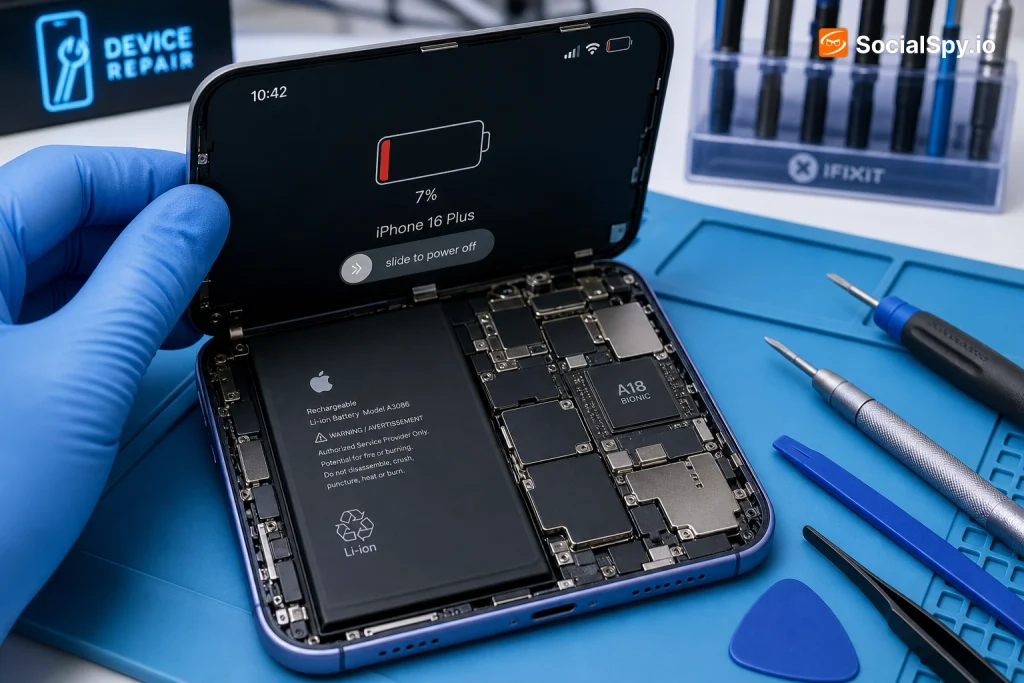
Apple’s in-store process for the iPhone 16 Plus is faster than most people expect, largely because the phone’s internal layout was redesigned for easier battery access compared to the iPhone 15 generation.
- Check-in and diagnostic: A technician runs Apple’s diagnostic suite, confirming battery health percentage and checking for other issues like camera or Face ID faults that could complicate the repair.
- Back glass removal: The iPhone 16 Plus uses a redesigned adhesive and internal structure that Apple has said allows for quicker back-panel removal than prior Pro models, part of a broader repairability push.
- Battery disconnect and extraction: The battery is secured with pull-tab adhesive strips; technicians gently heat and pull these strips to avoid puncturing the cell, since punctured lithium-ion batteries pose fire risk.
- New battery installation and reseal: The genuine replacement battery is seated, reconnected, and the back glass is resealed with fresh adhesive to restore the phone’s IP68 water resistance rating.
- Calibration and testing: The phone runs through a calibration cycle and final diagnostics before being handed back.
Apple typically completes this in-store in about 45 minutes to a few hours, depending on store traffic, while mail-in repair through Apple’s service center adds 3 to 5 business days including shipping. Independent shops often advertise 30-minute turnarounds, which is realistic given their more accessible internal parts arrangement, but faster service can sometimes mean less careful adhesive work.
Repair vs. Replace: The Real Cost Math
A $99 battery job essentially resets the most consumable part of the phone, but it’s worth running the comparison against buying new or trading in.
Apple’s trade-in value for an iPhone 16 Plus in good condition, even a couple of years old, typically still lands in the $300 to $450 range depending on storage tier and market conditions at the time. That’s a meaningful chunk toward a new iPhone, but only if the rest of the phone — screen, cameras, structural integrity — is also holding up well.
- Choose repair if: The phone is otherwise in great shape, you’re not itching for new features, and you plan to keep using it for another 1-2+ years.
- Choose replace/upgrade if: You’re also dealing with a cracked screen, degraded cameras, or storage that’s too small, since combined repair costs can approach the cost of financing a new model.
- Choose AppleCare+ renewal instead: If you’re two years into ownership and the battery isn’t yet below 80%, extending coverage can preempt this decision entirely for a lower annual cost than a one-off repair.
Compare that to the standard-size iPhone before it: the iPhone 15 Plus Battery Replacement: Cost and What to Expect piece shows nearly identical Apple pricing, reinforcing that Apple’s $99 fee has become a fixed anchor point across Plus models rather than fluctuating by device generation.
Analysts tracking device longevity trends note the average American now keeps a smartphone for roughly 2.8 years, meaning a huge share of iPhone 16 Plus owners will likely hit meaningful battery degradation right around the time their original warranty and AppleCare+ terms expire.
Conclusion
The iPhone 16 Plus battery replacement decision ultimately comes down to how much you value verified parts and warranty protection versus a modest short-term discount. Apple’s $99 flat fee, unchanged from recent generations, buys genuine hardware, full Battery Health reporting, and a resealed water-resistant housing — details that matter more on a phone this size given its larger, harder-to-source cell. Third-party repair can save $20 to $30 upfront, but the “Unknown Part” warning and missing capacity readout are real functional downsides, not just cosmetic annoyances. For most owners planning to keep their iPhone 16 Plus beyond the two-year mark, paying Apple’s price — or better yet, having AppleCare+ already in place — remains the most predictable and lowest-risk path forward.
FAQ
It’s covered for free only if your phone is still within its original one-year Apple warranty period, or under active AppleCare+ coverage, and Apple’s diagnostic confirms the battery’s Maximum Capacity has fallen below 80%. Outside of those conditions, Apple charges the standard $99 out-of-warranty fee regardless of how degraded the battery actually is.
It won’t void the entire device warranty on unrelated components, since US consumer protection law generally prevents that, but it does void Apple’s warranty coverage specifically on the battery and can trigger a persistent “Unknown Part” notification in Settings. Any future Apple service on that phone will also note the non-genuine part, which can affect trade-in valuations.
Apple rates the battery to retain about 80% of its original capacity after roughly 1,000 full charge cycles, which for a typical daily-charging user works out to approximately 2.5 to 3 years of regular use. Heavy 5G usage, gaming, and frequent fast-charging can shorten that timeline, while enabling Optimized Battery Charging in Settings can help extend it slightly.