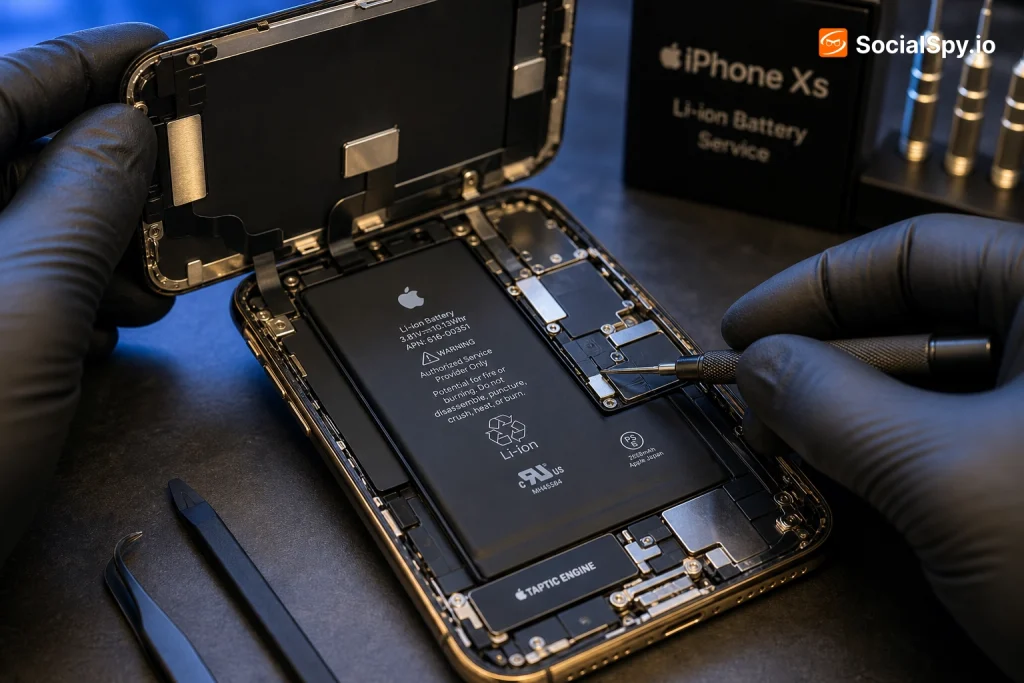
The iPhone XS turns six years old this year, and if yours still has its original battery, you’ve likely noticed the signs: it dies by 3pm, throttles under load, or shuts off unexpectedly at 20% battery. Apple’s own chemistry-based lithium-ion cells simply don’t last forever, and the XS is old enough now that replacement isn’t a luxury decision anymore — it’s a math problem. Here’s exactly what that math looks like, what happens in the repair bay, and where the real tradeoffs are hiding.
How to Know Your Battery Actually Needs Replacing
Before spending anything, check the data Apple already gives you. Go to Settings > Battery > Battery Health & Charging — this feature has existed since iOS 11.3 and it’s the single most reliable diagnostic tool on the phone.
- Maximum Capacity below 80%: Apple’s official spec says a battery is designed to retain 80% of its original capacity at 500 complete charge cycles. Most XS units hit this somewhere between 2-3 years of daily use.
- “Peak Performance Capability” warning: This means iOS has throttled your CPU to prevent unexpected shutdowns — a direct sign the battery can’t supply peak current anymore.
- Rapid percentage drops: Going from 30% to 5% in a few minutes, especially in cold weather, points to a degraded cell that can’t hold voltage under load.
- Unexpected shutdowns even above 20%: This was the exact issue that triggered Apple’s 2017-2018 “batterygate” settlement and led to the Battery Health feature existing at all.
- Physical swelling: If the screen is lifting slightly at the edges or won’t sit flush, stop charging it immediately — a swollen lithium-ion battery is a fire risk, not just an inconvenience.
Apple’s internal benchmark: a battery is considered “healthy” until it drops below 80% maximum capacity — below that threshold, AppleCare+ will replace it for free.
What It Actually Costs: Every Option Compared
Pricing varies more than most people expect, and the cheapest option isn’t always the smartest one for this specific phone.
| Option | Typical Cost | Turnaround | Warranty on Repair |
|---|---|---|---|
| Apple Store / mail-in (out of warranty) | $89 | Same day (in-store) or 5–9 days (mail) | 90 days |
| AppleCare+ (battery under 80% health) | $0 | Same day or mail-in | 90 days |
| Independent shop (uBreakiFix/Asurion, CPR) | $50–$80 | Same day, often under an hour | 90 days to 1 year, varies by chain |
| Local independent repair shop | $40–$70 | Same day | Varies, often 30–90 days |
| DIY (iFixit kit) | $25–$40 for parts | 30–60 minutes of your time | None |
Apple’s pricing tier for the XS puts it in the $89 bracket alongside the iPhone X, XR, and 11 series — one step above the $69 tier reserved for the iPhone SE, 6, 6s, 7, and 8 lines. That $89 price has stayed roughly flat since Apple’s last major battery-service price adjustment, unlike the newer iPhone 14 and 15 lines which now sit at $99.
Why AppleCare+ Matters Here Specifically
If you bought AppleCare+ when the XS was new back in 2018, there’s a decent chance it’s expired by now — standard AppleCare+ only covers 2 years from purchase unless you converted to the monthly AppleCare+ subscription, which renews indefinitely. If you’re still on the subscription plan, check your coverage before paying anything; it’s an easy $89 to forget you’re entitled to.
What Actually Happens During the Repair
Whether you go to an Apple Store or ship the phone in, the process is more standardized than most people assume.
- Diagnostic check: A technician runs a quick software diagnostic to confirm the battery is genuinely the issue and not, say, a software bug or a failing charging port.
- Backup reminder: You’re advised to back up via iCloud or a computer first — Apple’s battery swap rarely wipes data, but it’s standard precaution before any hardware is opened.
- Disassembly: The screen is separated from the frame (it’s adhesive-sealed, not clipped), and the battery — held down with stretch-release adhesive strips — is pulled out.
- New battery installation: A genuine 2,658 mAh cell (the XS’s stock capacity) is installed and paired to the phone’s logic board.
- Reseal and pressure test: The screen is resealed with new adhesive to maintain the XS’s IP68 water resistance rating, then the phone typically goes through a water-resistance pressure check.
- Calibration: The phone needs a full charge-discharge cycle before Battery Health reporting stabilizes — don’t panic if the percentage looks slightly off in the first 24–48 hours.
At an Apple Store, this whole process usually takes 30–45 minutes if a technician is available and the part is in stock. Mail-in service through Apple’s support site typically adds 3–5 shipping days on each end.
Genuine vs. Third-Party Batteries: The Trap Nobody Warns You About
This is the part where the iPhone XS specifically punishes bargain-hunting. Starting with the XS, XR, and continuing through every model since, Apple embedded a small authentication chip inside the battery itself that communicates with the logic board.
- With a genuine Apple battery: Battery Health reports a normal maximum capacity percentage, and everything functions as expected.
- With most third-party batteries: iOS displays “Important Battery Message: Unable to verify this iPhone has a genuine Apple battery,” and the Maximum Capacity percentage simply disappears from Battery Health — replaced with “Service.”
- Functional impact: The phone still charges and runs fine in most cases, but you lose visibility into battery health and, in some iOS versions, lose access to the “Peak Performance Capability” throttling toggle.
- Independent repair shops workaround: Reputable chains like uBreakiFix now source batteries with proper authentication pairing or use Apple-approved parts through Apple’s Independent Repair Provider program, which avoids the warning entirely.
The practical lesson: if you’re paying a third party, specifically ask whether they’re an Apple Authorized Service Provider or part of the Independent Repair Provider Program. Random kiosk repair shops using generic aftermarket cells are where the “Unknown Part” warning shows up most often.
The DIY Route
iFixit sells complete battery replacement kits for the XS, typically bundled with the adhesive strips, opening tools, and a screwdriver set. The XS scored a modest repairability rating from iFixit largely because of the glued-down screen and the fragility of the stretch-release adhesive tabs holding the battery in place.
- Pull the adhesive tabs too fast and they can snap, leaving glue residue that requires isopropyl alcohol to soften before you can safely pry the battery out.
- Puncturing a lithium-ion cell during removal is a genuine fire hazard — this is the single biggest risk of the DIY route.
- You’ll also trigger the same “Unknown Part” battery warning unless you buy a kit that includes a proper authentication chip pairing process.
Is It Even Worth Fixing a Six-Year-Old Phone?
This is the real question hiding behind the cost question, and it deserves an honest answer.
- Resale value check: A used iPhone XS in good condition typically sells for $100–$180 depending on storage size and carrier lock status — meaning an $89 Apple repair can eat half its resale value.
- Performance ceiling: The XS runs on the A12 Bionic chip, which still supports the current iOS releases as of this writing, but it’s aging out of newer feature support faster each year (no Apple Intelligence, limited camera software features compared to newer models).
- Environmental angle: Apple and independent electronics-recycling advocates both note that extending a phone’s life by even one more year meaningfully reduces e-waste compared to replacing the whole device — a battery swap is a fraction of the carbon and mineral cost of manufacturing a new iPhone.
- Practical use case: If the XS is a backup phone, a kid’s first device, or a work phone with light use, an $89 battery is far cheaper than any replacement device on the market, new or used.
Industry repair analysts commonly frame the rule this way: if a battery replacement costs less than 30% of a device’s current resale value and the rest of the hardware is healthy, it’s almost always worth doing.
For the XS specifically, $89 against a $100–$180 resale value sits right at that threshold — meaning the decision genuinely comes down to whether you plan to keep using the phone or sell it as-is.
Conclusion
The iPhone XS occupies an odd spot in Apple’s lineup right now: old enough that batteries are reliably failing across the installed base, but not so old that a battery swap is throwing good money after bad. If your Battery Health reads below 80% and you plan to keep the phone another year or two, the $89 Apple repair (or free replacement under active AppleCare+) is the least risky move, because it preserves the Battery Health readout and the phone’s water resistance rating.
If you’re chasing the lowest price, an Apple Authorized Independent Repair Provider is the sweet spot — meaningfully cheaper than Apple’s own counter price while still avoiding the “Unknown Part” warning that plagues cheap aftermarket cells. Skip the unauthorized kiosk repair and the DIY kit unless you’re comfortable with adhesive removal and lithium-ion battery handling, because the failure modes there range from a permanently disabled Battery Health reading to an actual fire risk. Six years in, the XS still has real utility left in it — the battery is usually the only thing standing between you and another year or two of daily use.
FAQ
Yes, if the rest of the phone works well and you plan to keep using it — an $89 Apple battery replacement is far cheaper than any comparable replacement phone, and it typically restores a device that’s been throttling or shutting down unexpectedly back to normal daily performance.
In most cases yes — the iPhone XS includes an authentication chip inside genuine Apple batteries, so non-authorized third-party cells usually trigger an “Unable to verify this iPhone has a genuine Apple battery” message and hide your Maximum Capacity percentage in Battery Health, even though the phone typically still functions normally.
A same-day in-store repair usually takes about 30 to 45 minutes if a technician and part are available immediately, while mail-in service through Apple typically takes 5 to 9 business days including shipping both ways.