The iPhone XS Max turned six years old in 2024, and for anyone still relying on Apple’s last big-screen flagship before Face ID got smaller notches, the battery is almost certainly showing its age. Lithium-ion cells degrade predictably over hundreds of charge cycles, and a phone this old is well past the point where a fresh battery can meaningfully extend its life. Here’s exactly what a replacement costs in 2024, how the process works, and whether it’s still worth doing.
Why the Battery Is Almost Certainly Degraded by Now
Apple built the iPhone XS Max with a 3,174 mAh lithium-ion battery, rated for roughly 500 full charge cycles before capacity drops to about 80% of its original design.
For a phone released in September 2018, most units have logged well over 1,000 cycles by now, even with moderate use. That means real-world capacity is likely sitting somewhere between 50% and 75% of original spec for anyone who hasn’t already replaced it.
- Battery Health under 80%: Apple explicitly recommends replacement at this threshold.
- Peak Performance Capability warnings: iOS may throttle CPU speed to prevent unexpected shutdowns on a badly worn battery.
- Sudden percentage drops: Jumping from 30% to 5% in minutes is a classic sign of a battery that can no longer hold a stable charge.
- Physical swelling: A battery that pushes the screen up slightly at the edges needs immediate replacement — this is a safety issue, not just a performance one.
You can check your current number in Settings > Battery > Battery Health & Charging. If Apple’s Peak Performance Capability message appears, that’s the software’s way of confirming the hardware has already degraded past a comfortable threshold.
What It Actually Costs in 2024
Pricing for XS Max battery service has shifted a few times since launch, and it’s worth knowing where the money goes before choosing a repair path.
| Repair Option | Typical Cost | Turnaround |
|---|---|---|
| Apple Store / Apple Authorized Service Provider | $89 | Same day, often 1-3 hours |
| AppleCare+ (health below 80%) | $0 | Same day |
| Independent repair shop (e.g., uBreakiFix by Asurion) | $50-$70 | Same day, often 30-60 minutes |
| Mail-in third-party service | $40-$60 plus shipping | 3-7 business days |
| DIY replacement kit (iFixit, etc.) | $20-$35 | 30-45 minutes, self-performed |
Apple raised its out-of-warranty battery replacement price from $69 to $89 in 2023, a roughly 29% increase that applies across most non-Pro/non-Max-Pro iPhone models, including the XS Max.
That $89 Apple price is a flat rate regardless of how bad the battery is — it doesn’t scale with damage severity the way screen repairs sometimes do. AppleCare+ subscribers get the swap free, but only if Battery Health has already dropped below the 80% threshold; Apple won’t replace a battery that’s merely “getting old” but still tests above that line, even for paying AppleCare+ customers.
What Actually Happens During the Repair
The physical process is fairly standardized whether you’re at a Genius Bar counter or a local shop, and it’s useful to know what technicians are actually doing with your phone.
- Diagnostic check — the technician runs Apple’s diagnostic tool (or a third-party equivalent) to confirm the battery is the actual problem, not a charging port or software issue.
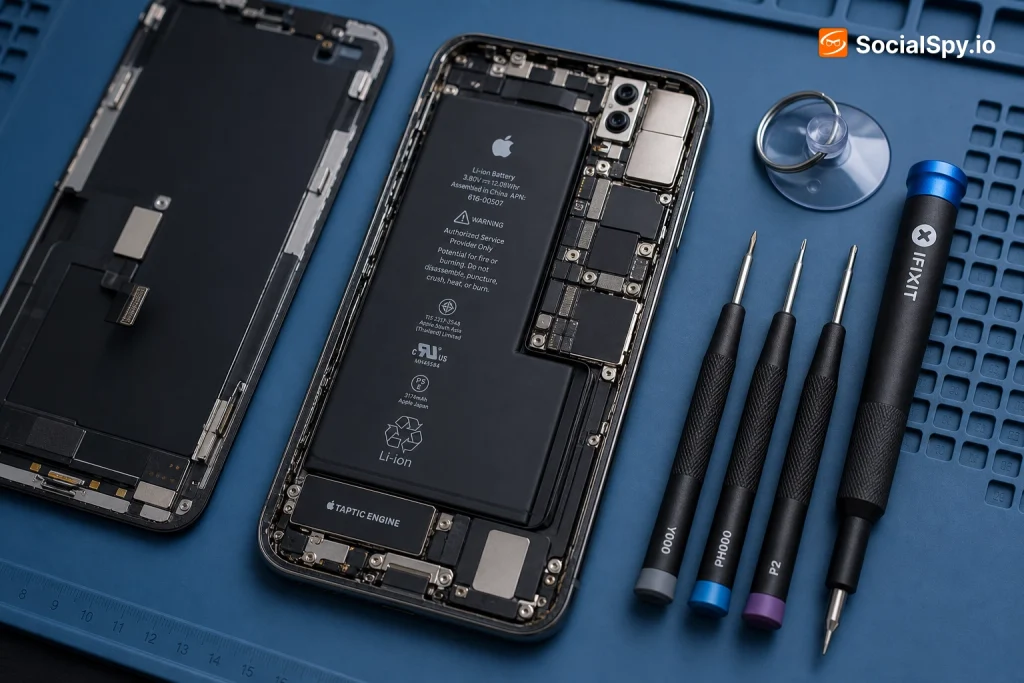
- Screen removal — the display is heated slightly to loosen adhesive, then lifted using suction tools; this is the step most likely to cause hairline seal issues if done carelessly.
- Battery disconnection — technicians disconnect the battery connector first, a critical safety step to avoid short circuits.
- Adhesive removal — the XS Max battery is glued down with pull-tab adhesive strips; stretching these tabs slowly is what separates a clean removal from a bent or punctured cell.
- New battery installation and reseal — the replacement cell goes in, connectors are reattached, and the display is resealed, ideally with fresh adhesive to preserve the original water resistance rating.
- Calibration — the phone is drained and recharged, or software-recalibrated, so iOS accurately reports the new battery’s health from 100%.
That last step matters more than most people realize. A battery installed without calibration can report inaccurate percentages for the first several charge cycles, making it look like the fix didn’t work when it actually did.
Apple vs. Third-Party vs. DIY: The Real Tradeoffs
The cheapest option isn’t automatically the best one, and the most expensive isn’t automatically the safest. Each path involves a different mix of cost, quality control, and risk.
Going Through Apple
Apple uses cells built to its own specifications and paired with the phone’s battery management chip, so Battery Health reporting stays accurate. The $89 price includes a 90-day warranty on the repair, and any water-resistance reseal is done to factory tolerances (though Apple itself notes water resistance isn’t guaranteed after any repair).
- Genuine Apple part, verified serial pairing
- Software recognizes the battery as authentic — no “Unknown Part” warning
- Slightly higher cost, appointment often required
Independent Repair Shops
Chains like uBreakiFix (owned by Asurion) and countless local shops now perform battery swaps using either genuine refurbished Apple parts or high-quality aftermarket cells. Since Apple’s 2022 rollout of its Self Service Repair program and parts-pairing changes, independent shops can now register genuine parts too, though not every shop does this consistently.
- Often 20-40% cheaper than Apple
- Faster turnaround, walk-in service common
- Quality varies significantly by shop — check reviews and ask what battery brand they use
DIY Kits
iFixit and similar suppliers sell XS Max battery kits with the tools included, priced around $20 to $35. The XS Max is rated a 4 out of 10 on iFixit’s repairability scale, mainly because of fragile screen adhesive and a battery glued flush against the frame.
- Lowest cost by far
- No warranty, and mistakes with the battery connector or adhesive can damage the display or Face ID module
- iOS will show an “Important Battery Message” noting the battery isn’t genuine — this doesn’t stop the phone from working, but it does remove some detailed health analytics
Industry repair analysts generally note that self-repair success rates on iPhones with glued-in batteries hover well below professional repair success rates, mainly due to punctured cells during adhesive removal — a real fire risk, not just an inconvenience.
Is It Even Worth Fixing a Phone This Old?
This is the question that actually matters more than the price tag. A $89 battery swap is objectively cheap compared to buying a new phone, but only if the rest of the hardware still holds up.
Consider the XS Max’s current standing:
- iOS support: Apple has continued supporting the XS Max through recent iOS versions, though it was excluded from Apple Intelligence features that launched with iOS 18, since those require an A17 Pro chip or newer.
- Performance: The A12 Bionic chip is still capable for browsing, messaging, and most apps, though newer, RAM-hungry apps and iOS updates continue to add strain.
- Resale value: A used XS Max with a fresh battery typically sells for $120-$180 depending on condition and storage size — often not far off from the repair cost itself.
- Camera and display: Both remain genuinely solid for everyday use; the OLED panel and dual-camera setup haven’t aged as poorly as the battery or chip.
For someone using the phone as a daily driver who doesn’t need the latest AI features, an $89-$150 total in battery plus minor repairs is far cheaper than a $599-plus new iPhone. For someone eyeing a hand-me-down or a backup device for a kid or elderly relative, it’s an easy call. But for anyone who needs current software features, faster performance, or better cameras, that money is better redirected toward a used iPhone 13 or 14, which now sell in similar price ranges to a repair-plus-new-phone combo.
How to Make the New Battery Last Longer
Once the swap is done, a few habits meaningfully extend the life of the replacement — no point paying twice in two years.
- Avoid extreme heat: Leaving the phone in a hot car or direct sun accelerates chemical degradation faster than almost any other factor.
- Stay out of the 0-20% and 90-100% zones when possible: Batteries degrade fastest at the extremes of their charge range.
- Use Optimized Battery Charging: Found in Settings > Battery > Battery Health & Charging, this learns your routine and delays reaching 100% until closer to when you’ll unplug.
- Skip cheap fast chargers: Uncertified chargers can deliver inconsistent voltage that stresses the cell over time; look for MFi-certified accessories.
- Update iOS regularly: Apple periodically tunes battery management algorithms in software updates, sometimes improving reported accuracy and charge behavior.
Conclusion
An iPhone XS Max battery replacement is one of the rare repairs where the math clearly favors fixing over replacing, at least for now. At $89 through Apple or $50-$70 through a reputable independent shop, the cost is a fraction of a new device, and the improvement in daily usability — no random shutdowns, no throttled performance, no anxiety about hitting 20% by lunchtime — is immediate and obvious. The real decision isn’t whether the battery swap is worth it; it’s whether the six-year-old phone underneath that new battery still fits your needs, particularly if Apple Intelligence features or top-tier camera performance matter to you. If they don’t, a fresh battery can realistically buy another one to two years of solid daily use out of hardware that, camera and display aside, has already proven remarkably durable.
FAQ
Check Settings > Battery > Battery Health & Charging first. If Maximum Capacity reads below 80%, or you see a Peak Performance Capability warning, the battery is the confirmed culprit rather than a charging port, software bug, or app-specific drain issue.
The XS Max is long past its original one-year warranty window by now, so there’s nothing left to void in that sense. However, opening the phone does risk compromising the factory water-resistance seal, and Apple explicitly states it can’t guarantee IP68 resistance is fully restored after any repair, including its own official service.
Not necessarily in raw capacity, but genuine Apple batteries integrate directly with the phone’s battery management system for more accurate health reporting and won’t trigger the “non-genuine part” notification in Settings. Reputable third-party shops using quality cells perform comparably in daily use, but budget aftermarket batteries bought online without installation can have inconsistent capacity and shorter real-world lifespans.