The iPhone 16 Pro’s battery won’t stay at peak capacity forever, and Apple’s own tools will eventually flag it for replacement. Whether you’re weighing an out-of-warranty repair, an AppleCare+ claim, or a third-party shop, the price you pay and the experience you get vary more than most owners realize. Here’s what actually happens when that battery health number starts slipping, and how to handle it without overpaying or voiding anything you shouldn’t.
Why the iPhone 16 Pro’s Battery Degrades (And When to Notice)
The iPhone 16 Pro ships with a 3,582mAh battery, a modest bump over the iPhone 15 Pro’s 3,274mAh cell, paired with Apple’s A18 Pro chip built on TSMC’s second-generation 3nm process. That efficiency gain matters because it means less heat and slightly gentler charge cycles hit the battery over time compared to older Pro models.
Apple rates every iPhone battery for 500 complete charge cycles before it’s guaranteed to retain at least 80% of its original capacity. A cycle counts as using 100% of the battery’s capacity, not necessarily one full charge from 0-100% in a single sitting — so two 50% charges equal one cycle.
Apple’s own documentation states batteries are “consumable components” that degrade with normal use, and that at 80% health, users may notice reduced screen-on time and more aggressive throttling under Low Power Mode.
Here’s the realistic degradation curve for typical use:
- Year 1: Battery health usually stays in the 95-100% range for most owners
- Year 2: Expect 85-92%, depending on charging habits and fast-charging frequency
- Year 3: Many users drop into the 75-85% window, especially with daily fast charging via a 20W+ adapter
- Beyond 500 cycles: Apple’s Battery Health screen (Settings > Battery > Battery Health & Charging) will explicitly flag “Service Recommended”
You can also check “Maximum Capacity” and, new since iOS 17, cycle count is now visible directly in that same menu — a change that eliminated the need for third-party apps like coconutBattery just to see it.
What Apple Charges: Warranty, AppleCare+, and Out-of-Pocket
Pricing for the iPhone 16 Pro follows Apple’s now-standard tiered structure, and it’s identical to what the company charges on the smaller iPhone 16 despite the Pro’s larger battery and more complex internal layout.
| Coverage Type | Cost | Turnaround |
|---|---|---|
| Under standard 1-year warranty (battery health below 80%) | Free | Same day to 3 business days |
| AppleCare+ | $99 | Same day (Apple Store) or 3-5 days (mail-in) |
| Out of warranty, no AppleCare+ | $119 | Same day to 5 business days |
A few nuances that catch people off guard:
- Apple’s standard 1-year limited warranty only covers a free battery replacement if the health has already fallen below 80% capacity — it’s not a courtesy swap for a battery still at 82% just because you’re annoyed by the dip.
- AppleCare+ removes that 80% threshold entirely; you can request a replacement even if your battery health tests at 88% but you’re experiencing unexpected shutdowns or throttling.
- Apple Stores handle Pro model battery swaps in-house same-day in most cases, while mail-in service through Apple’s website typically adds 3-5 business days plus shipping time both directions.
For context on how this compares across Apple’s lineup, the pricing structure tracks closely with what owners of the iPhone 15 Pro and iPhone 15 Pro Max have paid, since Apple hasn’t raised base battery service pricing in several generations despite inflation elsewhere in its repair catalog.
Third-Party and Independent Repair Options
Independent repair shops and mail-in services like uBreakiFix (an Asurion company, which is also an authorized Apple provider), CPR Cell Phone Repair, and countless local electronics shops offer iPhone 16 Pro battery swaps, often significantly cheaper than Apple’s out-of-warranty rate.
What Independent Shops Typically Charge
- Authorized providers (uBreakiFix/Asurion): $99-$119, often matching Apple’s pricing since they use Apple-supplied genuine parts
- Independent, non-authorized shops: $70-$100, using aftermarket or pulled OEM batteries
- Mail-in third-party services (like iFixit-adjacent networks): $60-$90 plus shipping, typically 5-10 day turnaround
The Genuine Parts Problem
This is where things get complicated for the 16 Pro specifically. Since the iPhone 12, Apple has used part-pairing software checks tied to the battery’s microcontroller, and with iOS 17.4 and later, non-genuine batteries trigger a persistent “Unknown Part” notification in Settings > Battery.
- A battery swapped with a non-Apple-authenticated part won’t show a battery health percentage at all — it displays “Important Battery Message: Unable to verify this iPhone has a genuine Apple battery.”
- Apple’s own System Configuration tool, which authorized shops can access, lets independent repair businesses pair a genuine replacement battery to the phone’s serial number, restoring full battery health reporting.
- Non-authorized shops without access to this tool will leave you with a functioning battery but permanently degraded software integration — no percentage tracking, and a notification banner that won’t go away.
For most owners, this pushes the calculus back toward either Apple directly or an authorized independent provider, even though the price difference shrinks to almost nothing once you account for it.
AppleCare+ Math: Is It Worth Buying Just for the Battery?
AppleCare+ for the iPhone 16 Pro costs $199 for two years upfront, or roughly $9.99/month. If battery replacement were your only consideration, the math is straightforward but not necessarily favorable.
Compare the two paths over a typical 3-year ownership window:
- Without AppleCare+: Pay $119 once, if and when the battery health actually drops below 80% — many owners never hit this in year 1 or 2
- With AppleCare+ (2-year plan): Pay $199-$240 total, plus $99 if you need the battery done, but you also get accidental damage coverage ($29 for screen, $99 for other damage) for the full term
The honest answer: AppleCare+ rarely pays for itself through battery replacement alone. Its value is almost entirely in the accidental damage and theft/loss coverage (on the AppleCare+ with Theft and Loss tier, which runs higher). If you’re disciplined about cases and screen protectors and mainly worried about the battery, self-insuring and paying the $119 out-of-pocket rate if it ever comes due is usually cheaper.
Industry repair analysts consistently note that battery-only replacement almost never justifies a multi-year protection plan on its own — it’s the drop/crack/water damage risk that makes AppleCare+ worth it for most people.
What Actually Happens During the Repair
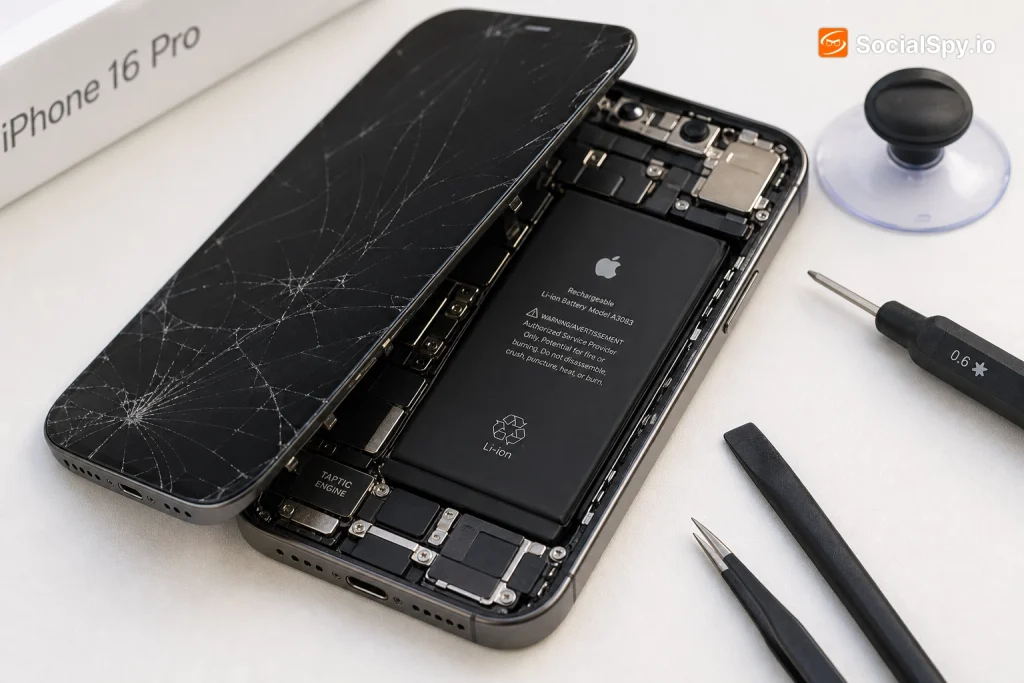
Unlike older iPhones where batteries were secured with simple pull-tabs and adhesive strips, the iPhone 16 Pro’s internal layout changed meaningfully due to Apple’s redesigned internal structure that debuted with the iPhone 16 lineup — partly to accommodate the Camera Control button’s internal wiring and a slightly revised logic board layout.
Step-by-Step at an Apple Store
- Diagnostic check: A technician runs Apple’s diagnostic suite confirming battery health, cycle count, and whether the issue is battery-related versus software (a bad iOS update misreporting battery drain is more common than people assume)
- Backup verification: You’ll be asked to confirm an iCloud or local backup exists, since some repairs (rare for battery-only jobs) may require a restore
- Physical replacement: The rear glass or internal tray is opened, the battery is disconnected, adhesive is released (often with a controlled heating tool), and the new genuine battery is installed and paired via Apple’s internal software
- Calibration: The phone is charged to 100% and drained partially to recalibrate the battery percentage indicator, which can otherwise read inaccurately for the first few charge cycles
- Final testing: Face ID, water resistance seals (if rear glass was opened), and charging speed are all verified before return
The entire in-store process usually takes 45 minutes to 2 hours if parts are in stock, though busier stores sometimes ask you to leave the phone for same-day pickup instead of waiting.
What You Lose With DIY
Self-repair kits from iFixit exist for the 16 Pro, priced around $85-$100 for the battery plus tools, but this is genuinely one of the harder DIY battery jobs in recent iPhone history:
- Adhesive pull-tabs are more failure-prone on the 16 Pro’s tighter internal tolerances, and a snapped tab often means scraping out old adhesive with isopropyl alcohol and patience
- Water resistance rating is not reliably restorable without proper adhesive replacement and Apple’s factory-sealing process
- You’ll trigger the same “Unknown Part” battery warning unless you have separate part-pairing software access, which retail DIYers don’t
Signs You Actually Need a Replacement (Not Just a Software Fix)
Not every battery complaint is really a hardware problem. Before booking a repair, rule out the cheaper explanations first.
- Check Battery Health first: Settings > Battery > Battery Health & Charging — anything above 80% generally shouldn’t need replacement yet
- Rule out background app drain: Settings > Battery shows per-app usage; a single app eating 40%+ of battery in a day points to a software bug, not battery wear
- Update iOS: Apple has shipped battery-drain fixes in point releases before (iOS 18.0.1 and similar patches have addressed drain bugs after major updates)
- Watch for unexpected shutdowns: This is the clearest hardware signal — a phone reporting 20% remaining and then shutting off instantly indicates the battery can’t sustain peak power draw anymore
- Peak Performance Capability warning: If Settings shows a message that the battery can no longer supply peak power and performance management has kicked in, that’s Apple’s clearest internal signal you need service
If you’re seeing genuine hardware symptoms rather than software quirks, it’s worth comparing your situation to how this plays out on related models — the underlying battery chemistry and degradation pattern on the standard iPhone 16 is similar enough that owner reports across both models tend to track closely.
Conclusion
The iPhone 16 Pro’s battery replacement situation in 2025 is straightforward on price but more nuanced on execution than most owners expect. Apple’s $99 to $119 range is competitive and predictable, but the real decision point is genuine-parts verification — paying slightly more for an authorized repair (Apple Store or Apple-authorized provider) protects your battery health reporting and avoids a permanent “Unknown Part” warning that non-authorized shops can’t fix. If your phone is still under 80% battery health and out of warranty, skip AppleCare+ purely for battery math and just budget the $119 as a one-time cost roughly every 2-3 years of ownership.
FAQ
Apple charges $119 for an out-of-warranty battery replacement on the iPhone 16 Pro when done at an Apple Store or through Apple’s mail-in repair service. This drops to free if your device is still within its first year and battery health has already fallen below 80%, and to $99 if you have an active AppleCare+ plan.
You can, but Apple’s part-pairing system will flag any battery not authenticated to your phone’s serial number with an “Unknown Part” warning and won’t display an accurate battery health percentage. Authorized independent repair providers with access to Apple’s System Configuration tool can pair genuine replacement batteries properly, avoiding this issue, while fully independent shops using aftermarket parts generally cannot.
Most iPhone 16 Pro batteries maintain 80% or higher capacity for roughly 2 to 3 years of typical daily use, based on Apple’s 500-cycle rating and real-world charging patterns. Heavy fast-charging, frequent full 0-100% cycles, and exposure to high heat can accelerate degradation, while moderate charging habits (staying between 20-80% when possible) can extend usable battery life closer to 3 years or beyond.