The iPhone 16e arrived in February 2025 as Apple’s replacement for the SE line, and it’s already racking up enough sales that battery questions are starting to pile up in Apple Support forums and third-party repair shops. Whether you’re two years into ownership or just want to know what you’re signing up for down the road, the battery math on this phone is different from what you’d expect on the standard iPhone 16 lineup. Here’s exactly what Apple charges, what independent shops charge, and where the 16e’s internals make the job easier or harder than its siblings.
What Apple Actually Charges for the iPhone 16e
Apple’s pricing structure for out-of-warranty battery service has stayed remarkably flat over the past few generations, and the 16e follows that pattern.
- $99 — out-of-warranty battery replacement at an Apple Store or through mail-in service, no AppleCare+
- $0 — covered under AppleCare+ if the battery’s maximum capacity has dropped below 80%
- $0 — covered under the standard one-year limited warranty only if the battery is defective (not just degraded from normal use)
- Diagnostic fee waived — Apple doesn’t charge separately to check battery health; it’s included in the Battery Health readout under Settings
That $99 figure has held steady since the iPhone 14 era, even as Apple’s phones have gotten more expensive at launch. The 16e itself started at $599, making it the cheapest current iPhone, so a $99 battery job represents roughly 16.5% of the phone’s original price — a noticeably higher ratio than what you’d pay to fix, say, an iPhone 16 Pro Max.
Industry repair analysts note that Apple’s flat-rate battery pricing is intentionally simple, but it means budget-tier iPhones like the 16e absorb a proportionally bigger hit when it’s time for a new battery.
For comparison, here’s how the 16e’s official battery pricing lines up against the rest of the current lineup.
| Model | Apple Battery Replacement (No AppleCare+) |
|---|---|
| iPhone 16e | $99 |
| iPhone 16 | $99 |
| iPhone 16 Plus | $99 |
| iPhone 16 Pro | $99 |
| iPhone 16 Pro Max | $99 |
Apple charges the same $99 across the entire current lineup, but that number tells only part of the story — the actual condition of your battery, and whether you have AppleCare+, changes the real-world cost far more than the model name does.
Why the 16e’s Battery Setup Is Different
The iPhone 16e doesn’t just look like a repurposed iPhone 14 chassis — its battery situation is a genuine departure from the rest of the 16 family, and it comes down to Apple’s in-house C1 modem.
A Smaller Cell With Better Efficiency
Apple rates the 16e for up to 26 hours of video playback, which is actually higher than the standard iPhone 16’s 22 hours despite the 16e using a smaller battery, estimated by teardown analysts at around 3,961 mAh compared to the iPhone 16’s 3,561 mAh nominal cell (Apple doesn’t publish raw mAh figures officially, so these numbers come from third-party teardowns and regulatory filings).
- The 16e is Apple’s first iPhone with the C1 modem, a chip designed entirely in-house instead of using a Qualcomm modem
- Apple claims the C1 draws meaningfully less power than the Snapdragon modems in prior SE and mainstream models
- That efficiency gain is why a phone starting at $599 can out-last a $799 iPhone 16 on paper despite a smaller physical cell
- Less current draw over time generally means slower chemical degradation, which could translate to a longer runway before you hit that 80% health threshold
This matters for repair timing. A battery that’s worked less hard per charge cycle tends to age more gracefully, so 16e owners may find themselves needing a replacement later in the ownership cycle than owners of phones with less efficient modems — though real-world usage patterns (5G reliance, screen brightness, background app refresh) still dominate the equation.
Adhesive and Internal Layout
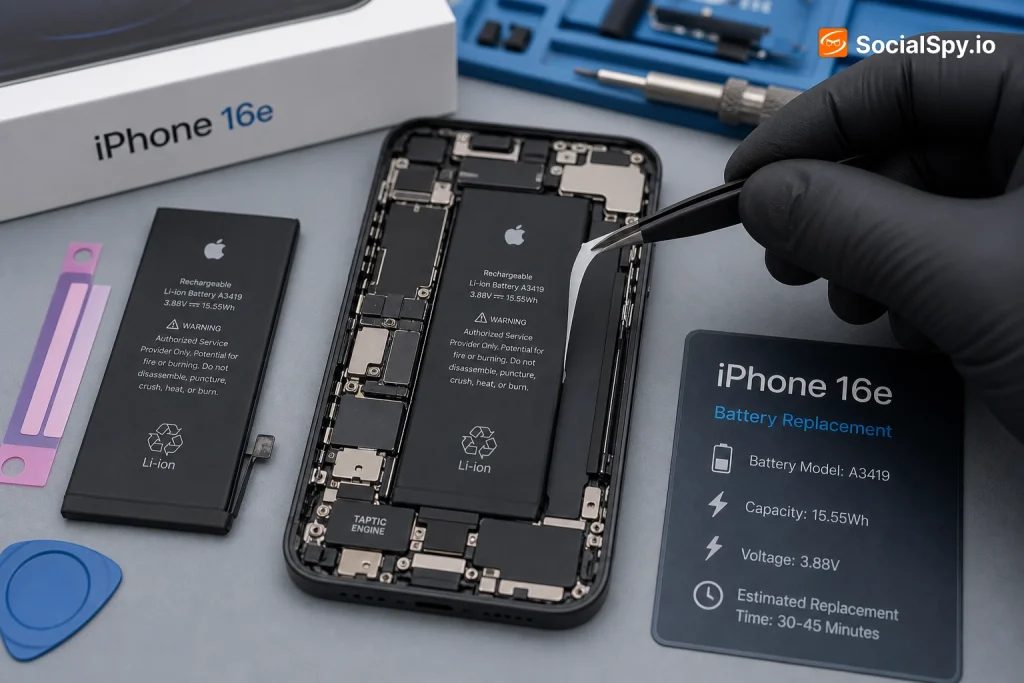
The 16e reuses design language from the iPhone 14’s internal layout more than the iPhone 16’s, according to teardown outlets that have opened both devices. That means:
- Similar stretch-release adhesive strips to those used since the iPhone 12, rather than any newer bonding method
- A battery connector position that’s accessible without needing to fully detach the display first, unlike some Pro models
- No structural battery/frame bonding of the kind found in the iPhone 16 Pro Max, which uses the battery as a partial structural element
For repair technicians, this is good news — it puts the 16e closer to the iPhone 16 and iPhone 16 Plus in terms of ease of service than the Pro models, which involve more disassembly steps.
Independent Repair Shops vs. Apple: A Real Cost Comparison
Not everyone wants to book a Genius Bar appointment or mail their phone away for a week. Independent shops and mobile repair services have become a legitimate option for battery swaps, especially post-2022 when Apple expanded parts access under its Self Service Repair and Independent Repair Provider programs.
- National chains (uBreakiFix by Asurion, CPR Cell Phone Repair) typically charge $89-$129 for a 16e battery, often with same-day service
- Local independent shops can run as low as $70-$90, especially in lower cost-of-living markets, but part quality varies widely
- Apple Authorized Service Providers (AASPs) charge Apple’s standard $99 rate and use genuine Apple parts, making them functionally identical to a Genius Bar visit for pricing purposes
- Apple Self Service Repair lets you buy the genuine battery module and rent Apple’s repair toolkit, but after accounting for the $49 tool rental (partially refundable) and the part itself, DIY rarely saves meaningful money unless you already own repair tools
The catch with cheaper independent options is Apple’s Parts Pairing system, introduced widely with iPhone 15 and carried forward on the 16e. If a shop installs a non-genuine or improperly paired battery, iOS will display a persistent “Important Battery Message” warning in Settings, and Battery Health percentage reporting may stop working entirely.
- Genuine Apple parts, or parts properly paired through Apple’s system, avoid this warning
- Non-paired third-party batteries still function but lose accurate health monitoring
- As of iOS 18.x, Apple does allow used genuine parts to be paired via software after entering a serial number system, a policy shift that’s made independent repair more viable than it was in 2023
If you care about resale value or want accurate battery percentage tracking going forward, sticking with Apple or an AASP is the safer bet, even at the higher price point.
AppleCare+ Math: Is It Worth It Just for the Battery?
AppleCare+ for the iPhone 16e costs $7.99/month or $79/year, depending on which plan tier you select at purchase (theft and loss coverage bumps that up).
Here’s the honest breakdown of whether it pencils out purely on battery coverage:
- If you buy AppleCare+ for $79/year and keep the phone 3 years, that’s $237 in premiums
- A single out-of-warranty battery swap without AppleCare+ costs $99
- Purely on battery math, AppleCare+ only “wins” if you’d otherwise need more than two battery replacements in that window, which is unlikely for most users
- The real value of AppleCare+ is the screen and back glass damage coverage ($29 per incident) and accidental damage protection — the battery coverage is more of a bonus than the main selling point
For readers who’ve looked at similar math on other current models, the calculus is nearly identical across the lineup — see our breakdowns for the iPhone 16 Plus battery replacement costs and the iPhone 16 battery replacement costs, where the same $99/$0 split applies.
If you’re buying AppleCare+ solely to hedge against a future battery bill, you’re overpaying. Buy it for accidental damage protection, and treat free battery service as a side benefit.
Signs Your 16e Battery Actually Needs Replacing
Battery Health percentage alone doesn’t tell the whole story, and Apple’s own guidance has gotten more nuanced since introducing the metric in 2019.
- Maximum Capacity below 80%: Settings > Battery > Battery Health & Charging shows this number; below 80% qualifies for free AppleCare+ replacement
- Peak Performance Capability warning: A message stating the phone has experienced an unexpected shutdown and iOS has throttled performance to compensate
- Rapid percentage drops: Going from 100% to 80% in under two hours of light use is a red flag even if Battery Health still reads high
- Swelling: Any visible lifting of the screen or back glass around the edges warrants immediate service — this is a safety issue, not just a performance one
- Charging inconsistency: The phone reports charging is complete well before it should be, or fails to hold charge overnight on standby
Apple’s own documentation notes that battery chemistry is rated for 500 complete charge cycles before dropping to roughly 80% of original capacity — a full cycle being 100% of battery capacity used, not necessarily one plug-in session. Heavy users who fast-charge frequently and let the phone drain to near-0% regularly will hit that 500-cycle mark faster than someone who tops up throughout the day and avoids deep discharges.
Conclusion
The iPhone 16e sits in an odd spot: it’s Apple’s cheapest current iPhone, but its battery service costs the same $99 as flagship models that cost hundreds more. That’s not necessarily bad news — the C1 modem’s efficiency gains suggest 16e batteries may age slower than past budget iPhones, and the simpler internal layout (closer to the standard iPhone 16 than the Pro models) keeps repairs quick, usually under 45 minutes.
The real decision points aren’t about Apple versus independent shops on price alone — they’re about parts pairing, warranty documentation, and whether you value accurate Battery Health reporting enough to pay Apple’s rate. For most owners, that $99 flat fee, paid once every few years, is a small cost relative to buying a new phone outright, and it’s a fee worth budgeting for rather than avoiding.
FAQ
Not automatically — it only covers a free battery replacement once the battery’s Maximum Capacity, shown in Settings under Battery Health, drops below 80%. If your battery is above that threshold but you’re still experiencing poor performance, Apple will diagnose it but may not replace it for free under AppleCare+.
Yes, through Apple’s Self Service Repair program, which sells the genuine battery part and rents the required toolkit for around $49 (partially refunded when you return the tools). Most people end up spending close to what an AASP would charge anyway once you factor in the tool rental and the risk of adhesive or connector mistakes, so it’s really only worth it for people who already do their own phone repairs regularly.
It can. Apple’s parts pairing system will show an “Important Battery Message” in Settings if the installed battery isn’t a genuine Apple part or hasn’t been properly paired through Apple’s serial number verification process, and your Battery Health percentage may stop displaying accurately as a result.