It sounds like a trivial punctuation mark shouldn’t cause trouble, but the comma is one of the most-searched “where is” questions on iPhone keyboards. Apple hides it depending on which keyboard mode you’re in, and the location shifts across the emoji keyboard, third-party keyboards, and even certain apps. Here’s exactly where to find it, why it moves, and how to type faster once you know the pattern.
The Default Keyboard: Where Apple Actually Put It
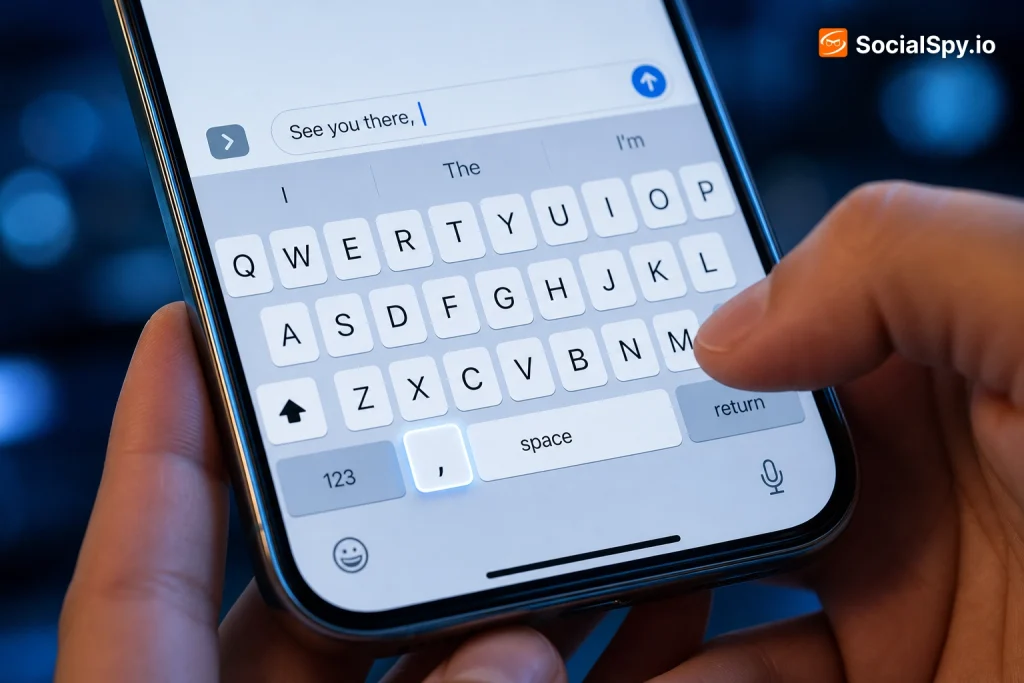
Apple’s stock keyboard layout keeps the comma and period visible at all times on the main letter screen, which trips people up because most other punctuation lives behind the 123 key.
- Comma (,): bottom row, immediately left of the space bar
- Period (.): bottom row, immediately right of the space bar
- Both are always visible on the ABC (letters) keyboard — you never need to tap 123 for basic sentence punctuation
This placement dates back to the very first iPhone keyboard and hasn’t changed through iOS 17, iOS 18, or the current iOS 26 release. Apple keeps high-frequency punctuation on the primary layer because commas and periods appear in nearly every sentence, while things like semicolons, brackets, and the @ symbol get pushed to secondary layers since they’re used less often.
A quick way to confirm you’re on the right screen: if you see a key labeled 123 on the bottom-left, you’re already on the ABC layout, and the comma is right there next to the space bar.
Why People Think It’s Missing
Confusion usually comes from switching contexts — a new keyboard, an unfamiliar app, or a numeric field that changes the entire layout without warning.
The Numbers and Symbols Pages
Tap 123 and the comma appears to vanish from its usual spot, replaced by a decimal point in some numeric layouts. It’s actually still there, but Apple repositions it depending on what you’re typing:
- On the 123 (numbers) page, comma sits in roughly the same bottom-row position, still to the left of space
- On the #+= (symbols) page, it stays in that same general area for consistency
- In numeric-only fields (like a PIN entry or phone number pad), the comma often disappears entirely because that field doesn’t accept punctuation
Password and Email Fields
Some apps force a restricted keyboard for security or formatting reasons. If you’re typing in a password field, Apple sometimes shows a simplified layout without a visible comma, since passwords rarely need one — but tapping 123 still reveals it.
Comma on Third-Party and International Keyboards
If you’ve installed keyboards like Gboard, SwiftKey, or Grammarly, the comma’s location can shift because each developer designs its own layout. This matters a lot if you’re a heavy texter switching between apps like Instagram, Slack, and Messages throughout the day.
| Keyboard | Comma Location | Notes |
|---|---|---|
| Apple Stock (QWERTY) | Bottom row, left of space | Always visible on letters screen |
| Gboard | Bottom row, left of space | Nearly identical to Apple’s layout |
| SwiftKey | Bottom row, left of space | Long-press for extra punctuation options |
| Emoji Keyboard | Not present | Must switch back to ABC or 123 |
| Numeric Pad (phone/PIN fields) | Not present | Field restricts input type |
International keyboards add another layer of confusion. Users switching to a Spanish, French, or Chinese (Pinyin) keyboard through Settings > General > Keyboard > Keyboards will often find the comma in a slightly different spot, or accessible only via a long-press on a related symbol key. This is one of many small settings adjustments — similar in spirit to how people dig through iPhone settings when researching things like how to block porn on iPhone — where the fix is simple once you know which menu to open.
How to Type a Comma Faster (Shortcuts and Tricks)
Most iPhone users tap the comma manually every time, but there are faster methods built into iOS that almost nobody uses.
- Long-press the exclamation/question key on some third-party keyboards to reveal a hidden punctuation tray
- Double-space trick: works for periods (typing two spaces auto-inserts a period + space), but it does not work for commas — a common misconception
- Dictation: saying “comma” out loud while using Siri dictation actually inserts a literal comma character into your text
- Text Replacement shortcuts: create a custom shortcut in Settings > General > Keyboard > Text Replacement that expands a short phrase into a longer one with commas already built in, useful for addresses or repeated phrases
Using Dictation for Punctuation
This is the most underused trick. When you tap the microphone icon and speak, iOS recognizes verbal punctuation commands:
- Say “comma” — inserts ,
- Say “period” or “full stop” — inserts .
- Say “question mark” — inserts ?
- Say “new line” — starts a new paragraph
This works system-wide, in Messages, Notes, Mail, and most third-party apps that support the native iOS text field, making it genuinely faster than hunting for the key when you’re typing one-handed.
Comma Placement Differences Across iPhone Models
The comma’s location doesn’t change based on hardware — an iPhone SE, iPhone 16, and iPhone 17 Pro all show it in the same spot on the software keyboard. What does change is how comfortably you can reach it, since screen size affects one-handed typing ergonomics.
- Smaller phones (iPhone SE, iPhone 16e): comma sits within easy thumb reach even one-handed
- Larger phones (iPhone 16 Plus, iPhone 16 Pro Max, iPhone 17 Pro Max): comma is often the reason people trigger Reachability (swipe down on the home indicator) to slide the keyboard lower
- Foldable-style split keyboard (enabled via pinch gesture on iPad, not standard on iPhone) doesn’t apply here, but iPhone users can still float the keyboard by pinching inward on supported models
Ergonomics matter more than people admit — repetitive stretching to hit corner keys on a Pro Max-sized device is a real contributor to thumb strain during heavy texting days. If you’re the type of person who’s already tracking battery health and physical wear on a larger device, it’s worth noting this alongside broader hardware maintenance topics like the iPhone 16 Pro Max battery replacement cost and what to expect, since typing habits and battery drain both tie back to daily screen-on time.
When the Comma Key Actually Disappears
There are a handful of legitimate scenarios where the comma is genuinely unavailable, not just hidden:
- Numeric-only input fields: phone number entry, PIN codes, verification codes
- Emoji-only keyboard mode: switch back using the globe or ABC icon
- Certain third-party app text fields that override the system keyboard entirely with a custom numeric pad
- Search bars in some apps that suppress punctuation to simplify query strings
If you’ve confirmed you’re on a full ABC keyboard and still don’t see a comma, it’s worth checking whether Settings > General > Keyboard > Keyboards has an outdated or corrupted third-party keyboard installed — removing and reinstalling it usually resolves display glitches. This is a similar troubleshoot mentality to checking device specs before assuming something’s broken, the same way people verify claims like whether the iPhone 14 Pro Max is actually waterproof before testing it themselves.
Conclusion
The comma isn’t hidden on the iPhone — it’s been sitting in the same bottom-row spot, left of the space bar, since the original 2007 keyboard design, and it remains there through iOS 26 in 2026. Confusion almost always stems from switching keyboards, entering restricted numeric fields, or assuming punctuation lives behind the 123 key when Apple deliberately keeps commas and periods on the primary layer. Once you internalize that placement, plus the dictation trick for verbal punctuation, typing punctuation-heavy text becomes noticeably faster whether you’re on a compact iPhone SE or a sprawling iPhone 17 Pro Max screen.
FAQ
It’s located in the bottom row of the standard ABC keyboard, immediately to the left of the space bar, with the period key mirroring it on the right side. This placement is consistent across nearly every iOS version, including the current iOS 26.
Certain fields, like PIN entry, phone number pads, or verification code boxes, restrict input to numbers only and remove punctuation entirely. If you’re in a full text field and still can’t find it, you may have accidentally switched to the emoji keyboard or a third-party keyboard with a nonstandard layout.
Yes, iOS dictation recognizes spoken punctuation commands like “comma,” “period,” and “question mark,” converting them into the actual symbols in real time. This works across most native apps including Messages, Notes, and Mail, and it’s often faster than manually tapping the key while typing one-handed.