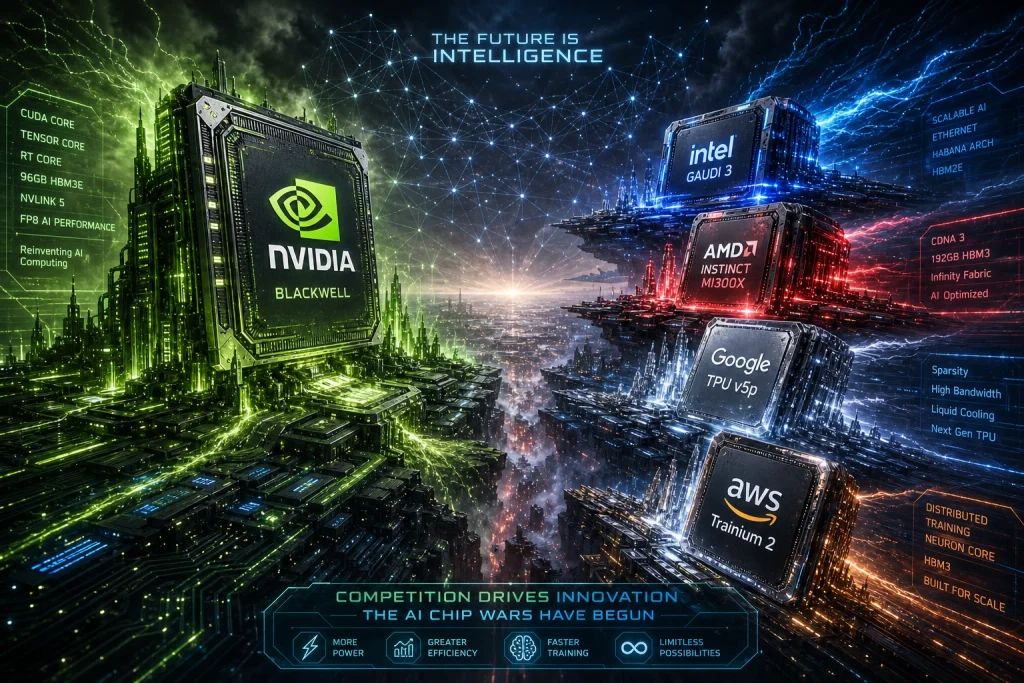
As the world hurtles toward an increasingly digital future, artificial intelligence (AI) has become a cornerstone of technological advancement. At the heart of this revolution are AI chips, specialized hardware designed to accelerate machine learning tasks. In this competitive landscape, Nvidia has emerged as a leading player, but it faces stiff competition from a host of formidable rivals. This article explores the battle for AI chip dominance, analyzing Nvidia’s position and the challenges posed by its competitors.
Nvidia: The Reigning Champion
Nvidia has long been a dominant force in the AI chip industry. Known primarily for its graphics processing units (GPUs), Nvidia has successfully leveraged this technology to become a powerhouse in AI processing. The company’s GPUs are highly efficient at handling parallel computing tasks, making them ideal for training complex AI models.
Key strengths of Nvidia’s AI chips include:
- CUDA Architecture: Nvidia’s proprietary CUDA architecture allows developers to harness the power of their GPUs for AI and machine learning applications, offering a robust ecosystem for development.
- Tensor Cores: Introduced with the Volta architecture, Tensor Cores are designed specifically for deep learning tasks, providing significant performance boosts for AI-related computations.
- Software Ecosystem: Nvidia’s support for AI extends beyond hardware. Its extensive software stack, including libraries like cuDNN and TensorRT, provides developers with the tools needed to optimize AI workloads.
Despite these advantages, Nvidia’s reign is not unchallenged. A range of competitors are vying for a share of the lucrative AI chip market, each bringing unique strengths to the table.
AMD: A Formidable Contender
Advanced Micro Devices (AMD) is one of Nvidia’s most prominent competitors. While traditionally focused on CPUs and GPUs for gaming and computing, AMD has made significant strides in the AI sector. The company’s GPUs are also capable of handling parallel processing tasks, making them suitable for AI applications.
Notable features of AMD’s AI chips include:
- Open Source Initiatives: AMD supports open-source software development, which appeals to a community of developers looking for transparency and flexibility in their tools.
- Radeon Instinct: This line of GPUs is specifically targeted at machine learning and AI workloads, providing enhanced performance for inference and training tasks.
- Collaboration with Major Players: AMD has formed strategic partnerships with major tech companies to integrate its chips into AI solutions, broadening its reach and influence in the AI market.
While AMD may not yet match Nvidia’s market share or comprehensive software ecosystem, its commitment to innovation and collaboration positions it as a formidable contender in the AI chip race.
Intel: The AI Ambitions of a Tech Giant
Intel, a titan in the semiconductor industry, is another key player in the AI chip arena. Despite being better known for its CPUs, Intel has invested heavily in AI, acquiring several companies to bolster its capabilities in this space.
Features that set Intel apart in the AI chip market include:
- Acquisition of AI Startups: Intel’s acquisition of AI-focused companies such as Nervana Systems and Movidius has enhanced its portfolio, allowing it to offer specialized AI chips.
- Xeon Processors with AI Optimizations: Intel’s Xeon processors are optimized for AI workloads, providing high-performance computing capabilities for data centers and enterprise applications.
- OneAPI Initiative: Intel’s OneAPI initiative aims to provide a unified programming model that simplifies the development of AI applications across different architectures.
Intel’s extensive experience in the semiconductor industry, combined with strategic acquisitions and innovations, positions it as a strong competitor against Nvidia.
Emerging Players: The Rise of Custom AI Chips
While established companies like Nvidia, AMD, and Intel dominate the AI chip market, several emerging players are making waves with custom chips designed specifically for AI applications. These companies aim to address specific needs that general-purpose chips may not fully satisfy.
Noteworthy emerging players include:
- Google’s Tensor Processing Units (TPUs): Designed specifically for machine learning tasks, Google’s TPUs offer high efficiency and performance, particularly in the context of its cloud services.
- Apple’s Neural Engine: Integrated into its A-series chips, Apple’s Neural Engine accelerates AI and machine learning tasks on its devices, enhancing user experiences with features like facial recognition and augmented reality.
- Amazon’s Inferentia: Targeted at machine learning inference, Amazon’s Inferentia chips are designed to provide cost-effective, high-performance solutions for its AWS cloud platform.
These custom AI chips highlight a growing trend toward specialization, as companies seek to develop hardware tailored to the unique demands of AI applications.
Conclusion: Navigating the AI Chip Landscape
The battle for AI chip dominance is a dynamic and rapidly evolving contest. Nvidia remains a leading force, thanks to its powerful GPUs and comprehensive software ecosystem. However, competitors like AMD, Intel, and emerging players offer compelling alternatives, each bringing unique strengths to the table.
As AI continues to permeate various industries, the demand for efficient and powerful AI chips will only grow. Companies that can innovate and adapt to the changing landscape will be best positioned to thrive in this competitive market. For consumers and businesses, this means a wealth of options, each promising to deliver the performance and capabilities needed to harness the full potential of AI.
FAQ
What makes Nvidia’s AI chips stand out from the competition?
Nvidia’s AI chips are distinguished by their CUDA architecture, Tensor Cores, and extensive software ecosystem. These features provide developers with powerful tools for optimizing AI workloads, making Nvidia a leader in the AI chip market.
How does AMD compete with Nvidia in the AI chip market?
AMD competes with Nvidia by offering GPUs that support parallel processing tasks, open-source initiatives, and strategic collaborations with major tech companies. Its Radeon Instinct line is specifically targeted at AI workloads, providing an alternative to Nvidia’s offerings.
Why are custom AI chips becoming more popular?
Custom AI chips are gaining popularity because they are designed to address specific needs that general-purpose chips may not fully satisfy. Companies like Google, Apple, and Amazon are developing custom chips to enhance the performance and efficiency of AI applications in their ecosystems.