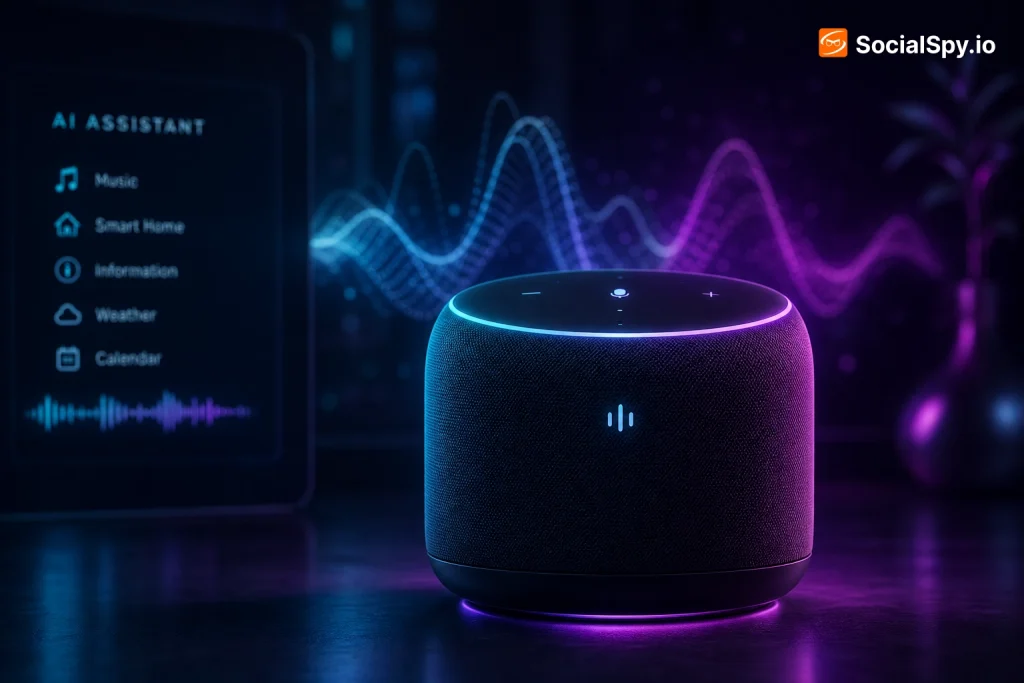
OpenAI’s long-rumored foray into consumer hardware is reportedly taking shape as a screenless, voice-first smart speaker, and now we may finally have a sense of what it will cost. According to multiple industry sources cited in recent reports, the device is expected to retail somewhere between $300 and $400, placing it well above budget-friendly smart speakers from Amazon and Google but squarely in premium territory alongside products like the Sonos Era or high-end HomePod configurations. The pricing detail is one of the clearest signals yet that OpenAI intends to position its first physical product not as a mass-market gadget, but as a flagship device built around the company’s most advanced conversational AI.
The move marks a pivotal moment for OpenAI, a company that has spent the better part of two years dominating headlines with software—ChatGPT, GPT-4, Sora, and a rotating cast of API tools—but has never shipped a piece of consumer hardware. If the reports are accurate, that’s about to change, and the implications stretch far beyond just another smart speaker on a shelf.
What We Know About the Device So Far
Details remain scarce, and OpenAI has not officially confirmed pricing, release timing, or even the final form factor. But a consistent picture has emerged from reporting over the past several months, painting the device as a minimalist, screenless companion designed to live in the home and respond primarily through voice.
- No screen, no camera (reportedly): Early descriptions suggest the device forgoes a display entirely, leaning into ambient, voice-driven interaction rather than visual interfaces.
- Deep design pedigree: The project has been linked to the design studio io Products, co-founded by legendary Apple designer Jony Ive, following OpenAI’s high-profile acquisition of the startup earlier this year.
- Built around OpenAI’s own models: Unlike traditional smart speakers that rely on rules-based voice assistants, this device is expected to run on OpenAI’s frontier AI models, enabling much more fluid, contextual conversation.
- Premium positioning: A $300 to $400 price point puts the device roughly three to four times the cost of an Amazon Echo Dot and comparable to premium audio and smart home products.
That price range is notable because it signals OpenAI isn’t trying to compete on volume with Amazon’s Alexa devices, many of which are sold near cost or even at a loss to drive ecosystem lock-in. Instead, OpenAI appears to be betting that consumers will pay a premium for a genuinely more capable conversational assistant, one that can reason, remember context, and handle far more nuanced requests than “set a timer for ten minutes.”
Why OpenAI Wants to Own the Hardware Layer
For a company whose entire business has been software and API access, building a physical product might seem like a strange detour. But there’s a strategic logic behind it that becomes clearer when you consider where the smart speaker market currently stands.
Amazon’s Alexa and Google Assistant have dominated the category for nearly a decade, yet both have struggled to meaningfully evolve. Alexa, in particular, has become something of a punchline for its limited comprehension and rigid command structure, and Amazon has spent years trying to retrofit generative AI capabilities into a product built on an older architecture. That struggle has created an opening, and OpenAI appears eager to walk through it.
By building its own hardware, OpenAI can:
- Control the full experience end to end: Rather than licensing ChatGPT to third-party device makers, OpenAI can design the speaker, microphone array, and software stack together for optimal voice recognition and response latency.
- Capture a new revenue stream: Hardware sales, combined with potential subscription tiers for premium AI features, could diversify OpenAI’s income beyond enterprise API fees and ChatGPT Plus subscriptions.
- Establish a foothold in the home: Smart speakers have become a gateway to smart home control, shopping, and daily habit formation—an ambient presence that competitors like Amazon and Google have leveraged for years to keep users inside their ecosystems.
- Showcase multimodal AI in a stripped-down format: A screenless device forces the AI to be genuinely conversational rather than leaning on visual shortcuts, which could serve as a proof of concept for how far voice-based AI has come.
There’s also a symbolic dimension. Sam Altman has spoken publicly about wanting AI to feel less like a search engine and more like a collaborative presence in daily life. A dedicated hardware device, always listening and always ready, is arguably the purest expression of that vision—far more so than a chatbot buried inside a phone app.
The Jony Ive Factor
Much of the intrigue around this device stems from its reported design lineage. Earlier this year, OpenAI acquired io Products, the secretive hardware startup co-founded by Jony Ive, the designer behind the iPhone, iPad, and Apple Watch. The deal was reportedly valued in the billions and was widely interpreted as OpenAI’s clearest signal yet that it intended to build consumer hardware, not just license its models to other companies’ devices.
Ive’s involvement raises the stakes considerably. His design philosophy has long emphasized minimalism, tactile materials, and reducing technology to its most essential, almost invisible form. If that sensibility carries through to this speaker, expect a product that looks and feels distinctly different from the plastic cylinders and fabric-wrapped orbs that currently populate the smart speaker market.
That pedigree also helps justify the premium price. Consumers have shown a willingness to pay more for products bearing the design fingerprints associated with Ive’s past work, and OpenAI likely knows that a $300–$400 price tag will only feel justified if the device looks and feels like it belongs in that tier. A cheap-feeling gadget with a premium price would be an immediate credibility problem, especially for a company under intense scrutiny for basically everything it does.
How It Might Stack Up Against Existing Smart Speakers
To understand just how aggressive this pricing strategy is, it helps to look at where OpenAI’s rumored device would sit relative to the current smart speaker landscape.
- Amazon Echo Dot: Roughly $50, often discounted further, designed for mass adoption and Alexa ecosystem lock-in.
- Amazon Echo (standard): Around $100, better speakers, same Alexa backbone.
- Google Nest Audio: Around $100, similar positioning to Amazon’s mid-tier offering.
- Apple HomePod (2nd gen): Around $300, Apple’s premium play, closest existing price comparison to OpenAI’s rumored device.
- Sonos Era 300: Around $450, positioned as a high-fidelity audio product first, smart assistant second.
Slotting in at $300 to $400, OpenAI’s device would essentially be competing directly with Apple’s HomePod and edging toward Sonos territory, but without the decades of audio engineering reputation that both of those companies bring to the table. That means the pitch will almost certainly center less on sound quality and more on intelligence: the promise that this speaker can actually understand what you’re asking, hold a real conversation, and assist with complex, multi-step tasks in a way Alexa and Google Assistant currently cannot.
Whether consumers agree that smarter conversation is worth two to three times the price of an entry-level competitor remains an open question. Smart speaker sales have plateaued industry-wide in recent years, and many households already own at least one device from Amazon or Google. Convincing people to buy an entirely new, pricier device from a company with zero hardware track record is a nontrivial challenge, pedigree design team or not.
What This Means for the Broader AI Hardware Race
OpenAI isn’t operating in a vacuum here. Humane’s AI Pin arrived with enormous hype and fizzled amid poor reviews and disappointing sales before the company was acquired by HP. Rabbit’s R1 device faced similar skepticism about whether dedicated AI hardware offers enough value over a smartphone app. Meta, meanwhile, has doubled down on AI-infused smart glasses through its Ray-Ban partnership, arguably the most successful AI wearable launch to date.
Against that backdrop, a smart speaker feels like a comparatively safer bet than a wearable pin or standalone gadget, mostly because the category is already familiar and proven. People understand what a smart speaker does; OpenAI’s challenge is convincing them its version does it dramatically better, and that better is worth the premium.
The Bottom Line
If the reported $300 to $400 price range holds, OpenAI is signaling that it wants to compete at the premium end of the smart speaker market from day one, leaning on design pedigree and genuinely superior conversational AI rather than trying to undercut Amazon and Google on price. It’s a bold, high-risk strategy for a company that has never shipped physical hardware, but it also fits neatly into OpenAI’s broader ambition to become as central to consumers’ daily lives as the smartphone itself. Whether the device lives up to that ambition, and whether shoppers are willing to pay a premium for it, will depend entirely on execution once it actually reaches the market. For now, all eyes remain on OpenAI to confirm details officially and give the public its first real look at what a ChatGPT-powered living room device actually looks and sounds like.
Frequently Asked Questions
Has OpenAI officially confirmed the price or release date?
No. As of now, the $300 to $400 price range comes from industry reports and sources familiar with the project, not an official OpenAI announcement. Pricing and timing could change before any formal launch.
Will the device work with existing smart home systems like Alexa or Google Home?
That hasn’t been confirmed. Given OpenAI’s emphasis on building its own AI-first experience, it’s plausible the device will initially operate independently, though broader smart home integrations could follow depending on partnerships and consumer demand.
Why is Jony Ive’s design studio involved in an AI speaker?
OpenAI acquired io Products, the hardware startup Ive co-founded, in a multibillion-dollar deal earlier this year. That acquisition is widely seen as the foundation for OpenAI’s push into consumer hardware, with the smart speaker reportedly being one of the first products to emerge from that collaboration.