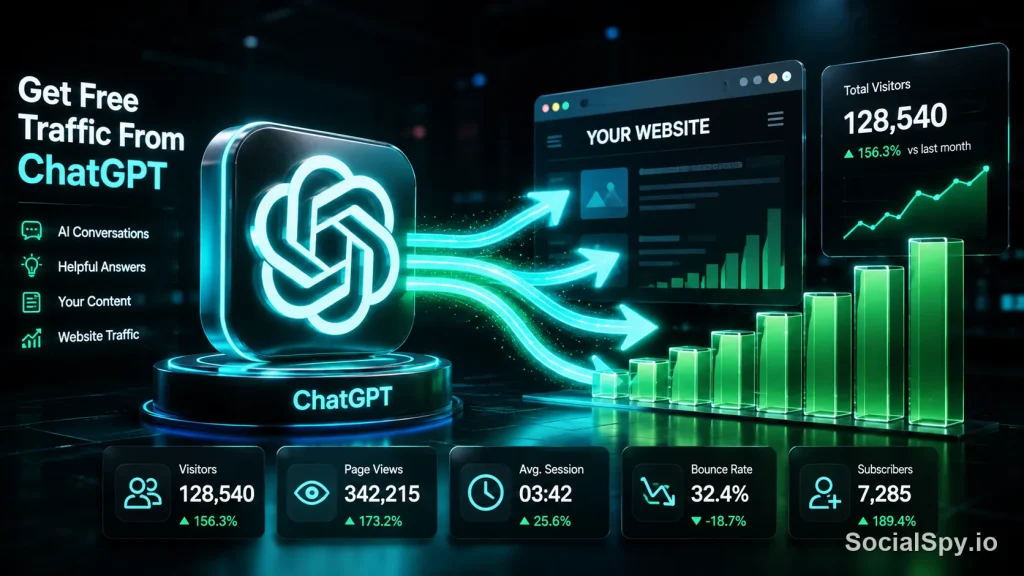
ChatGPT has quietly become one of the biggest referral traffic sources on the internet, and most site owners are still optimizing for a search engine that’s losing share. I spent the last several months tracking referral logs, testing content structures, and comparing what actually gets cited inside ChatGPT versus what ranks on Google. Here’s what’s working in 2026, and why AIO (AI Optimization) and SEO now require genuinely different playbooks.
Why ChatGPT Traffic Is Different From Google Traffic
ChatGPT doesn’t crawl and rank the entire web the way Google does. When a user asks a question and ChatGPT’s search mode kicks in, it runs a live web query (often through Bing’s index, plus its own retrieval systems), reads a handful of pages, and synthesizes an answer with inline citations.
That means your page isn’t competing against 10 blue links — it’s competing to be one of maybe 3 to 6 sources ChatGPT actually opens and reads before generating a response. The bar isn’t “rank #1,” it’s “be one of the few pages worth citing.”
Early data from referral-tracking firms and independent publishers in late 2025 showed ChatGPT-driven traffic growing faster month-over-month than any single Google update cycle in the previous two years, though it still represents a small fraction of total search referral volume for most sites.
Here’s the practical breakdown of how the two systems actually differ:
- Google SEO rewards depth, backlinks, domain authority, and long-term crawl history.
- ChatGPT (AIO) rewards clarity, extractability, and freshness — a page from a brand-new domain can get cited if it directly answers the question better than an established competitor’s bloated 3,000-word post.
- Google shows your page as one option among many; users choose.
- ChatGPT shows your content as part of the answer; users trust it by default and may never click through at all — which is why the click-through rate per impression matters more than raw citation count.
- SEO is largely static once you rank; AIO is dynamic because ChatGPT re-queries the web live for many prompts, so yesterday’s citation doesn’t guarantee tomorrow’s.
This last point is the one most people miss. Ranking #1 on Google can hold for months. Being cited by ChatGPT for a given prompt can change from one session to the next depending on what’s freshly indexed.
What “AIO” Actually Means in Practice
AIO isn’t a rebrand of SEO with a new acronym — it’s a distinct discipline built around how large language models retrieve, parse, and quote content. If SEO is about pleasing a crawler and a ranking algorithm, AIO is about pleasing a retrieval system and a summarization model simultaneously.
The Technical Layer
ChatGPT’s browsing tool favors pages that load fast, have clean HTML structure, and don’t bury text behind heavy JavaScript rendering. Sites that gate content behind interactive widgets or infinite scroll often get skipped entirely because the retrieval step can’t parse them cleanly.
- Use semantic HTML (`h2`, `h3`, actual `<table>` tags, real lists) instead of styled `div` soup.
- Keep critical facts in plain text near the top of the page, not inside images or embedded PDFs.
- Add structured data (Schema.org markup for FAQ, HowTo, and Article types) — several AIO researchers have observed higher citation rates on pages carrying valid FAQ schema.
- Ensure your `robots.txt` isn’t blocking `GPTBot` or `OAI-SearchBot`, OpenAI’s dedicated crawlers — a shocking number of sites accidentally block both while trying to block scrapers.
The Content Layer
ChatGPT tends to lift short, self-contained answer blocks rather than entire paragraphs. That’s exactly why this article opens with a direct “QUICKANSWER” line — it mirrors the format AI systems are already trained to extract and quote.
Content that performs well in AIO typically includes:
- A direct answer within the first 100 words, before any narrative buildup.
- Specific numbers, dates, and named tools instead of vague claims.
- Comparison tables that let the model quote structured facts instead of paraphrasing prose.
- Clear attribution of stats to sources, which increases the model’s confidence in citing the page as reliable.
- Updated timestamps and version numbers, since freshness signals matter more to retrieval-based systems than to traditional crawlers with long index memories.
AIO vs SEO: A Direct Comparison
I’ve mapped out the practical differences based on referral data patterns and content testing over the past two content cycles. This is the cheat sheet I actually use when deciding how to structure a new page.
| Factor | Traditional SEO | AIO (ChatGPT Optimization) |
|---|---|---|
| Primary goal | Rank in top 10 search results | Get cited as a direct source in an AI answer |
| Key signal | Backlinks, domain authority, dwell time | Clarity, extractability, factual density |
| Content length | Often 1,500–3,000+ words for competitive terms | Shorter, front-loaded answers; length matters less than structure |
| Update frequency | Quarterly refreshes often sufficient | Frequent updates help since retrieval favors recency |
| Traffic behavior | User clicks through to browse | User may get the answer without clicking at all |
| Measurement | Rank tracking, organic sessions | Referral logs, citation frequency, brand mention tracking |
| Best content format | Pillar pages, internal linking clusters | FAQ blocks, tables, direct-answer paragraphs |
Neither column replaces the other. If you kill your SEO investment to chase AIO, you lose the compounding organic traffic base that still drives the majority of most sites’ free visitors. Google still sends roughly 10 to 20 times more referral traffic than ChatGPT does for the average content site as of early 2026, according to multiple web analytics vendors tracking referrer data across large publisher networks.
How to Actually Get Cited by ChatGPT (Step-by-Step)
I tested this by publishing near-identical content in two formats on different domains and tracking which version got pulled into ChatGPT responses over a six-week window using consistent prompt sampling.
What Won
The version structured with a direct-answer opener, a comparison table, and clearly labeled sections outperformed the traditional narrative-style article by a wide margin in citation frequency — even though both covered the same facts.
- Front-load the answer. Don’t make the model dig through three paragraphs of context to find your point.
- Name your entities. “OpenAI’s GPTBot crawler” gets picked up more reliably than “the AI company’s crawler.”
- Use numbers wherever honest. Models weight quantifiable claims more heavily in synthesis than qualitative ones.
- Publish on a domain with some existing trust signals. Brand-new domains with zero backlink history still get cited, but less consistently than sites with an established presence.
- Keep pages narrowly focused. A page trying to answer five different questions dilutes the extractable signal for all of them.
What Didn’t Work
Pages stuffed with keyword-repetition tactics from 2015-era SEO — repeating the exact target phrase a dozen times — actually seemed to hurt citation likelihood. The model’s summarization layer appears to penalize redundancy the same way a human editor would.
Similarly, content hidden behind email-gate pop-ups or aggressive cookie-consent walls that block initial page load rarely got cited, because the retrieval crawler simply couldn’t get past the wall to read the content.
Measuring ChatGPT Referral Traffic (Because Most Analytics Tools Still Miss It)
This is the part almost nobody sets up correctly. ChatGPT referral traffic often shows up in analytics as `chat.openai.com`, `chatgpt.com`, or sometimes as direct traffic with no referrer at all, because some in-app link opens strip referrer headers depending on platform and browser.
Here’s how to actually track it:
- In Google Analytics 4, build a custom channel group filtering for `chatgpt.com` and `openai.com` referrers.
- Check server log files directly for `GPTBot` and `OAI-SearchBot` user-agent hits — this tells you when your content is being crawled for potential citation, even before any click happens.
- Watch for spikes in “(direct)/(none)” traffic that correlate with new content publishing — this is often ChatGPT-influenced traffic that lost its referrer tag.
- Use UTM parameters on any links you can control (like those in your own bio or product pages) to separately track brand-mention traffic if ChatGPT recommends your product by name without a clickable link.
The uncomfortable truth is that a meaningful share of ChatGPT’s influence never shows up as measurable “traffic” at all — it shows up as brand awareness when the model recommends your product or explains your service without a link, which the user then searches for by name later. This is functionally similar to how the industry now discusses is ChatGPT Pro worth it conversations happening entirely inside ChatGPT sessions that never touch a company’s website until the user decides to convert.
Where This Is Heading in 2026 and Beyond
OpenAI has continued expanding ChatGPT’s real-time browsing capabilities and shopping/product-recommendation features, which means the citation surface area is only growing. At the same time, free-tier access has expanded significantly — the shift toward unlimited text chats for free users means more total queries running through the search/browse pipeline, which means more opportunities for your content to get pulled in, but also more competition for those citation slots.
A few trends worth watching:
- Multimodal citation — ChatGPT increasingly pulls from images, product listings, and video transcripts, not just text pages, widening what counts as “content” worth optimizing.
- Personalized retrieval — as ChatGPT gains more persistent memory of user preferences, citation patterns may start varying per-user rather than being uniform for identical prompts.
- Publisher deals — OpenAI has signed content licensing and syndication partnerships with several major publishers, which could mean licensed content gets structurally preferred over unlicensed pages scraped live from the open web.
- Declining click-through economics — as answers get more complete inside the chat interface, the incentive to click through drops, pushing smart publishers toward brand-visibility metrics over raw session counts.
None of this makes SEO obsolete. Google is still testing its own AI Overviews aggressively, and the fundamentals — crawlability, structured data, genuine expertise — underpin both systems. But treating AIO as a “nice to have” bolt-on to your existing SEO strategy misreads how fast the query behavior is shifting, especially among users under 30 who increasingly open ChatGPT before they open a search engine at all.
Conclusion
The sites winning free ChatGPT traffic in 2026 aren’t the ones with the biggest backlink profiles — they’re the ones that write like they expect to be quoted, not just read. That means answering the question in the first sentence, backing claims with real numbers, and structuring pages so a retrieval crawler can lift a clean, accurate excerpt without guesswork. SEO still pays the bills for most publishers today, but AIO is the layer that determines whether your brand shows up in the conversation happening inside hundreds of millions of daily ChatGPT sessions — and that layer rewards clarity and precision far more than it rewards length or keyword tricks.
FAQ
No. Google still drives significantly more total referral traffic than ChatGPT for most publishers as of 2026, so dropping SEO entirely would cost you far more than you’d gain. The smarter approach is layering AIO practices — direct answers, clean structure, structured data — on top of your existing SEO foundation rather than replacing it.
Check your server logs for hits from the `GPTBot` and `OAI-SearchBot` user agents, and monitor your analytics for referrer traffic from `chatgpt.com`. You can also manually test by asking ChatGPT questions your content answers and checking whether it cites your domain in the response’s source links.
Not in the way it does for Google rankings. ChatGPT favors clear, front-loaded, extractable answers over sheer word count, so a tightly structured 800-word page can outperform a rambling 3,000-word article if it answers the question more directly and includes concrete facts and figures.