The iPhone 17 Pro Max packs Apple’s largest battery ever in a Pro-line phone, and its new internal architecture changes how — and how much — you’ll pay when that battery eventually needs replacing. Whether you’re planning ahead or already seeing “Battery Service” warnings in Settings, here’s what actually happens once this phone starts aging.
What Apple Actually Charges in 2025
Apple set official battery replacement pricing for the iPhone 17 Pro Max at $99 for out-of-warranty service, matching what it charged for the iPhone 16 Pro Max and iPhone 15 Pro Max the past two years. That price held steady even though the 17 Pro Max carries a physically larger, structurally different battery pack than its predecessors.
Here’s how that compares across recent flagship generations:
| Model | Apple Battery Replacement (Out of Warranty) | Battery Capacity |
|---|---|---|
| iPhone 17 Pro Max | $99 | ~5,088 mAh |
| iPhone 16 Pro Max | $99 | 4,685 mAh |
| iPhone 15 Pro Max | $99 | 4,441 mAh |
| iPhone 14 Pro Max | $99 | 4,323 mAh |
| iPhone 13 Pro Max | $99 | 4,352 mAh |
Industry analysts tracking Apple’s service pricing note that the company has held battery replacement fees flat at $99 for Pro Max models since 2021, even as battery cell costs and capacities have both risen.
If your phone is still under the standard one-year limited warranty, Apple will replace the battery for free, but only if it’s already degraded to 79% maximum capacity or lower — cosmetic wear or “it doesn’t last as long as it used to” complaints without that documented threshold typically won’t qualify.
Why This Battery Is Physically Different
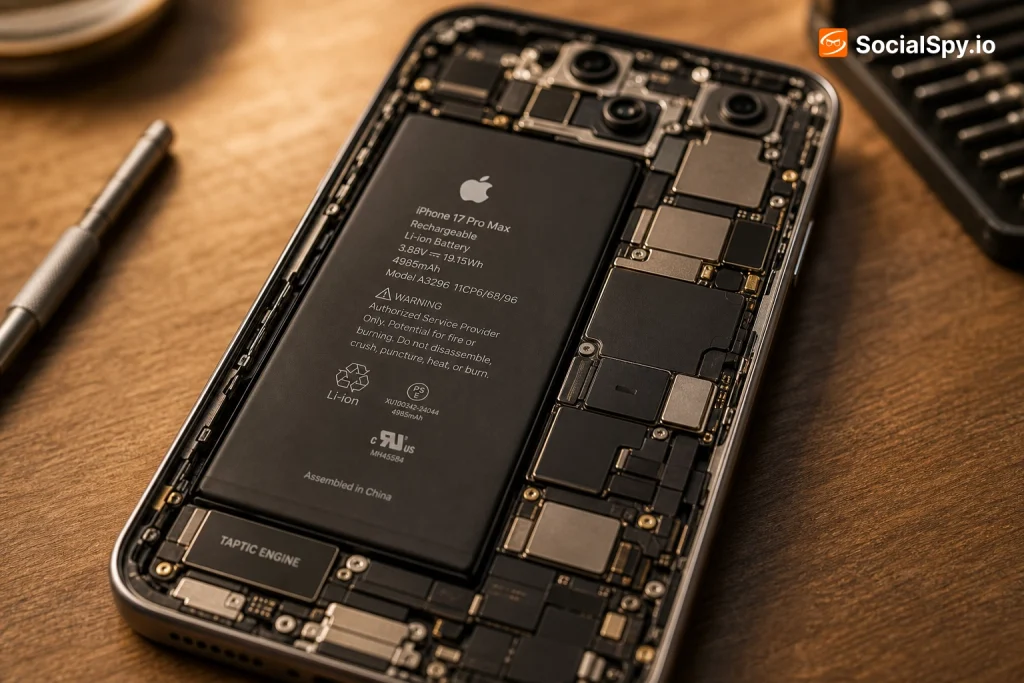
The iPhone 17 Pro Max is the first Pro Max to adopt Apple’s new unibody aluminum-and-vapor-chamber chassis, first tested on the iPhone 16e and iPhone 17 base models, scaled up for thermal management under sustained gaming and camera use. That redesign directly changed how the battery sits inside the frame.
Key differences from the 16 Pro Max’s internals:
- The battery uses a silicon-carbon anode, a chemistry shift Apple adopted to squeeze roughly 8% more capacity into a similar physical footprint.
- It’s held in place with adhesive strips paired with a stretch-release mechanism, rather than the pull-tab adhesive tabs used on 2022-2023 models.
- The battery connector sits closer to the logic board on the new internal layout, which technicians report adds a couple of extra steps compared to the 16 Pro Max teardown sequence.
- Apple’s internal frame now integrates part of the vapor chamber directly behind the battery bay, meaning technicians must be more careful with heat and prying tools near that region.
None of this changes the $99 price for the end customer, but it does affect repair time and, notably, how independent shops price the job.
Genuine Apple Service vs. Third-Party Repair Shops
Where you get the battery replaced matters more with this generation than with older iPhones, mainly because of parts pairing and battery health reporting.
Apple Store or Apple Authorized Service Provider
- Cost: $99 flat, no diagnostic fee.
- Turnaround: often same-day if parts are in stock, sometimes 1-3 business days for mail-in service.
- Uses a genuine Apple battery matched to the device’s serial number.
- Preserves full Battery Health reporting accuracy in Settings, including the new “Battery Health Guide” details Apple expanded starting with iOS 26.
- Comes with Apple’s standard 90-day repair warranty, or continued AppleCare+ coverage if you have it.
Independent Repair Shops
- Cost: typically $60 to $90, depending on region and shop reputation.
- Turnaround: frequently faster, sometimes under an hour for walk-in service.
- May use aftermarket or pulled batteries rather than genuine Apple cells.
- Can trigger a “Unknown Part” or “Important Battery Message” notification in Settings if the battery isn’t cryptographically paired to the device, similar to what iPhone 15 and 16 owners already experienced.
- Apple’s on-device battery health percentage may stop reporting reliably unless the shop has the proper calibration tools and genuine-adjacent parts.
If accurate battery health tracking and long-term resale value matter to you, genuine service is generally worth the price gap. If you just need the phone functional again cheaply and don’t plan to sell it, a reputable local shop can be a reasonable shortcut — just confirm they’re using quality cells and ask directly whether the repair will trigger a parts warning.
Does AppleCare+ Make This Free?
Yes, and this is where AppleCare+ quietly pays for itself for a lot of heavy users. Apple’s coverage terms state that a battery holding less than 80% of its original capacity qualifies for a free replacement under an active AppleCare+ plan, with no per-incident fee.
For context on what that 80% threshold actually looks like in daily use:
- A fully healthy iPhone 17 Pro Max should comfortably deliver Apple’s advertised up to 39 hours of video playback on a full charge.
- At 80% health, expect roughly 20-25% less real-world endurance, meaning a phone that lasted a full day now struggles by late afternoon on moderate use.
- Apple’s Battery Health screen will typically start showing a “Service Recommended” or peak performance capability message somewhere between 79% and 82%, prompting most users to book a repair before it drops further.
- Fast chargers rated 20W+ still work fine at degraded capacity, but charge cycles complete faster and heat up more, accelerating further wear.
AppleCare+ for the iPhone 17 Pro Max currently runs about $13.49/month (or roughly $199 for two years upfront), depending on region and whether you add theft and loss coverage. If you’re already paying for it, checking Battery Health every few months and requesting a free swap the moment you cross below 80% is the single best way to extend the phone’s usable life without spending extra money.
Compare that against the iPhone 16 Pro Max battery replacement process, where the same 80% AppleCare+ threshold and $99 out-of-warranty fee applied — Apple’s policy structure here is essentially unchanged year over year, only the internal hardware differs.
How Fast Will This Battery Actually Degrade?
Apple rates the iPhone 17 Pro Max battery for at least 80% capacity retention after 1,000 complete charge cycles, the same standard Apple has used since the iPhone 15 lineup introduced the upgraded rating (up from 500 cycles on older models).
What that means in practical terms:
- A “cycle” is one full 0-100% charge, which can be spread across multiple partial charges — so plugging in for 30% twice and 40% once still counts as roughly one cycle.
- Average heavy users (constant 5G, GPS navigation, gaming, camera use) tend to hit around 1-1.2 cycles per day, reaching 1,000 cycles in roughly 2.5 to 3 years.
- Lighter users might stretch that same 1,000-cycle threshold to 3.5-4 years before dipping meaningfully below 80% health.
- Heat exposure — leaving the phone in a hot car, wireless charging in direct sunlight, or heavy gaming while charging — is still the single biggest accelerant of chemical battery wear, more so than cycle count alone.
Apple’s on-device tools have also gotten more transparent about this. Since iOS 17, and continuing through iOS 26 on the 17 Pro Max, Settings > Battery > Battery Health shows not just a percentage but a peak performance capability status, flagging if the battery can no longer sustain peak power draw during demanding tasks like Pro camera video capture or intensive gaming sessions.
Should You Repair, Trade In, or Upgrade Instead?
This decision genuinely depends on where the rest of the phone stands, not just the battery.
| Factor | Repair Makes Sense | Trade-In/Upgrade Makes Sense |
|---|---|---|
| Battery health | 75-85%, otherwise healthy phone | Below 70% plus other hardware issues |
| Phone age | Under 3 years old | Over 4 years, storage/performance lagging |
| Screen/body condition | Good condition | Cracked screen, bent chassis |
| Trade-in value offered | Low ($50-150) | Strong carrier promo ($400+ off new model) |
| Plans to keep using it | 1-2+ more years | Ready for next Pro Max upgrade cycle |
A useful rule of thumb from repair technicians: if a $99 battery swap extends a phone you’d otherwise keep for another 18-24 months, it’s almost always the better financial move than trading in for a discounted upgrade — unless a carrier is offering an unusually aggressive trade-in credit that specific month.
It’s also worth remembering this calculus isn’t unique to the 17 Pro Max. Owners weighing the same decision on older devices, like those researching an iPhone 13 Pro Max battery replacement, generally find the same math holds: a sub-$100 repair on an otherwise solid phone beats financing a new device almost every time, unless the whole phone is genuinely reaching end-of-life.
What to Expect During the Repair Visit
Knowing the actual in-store process helps set realistic expectations, especially for first-timers.
- Diagnostic check — Apple runs a quick battery and hardware diagnostic before quoting final pricing, confirming there isn’t unrelated damage complicating the swap.
- Backup reminder — Technicians strongly recommend backing up to iCloud or a computer beforehand, since data loss is rare but always possible during any internal repair.
- Parts availability — Same-day service depends on local stock; the 17 Pro Max’s newer battery design means some smaller Apple Authorized Service Providers may need to order the part, adding a day or two.
- The actual swap — Apple’s own repair time estimate is about 45 minutes to 1 hour for a straightforward battery-only replacement.
- Post-repair calibration — Battery Health percentage may show 100% or a “waiting for calibration” message for the first 1-2 charge cycles after replacement, which is normal.
- Face ID and Face verification — Because of Apple’s parts-pairing system, a same-day genuine repair generally preserves full Face ID functionality without extra steps; non-genuine parts can occasionally trigger warning banners even when the phone still works fine.
Conclusion
The headline number hasn’t moved — $99 remains Apple’s price for a genuine out-of-warranty battery replacement on the iPhone 17 Pro Max, exactly what it charged on the last two Pro Max generations. What has changed is the hardware underneath: a silicon-carbon anode cell, a vapor-chamber-adjacent internal layout, and a repair process that rewards going through Apple or a certified provider rather than chasing the cheapest independent quote. For most owners, the real decision isn’t whether $99 is a fair price — it clearly is compared to a $1,199-plus upgrade — but whether AppleCare+ is already covering you for free, and whether your phone’s overall condition justifies keeping it running for another two to three years.
FAQ
Apple charges a flat $99 for an out-of-warranty battery replacement on the iPhone 17 Pro Max, the same rate it has charged for Pro Max models since the iPhone 13 Pro Max generation.
Yes, AppleCare+ covers a battery replacement at no additional cost once the battery’s maximum capacity drops below 80% as reported in Settings > Battery > Battery Health, with no separate service fee charged for that specific repair.
It can be safe and often cheaper, typically $60-$90, but non-genuine or improperly paired batteries can trigger an “Important Battery Message” in Settings and may stop reporting accurate battery health, which can affect resale value and long-term troubleshooting.