The iPhone 17 Pro’s redesigned internal chassis and larger battery cell changed more than just endurance numbers — it also changed what a battery swap costs and how long it takes at the Genius Bar. Apple’s shift to a new battery-adhesion system introduced with the iPhone 16 lineup carries forward here, but the Pro model’s aluminum unibody design adds a few wrinkles for anyone planning a repair. Here’s exactly what US owners should budget for and expect.
How Much Does It Actually Cost?
Apple’s official pricing structure for the iPhone 17 Pro mirrors what it charged for the iPhone 16 Pro, with a modest bump reflecting the larger, more complex battery module. Out-of-warranty customers without AppleCare+ pay the standard out-of-warranty rate, while AppleCare+ subscribers get a steep discount.
- With AppleCare+: $99 per replacement (unlimited claims, subject to the plan’s terms)
- Without AppleCare+, out of warranty: $119 through Apple directly
- Under standard warranty or covered by a battery health recall: Free, if capacity has degraded below Apple’s 80% threshold
- Independent repair shops: $70-$100, depending on parts sourcing and labor
- Mail-in service through Apple: Same $119 rate, plus shipping time
Industry repair trackers note that Pro models consistently run $20-$30 above the base iPhone 17 for battery service, largely due to the titanium-to-aluminum frame transition requiring more careful disassembly around camera modules and the Action Button mechanism.
For context, this pricing sits right in line with what we’ve seen on the iPhone 16 Pro battery replacement, suggesting Apple has settled into a fairly predictable pricing tier for its Pro-series repairs rather than escalating costs every generation.
Why Pro Costs More Than Standard Models
The base iPhone 17 battery replacement runs a few dollars cheaper than the Pro variant, and the gap comes down to internal architecture. The Pro’s battery cell is physically larger to support the 6.3-inch display and sustained performance under the A19 Pro chip, meaning more adhesive strips, tighter tolerances around the vapor chamber cooling system, and additional care needed near the telephoto camera assembly.
What Changed Inside the iPhone 17 Pro
Apple redesigned the internal layout for this generation, moving away from the horizontal battery placement that defined recent Pro models. The iPhone 17 Pro uses a vertically-stacked internal architecture that Apple’s engineering team says improves thermal management for sustained gaming and video work.
- Battery capacity: Estimated in the 4,000-4,200 mAh range, up from the iPhone 16 Pro’s roughly 3,582 mAh cell
- Cell chemistry: Continues Apple’s shift toward silicon-carbon anode technology, first introduced broadly across the 16 lineup, which packs more energy density into a similar footprint
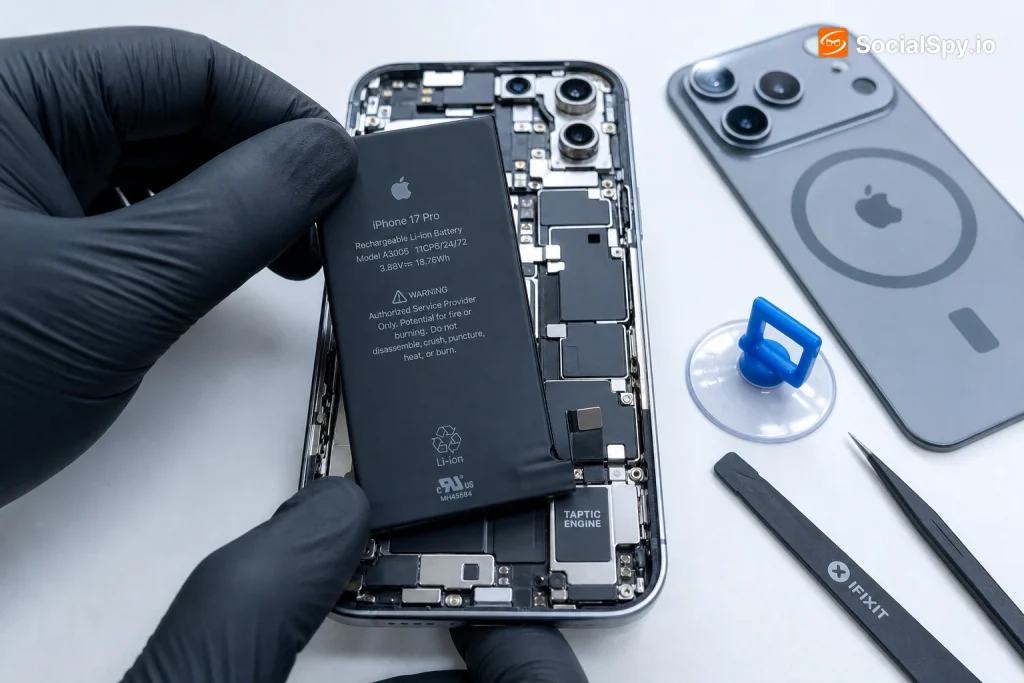
- Adhesion system: Retains the pull-tab electric release adhesive that debuted on the iPhone 16 series, replacing the older stretch-release strips
- Frame material: Aluminum unibody replaces the titanium frame used on iPhone 15 Pro and 16 Pro models, changing how technicians access the battery bay
The pull-tab adhesive system is genuinely the biggest practical change for repair techs. Rather than yanking on thin adhesive strips that frequently snap mid-removal, technicians now run a low-voltage current through a conductive tab that weakens the glue bond in about two minutes, letting the battery lift out with minimal prying.
Battery Health and Longevity Expectations
Apple rates the iPhone 17 Pro battery to retain 80% of its original capacity after 1,000 complete charge cycles, the same benchmark Apple has used since the iPhone 15 generation. A charge cycle counts as using 100% of battery capacity, whether that happens in one day or across three days of partial charges.
- Average heavy users hit 1,000 cycles in roughly 2.5 to 3 years
- Light-to-moderate users may not cross that threshold until year 4
- Battery degradation accelerates faster in extreme heat (regularly above 95°F) or when phones sit at 100% charge for extended periods
- Apple’s Optimized Battery Charging feature, active by default, slows this degradation by learning your daily routine and delaying the final charge push until shortly before you unplug
Genius Bar vs. Third-Party vs. DIY
Where you get the repair done matters as much as the price tag. Each path involves different tradeoffs around warranty preservation, parts authenticity, and turnaround speed.
| Repair Option | Typical Cost | Turnaround | Warranty Impact |
|---|---|---|---|
| Apple Store (Genius Bar) | $99-$119 | 1-3 hours, same day | Preserves full coverage |
| Apple Mail-In Service | $119 | 3-7 business days | Preserves full coverage |
| Independent Repair Provider (Apple-certified) | $80-$110 | Same day, often 1-2 hours | Preserves coverage if genuine parts used |
| Uncertified Third-Party Shop | $70-$100 | Same day | May void remaining warranty |
| DIY (self-repair kit) | $69.95 parts + tools rental | 45-90 minutes if experienced | Voids warranty on most damage claims |
Apple’s Self Service Repair program does sell genuine battery kits for the iPhone 17 Pro through Apple’s parts site, including the tools needed and a return-and-credit option for the old battery. Most reviewers who’ve tried Apple’s DIY kits describe them as functional but genuinely time-consuming for first-timers — closer to an hour and a half once you factor in screen removal, connector disconnection, and reassembly.
A notable caveat: starting with the iPhone 15 generation, Apple introduced parts pairing checks that can trigger “Unknown Part” warnings in Settings > Battery if a non-genuine or improperly paired battery is installed, even if the repair itself was done competently.
Signs You Actually Need a Replacement
Not every battery complaint requires a full swap. Before booking an appointment, check your actual battery health data, which lives in Settings > Battery > Battery Health & Charging.
- Maximum capacity reads below 80% — this is Apple’s own trigger point for recommending replacement
- Peak Performance Capability shows a warning — meaning the phone has throttled performance to prevent unexpected shutdowns
- Unexpected shutdowns at 20-30% charge — a classic sign the battery can no longer deliver consistent voltage under load
- Phone feels noticeably warm during normal use, not just gaming or charging — sometimes points to a swelling cell
- Visible screen lifting or a case that no longer sits flush — a physical red flag suggesting battery swelling that needs immediate attention, not just an inconvenience
If you’re seeing swelling, stop using the phone and get it serviced immediately rather than waiting for a convenient appointment slot — a swollen lithium-ion cell is a legitimate fire and puncture risk, not just a cosmetic issue.
AppleCare+ Math: Is It Worth Buying For This Alone?
AppleCare+ for the iPhone 17 Pro runs $199 for two years or roughly $9.99/month depending on how you enroll, and battery coverage is just one small piece of what you’re paying for. Still, it’s worth running the numbers if battery longevity is your main worry.
- One out-of-warranty battery swap without AppleCare+: $119
- Same swap with AppleCare+ active: $99
- Straight savings on a single battery job: $20
On battery repair alone, AppleCare+ doesn’t pay for itself — the real value comes from accidental damage coverage, which runs $29 for screen repairs and $99 for other damage, potentially saving hundreds of dollars over two years if you drop the phone even once. Anyone who’s already read up on the iPhone 17 Air battery replacement pricing will notice Apple keeps this $99/$119 split remarkably consistent across its current lineup, which makes AppleCare+ decisions more about drop protection than battery math specifically.
Conclusion
The iPhone 17 Pro’s battery replacement economics land almost exactly where seasoned Apple owners would expect: a $99-$119 range through official channels, a same-day Genius Bar appointment in most metro areas, and a battery built to hold 80% capacity through roughly 1,000 charge cycles. What’s genuinely new this generation is the internal redesign — the vertically stacked cell and continued pull-tab adhesive system mean technicians spend less time wrestling with stuck strips, which should, in theory, keep third-party labor costs stable rather than climbing. The smartest move for most owners isn’t agonizing over where to get the repair done — it’s checking Battery Health regularly so you catch the 80% threshold before performance throttling or unexpected shutdowns start affecting daily use.
FAQ
Yes, if the phone is still under its original one-year limited warranty and the battery has dropped below 80% maximum capacity through normal use, Apple replaces it at no charge as a manufacturing defect claim.
You can, but iOS may display an “Unknown Part” notification in the Battery Health settings due to Apple’s parts-pairing system, and in rare cases this can limit access to battery health percentage readouts until the part is verified through Apple’s system.
Most iPhone 17 Pro battery swaps at a Genius Bar are completed the same day, often within 1 to 3 hours depending on store volume, though booking an appointment in advance rather than walking in significantly speeds up the process.