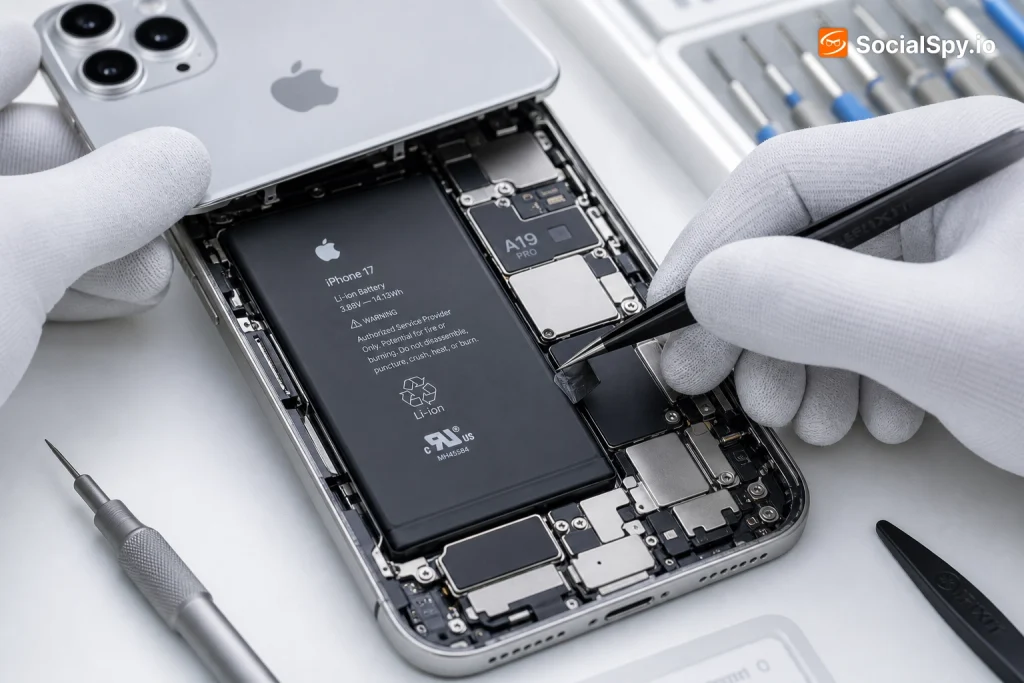
The iPhone 17 lineup brought bigger batteries, a new internal chassis design, and Apple’s shift toward a more repair-friendly build than the 16 series – but battery replacement still isn’t free, and pricing varies more than most owners expect. Whether you’re weighing an out-of-warranty repair, an AppleCare+ claim, or a third-party fix, the numbers and process details matter. Here’s what actually happens when your iPhone 17’s battery health drops and you decide to do something about it.
How Much Does an iPhone 17 Battery Replacement Actually Cost
Apple’s official pricing for the iPhone 17 family follows the same tiered structure it’s used for years, though the Pro Max now carries a slightly higher fee than in past generations due to its larger cell capacity and revised internal shielding around the vapor chamber.
- iPhone 17: $99 out-of-warranty replacement
- iPhone 17 Pro: $99 out-of-warranty replacement
- iPhone 17 Pro Max: $109 out-of-warranty replacement
- AppleCare+ subscribers: $0 (covered when battery capacity falls below 80%)
- Independent repair shops: roughly $70-$110 depending on region and part quality
- Mail-in Apple Support service: same base price plus shipping time, typically 5-7 business days
These prices reflect Apple’s direct battery-only service, not a full device replacement. If a technician finds unrelated damage – a cracked back glass panel, water intrusion, or a bent chassis from a drop – Apple will flag it during diagnostics and the job stops being a flat-fee battery swap.
Industry repair analysts note that battery-only service accounts for a disproportionate share of walk-in Apple Store appointments in a phone’s second year on the market, and the 17 series is expected to follow that same curve starting around mid-2026.
For comparison, Apple charged similar or slightly lower rates on the outgoing lineup, and readers curious how the newest pricing lines up against last year’s models can see the full breakdown in our iPhone 16 Pro Max battery replacement guide.
Why the Pro Max Costs More Than the Base Model
The $10 price gap between the standard iPhone 17 and the iPhone 17 Pro Max isn’t arbitrary. Apple’s internal service pricing generally tracks battery cell size, cooling architecture complexity, and how many additional steps a technician needs to safely access the cell.
Battery Capacity Differences
The iPhone 17 Pro Max houses Apple’s largest battery to date, part of what the company markets as its best-ever all-day battery life on a Pro model. Bigger cells mean higher raw material cost and, in the case of the 17 Pro line’s aluminum unibody with internal vapor chamber cooling, more disassembly steps to reach the battery tray safely.
Structural and Adhesive Changes
Apple redesigned the internal battery mounting for the 17 series, moving toward a stretch-release adhesive system that’s supposed to make the cell easier to remove without heat guns or excessive prying. In theory this should make labor faster and cheaper – but Apple’s official pricing hasn’t dropped to reflect that, since the adhesive change mainly benefits self-repair and third-party technicians rather than shortening Apple’s own certified service workflow time.
| Model | Apple Out-of-Warranty Price | Typical Independent Shop Price |
|---|---|---|
| iPhone 17 | $99 | $75-$95 |
| iPhone 17 Pro | $99 | $80-$100 |
| iPhone 17 Pro Max | $109 | $85-$110 |
What Actually Happens During the Replacement Process
Most owners assume a battery swap is a quick counter transaction, but Apple’s process involves several checkpoints before a technician even opens the phone.
- Diagnostic check – Apple runs its proprietary diagnostic suite to confirm battery health, cycle count, and rule out other hardware faults that might be causing the perceived battery issue.
- Data backup recommendation – while battery service shouldn’t wipe your device, Apple strongly recommends a full iCloud or Finder backup beforehand in case a restore becomes necessary.
- Physical disassembly – technicians remove the display assembly, disconnect the battery connector, and use the new stretch-release adhesive tabs to lift the old cell.
- New cell installation and calibration – the replacement battery is paired, and the phone’s battery health percentage resets to reflect the new cell’s baseline capacity.
- Water resistance reseal – Apple replaces the adhesive gaskets around the display and chassis to restore the IP68 rating, which is disrupted any time the phone is opened.
- Final diagnostics – a post-repair check confirms Face ID, cameras, and battery reporting are functioning before the device is returned.
The whole process at an Apple Store typically takes under an hour if the part is in stock, though many locations now schedule same-day appointments rather than instant walk-in service due to demand.
AppleCare+ vs Paying Out of Pocket
Deciding whether AppleCare+ is worth it often comes down to battery longevity math. Apple’s threshold for a “free” battery replacement under warranty or AppleCare+ is a maximum capacity below 80% of original design capacity, as measured in Settings > Battery > Battery Health & Charging.
- Without AppleCare+, Apple won’t replace a battery under standard warranty unless it’s a manufacturing defect – normal degradation isn’t covered in year one.
- With AppleCare+, degradation below 80% is covered at any point during the two-year plan, no deductible required for battery-only service.
- AppleCare+ for the iPhone 17 Pro Max costs meaningfully more annually than the base model plan, so heavy users should weigh the plan’s total cost against a single $99-$109 out-of-warranty repair.
- Battery health typically doesn’t drop below 80% until somewhere between 500 and 1,000 full charge cycles, which for most users lands around the two-to-three-year mark.
For many buyers, the real value of AppleCare+ isn’t the battery clause specifically – it’s bundled screen and accidental damage coverage that makes the battery perk feel like a bonus rather than the main draw.
Third-Party and DIY Repair Options
Not every iPhone 17 owner wants to book an Apple Store appointment or mail their phone away. The independent repair landscape has changed meaningfully since Apple expanded its Self Service Repair program and California’s right-to-repair law took full effect.
Apple Self Service Repair Store
Apple sells genuine battery kits directly to consumers through its Self Service Repair Store, including the battery, adhesive strips, and a loaner tool kit. Pricing for the genuine part alone typically runs close to what Apple charges for labor at retail, meaning DIY only saves money if you already own repair tools or plan to do multiple repairs.
Independent Repair Shops
Third-party shops – including national chains and local independents – now often use genuine Apple parts sourced through the expanded parts pairing program Apple opened up in recent years. This matters because:
- Non-genuine batteries can trigger a persistent “Unknown Part” battery health warning in iOS.
- Since iOS 15.x, Apple’s parts pairing system flags unauthorized batteries, though it stops short of disabling the phone.
- Shops using Apple-authorized parts avoid this warning and typically offer their own 90-day to lifetime labor warranties.
Mail-In and Chain Retailer Repair
Big-box repair chains offer mail-in and walk-in battery service, generally cheaper than Apple’s Store pricing but with more variability in turnaround time. Expect 3 to 10 business days depending on part availability and shop volume, versus Apple’s typically faster in-store turnaround.
Signs Your iPhone 17 Battery Actually Needs Replacing
Not every performance dip means a bad battery. Apple’s Battery Health tool remains the most reliable diagnostic, but there are behavioral signs worth watching for too.
A battery health reading in the 80-90% range is normal wear for a device that’s a year or two old and doesn’t automatically require replacement – the 80% threshold exists specifically because that’s where users typically start noticing real-world impact.
Warning signs that typically justify a replacement appointment:
- Battery health percentage reading below 80% in Settings
- Unexpected shutdowns even when the battery shows charge remaining
- Noticeable physical swelling, bulging, or a warped back glass/screen
- Peak Performance Capability messages indicating the battery can no longer supply peak power
- Charging that stalls or reverses (percentage dropping while plugged in)
If you’re seeing swelling specifically, stop using the phone and book service immediately rather than waiting – a swollen lithium-ion cell is a genuine safety concern, not just a performance issue.
Conclusion
The iPhone 17’s battery replacement economics land almost exactly where seasoned Apple owners would expect: a $99 to $109 flat fee from Apple, free coverage if you’ve got AppleCare+, and a genuinely competitive independent repair market now that parts pairing and Self Service Repair have matured. The bigger story is the redesigned stretch-release adhesive, which should make future replacements – whether at Apple, a certified shop, or your own kitchen table – meaningfully less destructive to surrounding components than the heat-and-pry method that defined iPhone repairs for over a decade. If you’re on the fence, check your Battery Health percentage first; there’s no reason to pay for a repair your phone doesn’t need yet, but once you’re under 80%, the fix is fast, affordable, and increasingly your choice of where to get it done.
FAQ
Apple charges $99 for the standard iPhone 17 and iPhone 17 Pro, and $109 for the iPhone 17 Pro Max, when the repair is done out of warranty at an Apple Store or through mail-in service.
Yes, but only once battery health drops below 80% of original capacity; AppleCare+ subscribers pay nothing for this specific repair during their two-year coverage window, though the plan’s own subscription cost should factor into the overall value calculation.
It’s physically possible and often cheaper, but non-genuine batteries can trigger an “Unknown Part” warning in Battery Health due to Apple’s parts pairing system; choosing a shop that uses genuine or Apple-sourced parts avoids that warning and typically preserves normal battery health reporting.