Apple has shipped more than 40 distinct iPhone models since 2007, and almost every one of them has a slightly different screen size, pixel count, or aspect ratio. That variety matters far more than most people realize — it affects everything from which case fits your phone to how a website or app actually renders on your display. Here’s a practical breakdown of iPhone screen dimensions, why they keep changing, and what the numbers actually mean for you.
Why iPhone Screen Dimensions Keep Changing
Apple didn’t touch screen size for the first four years of the iPhone’s existence. The original 2007 iPhone through the iPhone 4S all used the same 3.5-inch, 320 x 480 display.
Everything changed with the iPhone 5 in 2012, which stretched to a 4-inch, 1136 x 640 panel to accommodate a new row of app icons. From there, screen growth became a near-annual event, driven by consumer demand for bigger media viewing and Apple’s need to differentiate its lineup with size tiers.
- 2012: iPhone 5 introduces the 4-inch era
- 2014: iPhone 6 and 6 Plus jump to 4.7 and 5.5 inches, splitting the lineup into two sizes
- 2017: iPhone X ditches the home button and introduces the notch, changing aspect ratio math entirely
- 2020: iPhone 12 mini shrinks things back down to 5.4 inches for one generation
- 2026: iPhone 17 Pro Max pushes the ceiling to 6.9 inches
Each jump wasn’t arbitrary. The move to edge-to-edge displays starting with the iPhone X, for instance, let Apple grow screen real estate without making the physical phone dramatically bigger — a trend covered in more depth in Dimension of iPhone, which tracks how body size and screen size have diverged over the years.
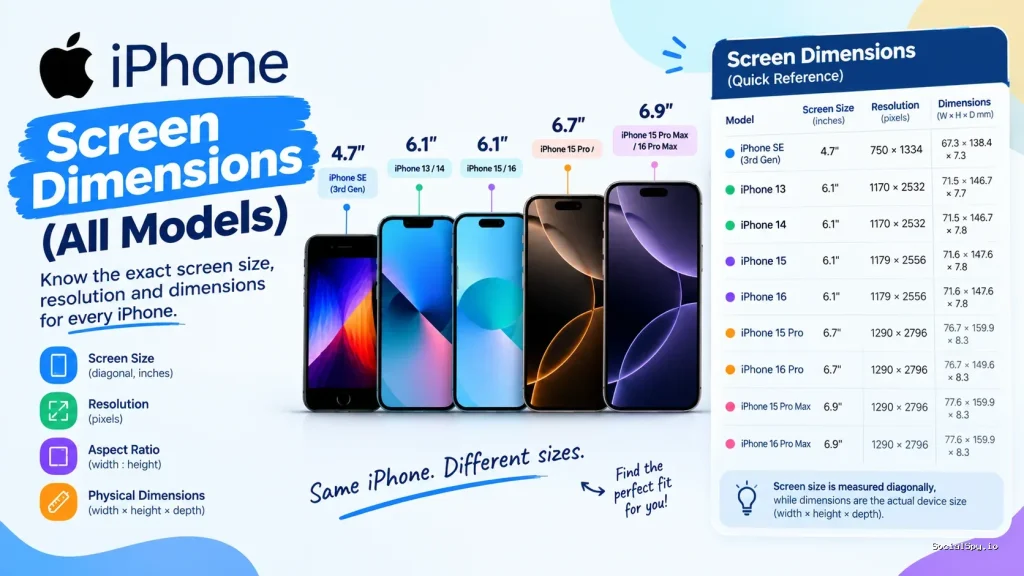
Current iPhone Lineup: Full Screen Specs
As of September 2026, Apple sells six actively marketed iPhone models spanning four distinct screen sizes. Here’s how they stack up.
| Model | Screen Size | Resolution | PPI |
|---|---|---|---|
| iPhone SE (2022) | 4.7 in | 750 x 1334 | 326 |
| iPhone 16e | 6.1 in | 1179 x 2556 | 460 |
| iPhone 17 | 6.3 in | 1206 x 2622 | 460 |
| iPhone Air | 6.5 in | 1260 x 2736 | 460 |
| iPhone 17 Pro | 6.3 in | 1206 x 2622 | 460 |
| iPhone 17 Pro Max | 6.9 in | 1320 x 2868 | 461 |
A few things jump out from that table. First, the iPhone SE is now a genuine outlier — it’s the only current model still running a Home button design with thick bezels and a 4.7-inch LCD, which explains why Apple has heavily discounted it rather than positioned it as a flagship-adjacent option.
Second, pixel density has basically plateaued. Apple settled on roughly 460–461 PPI years ago because that’s beyond what the human eye can distinguish from a normal viewing distance — going higher would just burn battery and GPU cycles for no visible benefit.
If you’re trying to figure out which current model actually gives you the most screen to work with, the answer isn’t always obvious from marketing names alone — Which iPhone Has the Largest Screen breaks down how the Pro Max and Air compare once you account for bezel thickness and usable area, not just the advertised diagonal measurement.
Understanding Aspect Ratio and Points vs. Pixels
Raw pixel counts don’t tell the whole story, and this is where a lot of confusion happens for developers, designers, and even casual users trying to take a perfectly cropped screenshot.
Apple’s iPhone displays use two aspect ratios depending on generation:
- 19.5:9 — used on all Face ID models from the iPhone X through the iPhone 16 lineup, including the notch and Dynamic Island generations
- 20:9 — introduced with certain iPhone Air and iPhone 17 Pro Max configurations to slightly elongate the display for more vertical content
- 16:9 — the older aspect ratio on Home button models like the iPhone SE (2022) and earlier 8-series phones
Then there’s the points-versus-pixels distinction, which trips up almost everyone who isn’t building software professionally.
iOS renders everything in “points,” a resolution-independent unit, and then multiplies by a device-specific scale factor (typically 2x or 3x) to get actual pixels. That’s why an iPhone 17 Pro Max and an iPhone SE can display the same layout proportionally despite wildly different pixel counts.
For app developers, this means designing at logical resolution (like 428 x 926 points) rather than raw pixels, then letting iOS handle the scaling. For everyday users, it explains why a screenshot file size and dimensions look bigger on a Pro Max than an SE, even though the interface looks nearly identical on both.
Screen Size vs. Body Size: The Bezel Factor
Screen dimensions alone don’t tell you how big a phone will feel in your hand or pocket — that’s a function of bezels, corner radius, and overall industrial design.
Apple has shrunk bezels dramatically since the iPhone X, and the Dynamic Island (introduced on the iPhone 14 Pro) actually let Apple reclaim space that used to be wasted around the notch. That’s part of why an iPhone 17 with a 6.3-inch screen has a noticeably smaller footprint than an old iPhone 8 Plus, despite the 8 Plus having a smaller 5.5-inch display.
Screen-to-body ratio is the metric that actually captures this:
- iPhone SE (2022): roughly 65% screen-to-body ratio due to thick top/bottom bezels
- iPhone 16e: around 86%, thanks to the Dynamic Island design
- iPhone 17 Pro Max: approximately 90%, among the highest Apple has achieved
That gap matters when you’re choosing a case, a screen protector, or even a car mount — dimensions that look close on paper (say, a 6.1-inch and 6.3-inch model) can result in phones with meaningfully different physical widths and heights. Anyone shopping for accessories should always check exact millimeter measurements rather than trusting diagonal screen size as a proxy for overall phone size, a distinction explored further in Dimension of iPhone.
How Screen Size Affects Battery Life and Repairs
Bigger screens don’t just mean more viewing area — they change the entire internal engineering of the phone, especially battery capacity and repairability.
Larger chassis (like the Pro Max and Air-class phones) can fit bigger batteries, which is why Apple’s largest-screen models routinely post the best battery-life benchmarks in the lineup despite pushing more pixels. The tradeoff is that bigger, more tightly packed batteries in slimmer designs can also be more labor-intensive to service.
- Smaller-screen phones (SE, mini-class models) tend to have simpler, more accessible batteries but shorter runtime
- Larger-screen Pro and Pro Max models typically use L-shaped or dual-cell battery designs to maximize capacity within an irregular internal shape
- Ultra-thin models like the iPhone Air trade some battery capacity for a slimmer profile, often compensating with more efficient chip designs
If your battery is degrading and you’re weighing a replacement against a full upgrade, it helps to know what you’re actually working with model-by-model. SocialSpy has detailed cost breakdowns for several generations, including the iPhone 15 Plus Battery Replacement, the iPhone 13 Battery Replacement, and the iPhone 12 Mini Battery Replacement, all of which factor in how screen size and internal layout affect service pricing and turnaround time.
Practical Implications: Cases, Screen Protectors, and Wallpapers
Screen dimensions aren’t just a spec-sheet curiosity — they directly determine what accessories and content will actually fit your phone correctly.
Cases and Screen Protectors
Even a 0.1-inch difference in screen size, or a slight change in corner radius between generations, can make a case or tempered-glass protector fit poorly. This is why:
- Cases labeled for “iPhone 16” often don’t fit the “iPhone 17” even though both are roughly 6.1–6.3 inches
- Camera cutout placement shifts between generations as lens arrays get reshuffled
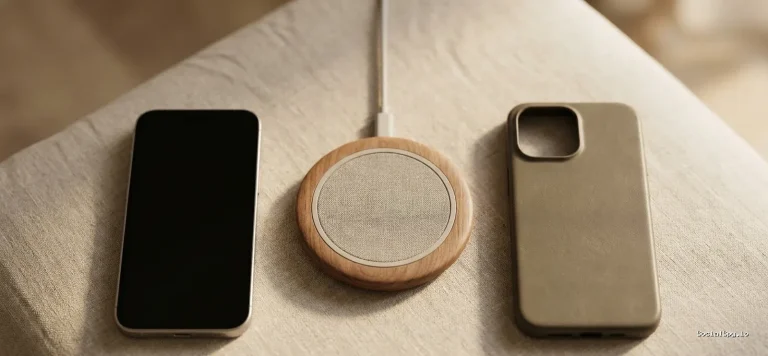
- MagSafe alignment rings must match exactly, or wireless charging efficiency drops
Wallpapers and Screenshots
Content creators and designers exporting wallpapers or UI mockups need to match exact pixel dimensions, not just “iPhone size” categories. Common current targets include:
- 1179 x 2556 for iPhone 16e and similarly sized standard models
- 1206 x 2622 for iPhone 17 and 17 Pro
- 1320 x 2868 for iPhone 17 Pro Max
- 750 x 1334 for the iPhone SE, still relevant for the budget segment
Getting these wrong results in wallpapers that get auto-cropped or stretched, which is a common complaint in Apple support forums whenever a new model launches with a resolution nobody anticipated.
Conclusion
The iPhone’s screen has grown from a single 3.5-inch panel to a family of displays spanning 4.7 to 6.9 inches, but the underlying trend is consistency in pixel density paired with continuous refinement in screen-to-body efficiency. Apple isn’t chasing bigger numbers for their own sake anymore — the 460–461 PPI ceiling has held for years because it’s already at the edge of visible sharpness, and further gains now come from shrinking bezels and reshaping aspect ratios rather than adding raw resolution. For most buyers in 2026, the practical decision isn’t about resolution at all — it’s about physical size, one-hand usability, and battery capacity, all of which trace back to that same screen-dimension spec sheet more than people expect.
FAQ
The iPhone 17 has a 6.3-inch display with a resolution of 1206 x 2622 pixels at 460 pixels per inch, making it slightly larger than the previous standard iPhone 16 while keeping the same pixel density.
Screen diagonal measurement only captures one dimension, while case fit depends on exact width, height, corner radius, button placement, and camera cutout position, all of which Apple frequently tweaks even when the advertised screen size stays nearly identical between generations.
No, larger-screen iPhones like the Pro Max typically have better battery life than smaller models because their bigger chassis fits a significantly larger battery cell, often more than offsetting the extra power draw from the larger display.