The iPhone 12 Mini’s biggest complaint has never been performance or camera quality — it’s battery life. That small, dense frame packs a 2,227 mAh cell, the smallest of any phone in the iPhone 12 lineup, and after three-plus years of daily charge cycles, many owners are now watching their battery health percentage slide well below the number where Apple starts recommending a swap.
Why the iPhone 12 Mini’s Battery Ages Faster
The iPhone 12 Mini launched in November 2020 as the smallest 5G phone Apple ever made, cramming a 5.4-inch OLED display, A14 Bionic chip, and MagSafe hardware into a body barely larger than an iPhone SE. To fit all that in, Apple had to shrink the battery to 2,227 mAh — nearly 30% smaller than the 3,110 mAh cell in the standard iPhone 12.
Lithium-ion batteries degrade based on charge cycles, not calendar age, but smaller batteries hit their cycle count faster because they need more frequent full charges to get through a day.
Apple itself states its batteries are designed to retain 80% of original capacity at 500 complete charge cycles — a milestone many Mini owners have already blown past given how often the phone needs topping off.
Here’s how the Mini compares to its siblings from the same generation:
| Model | Battery Capacity | Apple-Rated Video Playback |
|---|---|---|
| iPhone 12 Mini | 2,227 mAh | Up to 15 hours |
| iPhone 12 | 2,815 mAh | Up to 17 hours |
| iPhone 12 Pro | 2,815 mAh | Up to 17 hours |
| iPhone 12 Pro Max | 3,687 mAh | Up to 20 hours |
That gap explains why so many Mini owners are hitting the replacement conversation years before Pro Max owners even think about it.
How to Tell If You Actually Need a Replacement
Apple builds a battery health diagnostic directly into iOS, and it’s the first place to check before spending any money. Go to Settings > Battery > Battery Health & Charging.
There, you’ll see a Maximum Capacity percentage — this compares your current battery’s ability to hold a charge against when it was new. Apple’s own guidance is straightforward:
- 100%–90%: Battery is performing normally; no action needed.
- 89%–80%: Noticeable decline is possible; monitor performance and charging habits.
- Below 80%: Apple explicitly recommends service, and you may see a message stating the battery has “significantly degraded.”
- Peak Performance Capability warning: If the battery can no longer supply enough peak power, iOS may show a note that performance management features have activated, which can cause slowdowns during demanding tasks.
Real-world symptoms tend to show up before the percentage even confirms it. Common signs among Mini owners include:
- The phone dying at 30–40% displayed battery, especially in cold weather.
- Sudden shutdowns during camera use, GPS navigation, or gaming.
- The battery percentage jumping erratically (e.g., 15% straight to 1%).
- Noticeably slower app launches or frame drops that weren’t there a year ago.
- The phone feeling warm even during light use, a sign the battery is struggling to regulate power delivery.
If you’re seeing two or more of these alongside a Maximum Capacity reading under 80%, replacement is worth pursuing rather than waiting.
Apple’s Official Pricing and What’s Included
Apple performs battery replacements at Apple Stores, through mail-in service, and via Apple Authorized Service Providers. Pricing depends entirely on whether the phone is still covered.
Out-of-Warranty Pricing
For an iPhone 12 Mini with no AppleCare+, Apple charges $99 for a battery replacement as of current published pricing — this has been Apple’s standard out-of-warranty battery fee for iPhone 12-series devices since launch. That price includes:
- A genuine Apple battery with full capacity rating.
- Testing of the display, cameras, and Face ID to confirm nothing else is affected.
- A 90-day warranty on the repair itself.
- Software recalibration so battery health reporting resets accurately.
With AppleCare+
If the phone is enrolled in AppleCare+, the replacement is free whenever Maximum Capacity drops to less than 80% — this is one of the most underused perks of the plan. Apple’s standard iPhone hardware warranty (the free one bundled with every new iPhone) also covers a defective battery, but only if it drops below 80% capacity within the first year of ownership, which for a 2020-era Mini has long since expired for most owners.
Turnaround Time
- Walk-in Apple Store appointment: Often completed same-day, sometimes within 1–2 hours if parts are in stock.
- Mail-in service: Apple typically quotes 5–7 business days round trip, including shipping both ways.
- Authorized Service Provider: Varies by location, but many independent Apple-authorized shops can turn it around same-day as well.
One thing worth flagging: because the iPhone 12 Mini is now several years past release, some Apple Stores no longer keep the part in stock at every location, which can push a walk-in visit into a multi-day mail-in repair instead. It’s smart to call ahead or check the “batteries” repair estimate tool on Apple’s support site before showing up.
Third-Party and Independent Repair Options
Given the Mini’s age, plenty of owners are choosing to go outside Apple entirely — and the price difference can be significant.
What Independent Shops Typically Charge
Chains like uBreakiFix (by Asurion), CPR Cell Phone Repair, and countless local independent shops offer iPhone 12 Mini battery swaps generally in the $40–$70 range, depending on region and battery quality tier offered.
- uBreakiFix: Often prices Mini battery replacements around $49–$69, with many locations offering same-day service and a warranty (commonly 90 days to 1 year depending on location).
- Local independent shops: Can be the cheapest option, sometimes $30–$50, but battery quality and warranty terms vary enormously — always ask what brand/grade of battery cell they’re installing.
- Mail-in specialty repair services: Some offer kits or mail-in service in a similar $40–$60 range, useful for people without a nearby shop.
The Self-Repair Route
Apple also sells parts directly through its Self Service Repair program, launched in 2022, which includes iPhone 12-series batteries. A genuine Apple battery part for the Mini through this program typically runs in the $65–$75 range before any tool rental deposit, and Apple charges a $49 credit-back if you return the old battery for recycling — effectively lowering real cost.
That said, this path isn’t for everyone:
- Requires renting Apple’s proprietary repair toolkit (or buying specialty tools separately).
- Involves handling a lithium-ion battery, disconnecting the taptic engine and display connectors, and dealing with strong adhesive strips.
- Any mistake with the battery adhesive pull-tabs can risk puncturing the cell, which is a genuine fire safety concern.
- Best suited to people already comfortable with small-device electronics repair, not casual DIYers.
Apple vs. Third-Party: A Side-by-Side Look
Choosing where to get the repair done comes down to trusting the part quality versus prioritizing cost and speed. Here’s how the major paths stack up:
| Factor | Apple (Out-of-Warranty) | Third-Party Shop | Self-Repair (DIY) |
|---|---|---|---|
| Typical Cost | $99 | $40–$70 | $65–$75 (parts) |
| Turnaround | Same-day to 1 week | Often same-day | Several hours (DIY time) |
| Battery Warranty | 90 days | Varies (90 days–1 yr) | Limited/none typically |
| Genuine Apple Part | Yes | Sometimes (varies by shop) | Yes (via Apple program) |
| Affects Future Apple Service | No | Can flag “non-genuine part” | No, if genuine part used |
That last row matters more than people expect. If a non-Apple battery is installed, iOS will display a message under Battery Health stating the battery’s health cannot be verified — a permanent notice on that phone unless a genuine Apple battery is later installed by Apple or an authorized provider.
What Actually Happens During the Repair
For readers who’ve never had a phone battery replaced, the process is more involved than swapping a phone case, mainly because of the iPhone 12 Mini’s compact internal layout.
- Diagnostic check: Technician confirms battery health percentage and cycle count, and checks for swelling (a bulging battery is a safety hazard and gets flagged immediately).
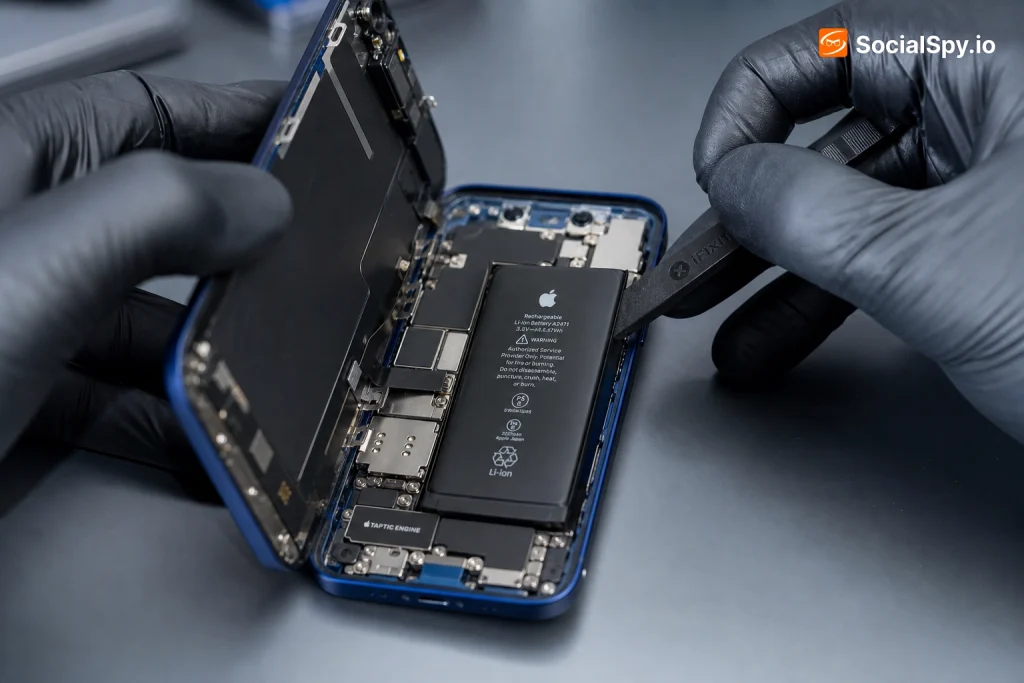
- Screen removal: The display is disconnected using suction and a spudger tool — on the Mini, this is a tighter process than larger iPhone models due to less internal clearance.
- Disconnecting components: Battery connector, taptic engine, and sometimes the earpiece speaker cable are unplugged to access the battery safely.
- Adhesive removal: The battery is held in with stretch-release adhesive strips; technicians pull these slowly to avoid flexing or puncturing the cell.
- New battery installation: A genuine or compatible replacement battery is seated, reconnected, and secured with fresh adhesive.
- Reassembly and calibration: Screen is resealed (often with new adhesive to maintain water resistance), and the phone is powered on to confirm Face ID, cameras, and battery health reporting all function normally.
- Software reset: Battery health percentage resets to reflect the new cell’s actual capacity, typically showing at or near 100%.
One overlooked detail: the iPhone 12 series, including the Mini, uses adhesive-sealed displays for water resistance. If a repair shop doesn’t replace that adhesive properly, the phone can lose its IP68 water resistance rating even though it looks fully reassembled.
Is It Worth Replacing an Aging iPhone 12 Mini’s Battery?
This is really a value-per-dollar question, and the math tends to favor repair for most owners. A new small-form-factor phone comparable to the Mini — Apple no longer makes one — would mean stepping up to a standard iPhone 16 starting around $799, a massive jump compared to a $99 battery swap.
- A battery replacement extends usable life by roughly 2–3 more years for typical daily use.
- Resale value on used marketplaces jumps noticeably when a listing states “battery health 100%, recently replaced.”
- Performance throttling caused by a degraded battery often gets misdiagnosed as the phone being “just old,” when a fresh battery alone restores much of the snappiness.
The Mini remains one of the last true compact flagship phones ever made, since Apple discontinued the mini form factor after the iPhone 13 Mini. For owners who specifically love the small size, there’s genuinely no direct upgrade path in Apple’s current lineup — making battery replacement the only way to keep that form factor alive.
Conclusion
The iPhone 12 Mini’s small battery was always its biggest tradeoff for its beloved compact size, and years later that tradeoff is catching up with early adopters. The good news is that fixing it is neither expensive nor complicated relative to other smartphone repairs — $99 through Apple, or often under $70 through a trusted independent shop, with the job usually done in under an hour. Given that Apple has permanently retired the mini form factor, a battery swap isn’t just a repair — for many owners, it’s the only way to keep using the phone they actually still prefer.
FAQ
Check Settings > Battery > Battery Health & Charging. If Maximum Capacity reads below 80%, or you see a “Peak Performance Capability” message, that’s Apple’s own signal that a replacement is warranted rather than a charging habit issue.
Getting it done through Apple or an Apple Authorized Service Provider with a genuine part has no negative effect on warranty or resale — in fact it typically boosts resale value. Using a non-genuine battery through some third-party shops can trigger a permanent “unable to verify battery health” notice in iOS, which is worth asking about before you book.
Yes, through Apple’s Self Service Repair program, but it requires renting specialty tools and carefully handling a lithium-ion cell during removal, which carries real safety risk if adhesive pull tabs are mishandled. Most owners without prior repair experience are better off paying the modest premium for a professional to do it in under an hour.