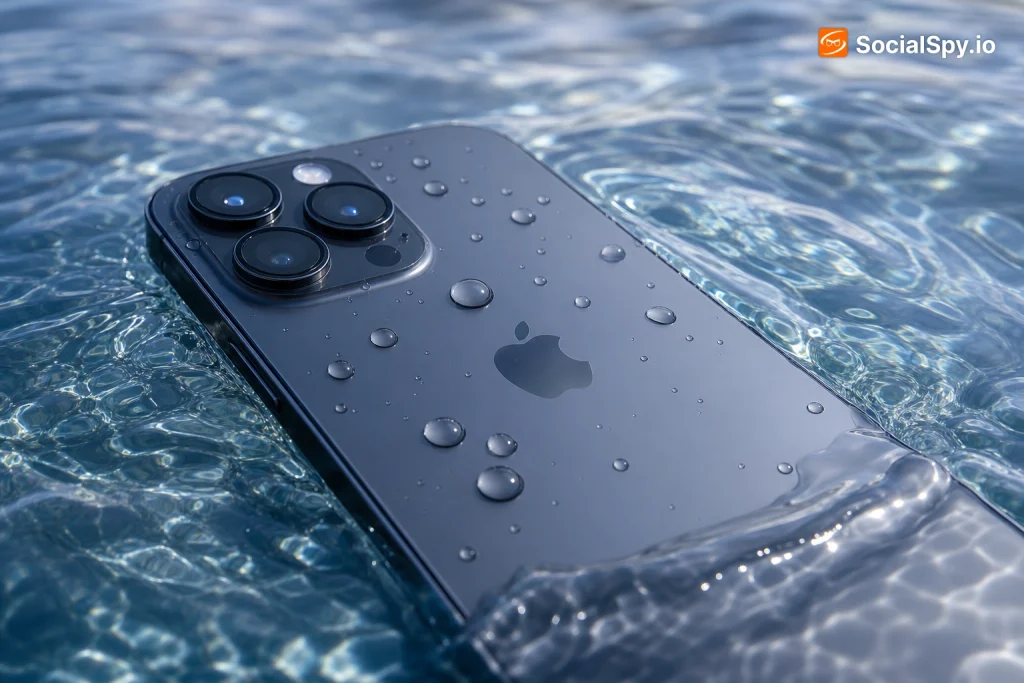
The iPhone 14 Pro Max is now several years into its life cycle, which means a lot of units are living second lives at the beach, on boats, and next to pool decks. Before you trust it near water, it’s worth understanding exactly what Apple’s marketing promises versus what actually happens when your phone takes a dunk. The distinction between “water resistant” and “waterproof” isn’t just semantics — it determines whether your warranty holds up and whether your phone survives.
What “IP68” Actually Means on Paper
Apple rates the iPhone 14 Pro Max at IP68 under the international standard IEC 60529. That “IP” code breaks into two numbers, and each one tells you something different.
- First digit (6): the highest possible rating for solid particle protection, meaning it’s fully dust-tight against sand, dirt, and lint.
- Second digit (8): protection against continuous submersion beyond 1 meter, with Apple specifying its own internal benchmark rather than a fixed industry number.
- Apple’s specific claim: submersion to a maximum depth of 6 meters for up to 30 minutes, tested in a controlled lab with static, still fresh water at room temperature.
That last bullet is the key detail most people skip. IP68 isn’t one universal test — manufacturers choose the depth and duration they want to certify, then submit that spec. Samsung’s Galaxy S-series phones, for comparison, are also IP68 but rated only to 1.5 meters for 30 minutes, which is a meaningfully lower bar than Apple’s 6-meter claim. On paper, the iPhone 14 Pro Max actually has one of the more aggressive water resistance ratings in the smartphone industry.
Why “Resistant” and “Proof” Are Legally Different Words
Apple never uses the word “waterproof” anywhere in its marketing or support documentation, and that’s intentional. No consumer electronics company legally claims a phone is fully waterproof, because doing so would create warranty and liability obligations they can’t guarantee.
Apple’s own support page states plainly that liquid damage isn’t covered under the standard limited warranty, and that water resistance “may decrease as a result of normal wear.”
Here’s what actually degrades that seal over time:
- Drops and impacts — even minor ones can compress or crack the internal gaskets and adhesive seals.
- Repeated exposure — the more times water touches the seams, the more the rubber gaskets compress and lose elasticity.
- Charging port corrosion — mineral deposits from repeated water exposure build up in the Lightning port over months.
- Screen or back glass repairs — any third-party repair that isn’t done with OEM adhesive breaks the factory seal entirely.
- Battery swelling — an aging or swollen battery, a known issue that eventually prompts owners to look at iPhone 14 Pro Max battery replacement cost and what to expect, can physically push against internal seals from the inside.
That last point matters more than people realize. A phone that was perfectly water resistant on day one might have noticeably weaker sealing by year three, purely from thermal cycling and battery expansion, with no visible external damage at all.
What Actually Happens When You Submerge It
Lab conditions and real life rarely match. Apple’s 30-minute, 6-meter test happens in still, clean, room-temperature fresh water — a scenario almost nobody replicates in daily use.
Situations that are genuinely low-risk
- A splash from a sink, rain, or spilled coffee
- Accidentally dropping it in a toilet bowl and grabbing it within seconds
- A quick dunk in a pool at the shallow end for a photo
Situations that regularly cause damage despite the IP68 rating
- Saltwater exposure — ocean water is corrosive and not part of Apple’s test parameters at all; salt residue attacks connectors and speaker mesh
- Chlorinated pool water — chlorine and other pool chemicals accelerate gasket degradation faster than fresh water
- Hot tubs and hot water — heat causes internal components to expand and contract, which stresses seals; Apple explicitly warns against this
- High-pressure water — pressure washing, jet skiing, or diving off a board creates forces far beyond a “static submersion” test
- Carbonated or sugary liquids — soda and juice leave residue that speaker grilles and ports can’t dry out on their own
A common misconception is that because the phone survived one pool dunk, it’ll survive the next one too. In reality, water resistance is a diminishing resource, not a permanent feature — every exposure event is essentially spending down a battery of protection that never fully recharges.
Comparing the iPhone 14 Pro Max to Other Generations
Water resistance has quietly improved across iPhone generations, even though Apple rarely highlights it as a headline feature. Here’s how the 14 Pro Max stacks up against its neighbors in the lineup.
| Model | IP Rating | Max Depth/Time (Apple’s spec) |
|---|---|---|
| iPhone 11 Pro Max | IP68 | 4 meters / 30 minutes |
| iPhone 12 Pro Max | IP68 | 6 meters / 30 minutes |
| iPhone 13 Pro Max | IP68 | 6 meters / 30 minutes |
| iPhone 14 Pro Max | IP68 | 6 meters / 30 minutes |
| iPhone 15 Pro Max | IP68 | 6 meters / 30 minutes |
| iPhone 16 Pro Max | IP68 | 6 meters / 30 minutes |
| iPhone 17 Pro Max | IP68 | 6 meters / 30 minutes |
Interestingly, the depth rating plateaued starting with the iPhone 12 Pro Max and has stayed at 6 meters through the current iPhone 17 Pro Max generation. Apple hasn’t pushed the number higher likely because 6 meters already exceeds what any realistic consumer scenario demands, and pushing further would require design tradeoffs — thicker seals, more internal space dedicated to gaskets — that conflict with making phones thinner.
If you’re weighing whether to hang onto an older 14 Pro Max or upgrade, know that water resistance genuinely isn’t a differentiator worth chasing across recent generations — it’s been essentially identical for five straight years of Pro Max models.
What To Do If Your iPhone 14 Pro Max Gets Wet
Apple has specific, documented steps for handling liquid exposure, and skipping them is the most common reason people end up with a permanently damaged phone.
- Do not charge it immediately. Charging while there’s still moisture near the Lightning port is the single biggest cause of corrosion and short circuits.
- Do not put it in rice. This popular myth doesn’t actually pull moisture out effectively, and rice dust can clog the ports further.
- Tap it gently, speaker-down, to release trapped water. iOS has a built-in liquid detection alert that will warn you and suggest this.
- Leave it in a dry, room-temperature spot for at least 24 hours before attempting to charge again.
- Watch for the “Charging Not Available” or liquid detection warning in the Lightning connector, which iOS displays automatically when moisture sensors are triggered.
- If problems persist after drying, get it looked at professionally rather than continuing to try charging it repeatedly.
Ignoring the liquid-detection warning and force-charging anyway is exactly how a survivable splash turns into a dead logic board. That warning exists because Apple’s engineers know the port sensors detect moisture more reliably than a visual check ever could.
The Warranty Reality Nobody Reads Until It’s Too Late
This is the part that catches even careful owners off guard. AppleCare+ and the standard one-year limited warranty explicitly exclude liquid damage from coverage — full stop, regardless of the IP68 rating.
- Standard warranty: Liquid damage voids coverage entirely; Apple’s diagnostic tools include liquid contact indicators (LCIs) inside the phone that turn red or pink when triggered by moisture.
- AppleCare+ without theft/loss: Covers “accidental damage from handling,” which does include liquid damage, but each incident carries a service fee (commonly around $99 for the Pro Max tier as of 2026 pricing).
- No AppleCare+ at all: Out-of-pocket liquid damage repair or replacement can run several hundred dollars, and in many cases Apple will simply recommend replacement over repair for extensively water-damaged units.
This is worth remembering if you’re also dealing with other aging-hardware issues on the same device. Someone budgeting for something like an iPhone 14 Pro battery replacement cost should factor in that a battery swap technically requires opening the sealed chassis, which — even done correctly by Apple or an authorized provider — can subtly affect long-term water sealing if it isn’t re-sealed with genuine adhesive.
Practical Ways to Protect It Better Than the Factory Seal Alone
If you genuinely spend time near water — boating, beach days, kayaking — the IP68 rating shouldn’t be your only line of defense. A few additions meaningfully reduce risk.
- A rugged waterproof case rated IP68 or higher independently, such as options built for extreme conditions, which adds a second physical barrier beyond Apple’s internal seals.
- A dedicated waterproof pouch for actual submersion activities like swimming, snorkeling, or paddleboarding, since no bare phone should be fully submerged intentionally even within the “safe” 30-minute window.
- Port covers or a case with sealed port flaps to reduce saltwater and sand intrusion into the Lightning port specifically.
- Choosing a case designed for older, larger form factors properly — as covered in guides like what cases work on the iPhone 11 Pro Max, fit and seal quality vary a lot between case brands even when they claim the same protection rating.
None of these turn the phone into something truly waterproof, but they buy meaningful margin for error on top of a rating that’s already degrading with age.
Conclusion
The iPhone 14 Pro Max earns its IP68 rating honestly — a 6-meter, 30-minute fresh water tolerance is genuinely strong for a consumer smartphone, and it will survive the vast majority of real-world accidents like a dropped call in the rain or a slip into a sink. But “resistant” was never meant to imply invincibility, and Apple’s own warranty terms make that distinction explicit by excluding liquid damage from free coverage. Treat the rating as a safety net for accidents, not a green light for intentional water exposure, especially as the phone ages and its internal seals inevitably wear down from drops, repairs, and years of thermal cycling.
FAQ
No, Apple explicitly advises against swimming, snorkeling, or any deliberate submersion, even though the IP68 rating technically covers brief submersion up to 6 meters. Chlorinated pool water, ocean saltwater, and water pressure from swimming motions all fall outside the controlled lab conditions Apple used for its rating.
Yes, liquid damage is excluded from Apple’s standard one-year limited warranty regardless of the phone’s IP68 rating, and Apple’s technicians use internal liquid contact indicators to detect moisture exposure during diagnostics. AppleCare+ can cover liquid damage repairs, but only as an accidental damage claim with a service fee, not as a warranty-covered repair.
Yes, water resistance is not permanent and degrades over time due to factors like gasket compression from drops, port corrosion, and wear on internal seals. Any third-party screen or battery repair that doesn’t use genuine Apple adhesive during reassembly can also significantly weaken or eliminate the original water resistance entirely.