The iPhone 14 Pro Max is now old enough that its 4,323mAh battery is starting to show real wear for early adopters, especially anyone who bought one at launch back in September 2022. If your battery health has dipped below 80% or your phone is shutting down at 20%, a replacement is likely the cheapest fix you’ll ever make to this device.
How Much Does It Actually Cost?
Pricing for this repair varies more than most people expect, and the gap between options can be $50 or more. Apple’s official pricing sits at the top of the market, while independent shops and DIY routes undercut it significantly.
| Repair Option | Typical Cost | Turnaround |
|---|---|---|
| Apple Store / Apple Authorized Service Provider | $99 | Same day to 1-2 days |
| Independent repair shop (e.g., uBreakiFix, local shops) | $60–$90 | 30–60 minutes |
| Mail-in third-party service | $50–$80 (plus shipping) | 3–7 business days |
| DIY replacement kit (iFixit, etc.) | $40–$70 | Same day, self-performed |
| AppleCare+ battery service (if battery health under 80%) | Free | Same day to 1-2 days |
A few pricing details worth knowing before you commit:
- Apple’s $99 flat rate applies to every iPhone 14 series model, from the base iPhone 14 up through the Pro Max — Apple doesn’t charge more for the bigger battery.
- If you have AppleCare+, battery replacement is free whenever Apple’s own diagnostic shows health has degraded to below 80% of original capacity, which is the exact threshold most people hit around 500-600 charge cycles.
- Independent shops sometimes advertise prices as low as $50, but that often reflects an aftermarket battery with a different cell chemistry or capacity rating than Apple’s own component.
- Taxes and diagnostic fees can add another $5-$15 on top of quoted prices, particularly at big-box repair chains.
Industry repair-cost trackers consistently place the iPhone 14 Pro Max battery swap in the same $99 bracket as the iPhone 13 Pro and iPhone 14 Pro, since Apple standardizes labor pricing across recent Pro-tier models rather than pricing by battery capacity.
Signs You Actually Need a New Battery
Not every performance dip means your battery is dying — but a specific pattern of symptoms is a reliable signal. Before paying for a replacement, confirm the problem is actually the battery and not iOS software behavior, a rogue app, or a charging cable issue.
Check these indicators first:
- Battery Health percentage — Go to Settings > Battery > Battery Health & Charging. Apple considers anything below 80% maximum capacity as degraded enough to warrant replacement.
- Peak Performance Capability warning — If iOS displays a message saying your battery “can no longer supply enough power,” that’s Apple’s own software throttling kicking in.
- Unexpected shutdowns — The phone powers off at 20-30% remaining even though the percentage indicator shows charge left.
- Rapid drain under normal use — Losing 15-20% battery in an hour of light use (texting, browsing) rather than heavy tasks like gaming or navigation.
- Physical swelling — A back glass panel that looks slightly raised or a screen that pops up at the edges is a serious warning sign and needs immediate attention, not a wait-and-see approach.
If you’re only seeing one of these symptoms occasionally, it might not be battery-related yet. But two or more happening consistently over a few weeks is a strong case for replacement.
Apple Store vs. Third-Party: What You’re Really Choosing Between
This decision comes down to trusting Apple’s ecosystem controls versus prioritizing cost and speed. Each path has real tradeoffs that go beyond just price.
Going Through Apple
Apple uses genuine parts with a battery serial number that pairs to your phone’s logic board, which means Battery Health reporting continues working accurately after the swap. You also get a 90-day warranty on the repair, or coverage extends further if you’re still under AppleCare+.
The tradeoff is availability and time. Apple Stores don’t always stock every battery on-site, and Genius Bar appointments in dense metro areas can be booked out several days in advance.
Going Third-Party
Independent shops and mail-in services are usually faster and cheaper, and reputable chains like uBreakiFix (an Asurion-owned company that’s an Apple Authorized Service Provider) actually use Apple-sourced parts too. That’s an important distinction — not all third-party repair is “aftermarket.”
The catch is quality control varies wildly between smaller independent shops. Watch for these red flags:
- Batteries with no visible mAh rating or brand markings on the packaging
- Shops unwilling to show you the physical battery before installation
- No written warranty on labor or parts (30-90 days should be standard)
- Suspiciously low prices under $50 total, which usually signals a low-grade cell
If you’re comparing this repair across the broader iPhone 14 lineup, it’s worth noting the Pro Max, Pro, and Plus models share nearly identical repair pricing and procedures despite their different battery capacities, since Apple’s labor rate is standardized rather than tied to component size.
What Actually Happens During the Repair
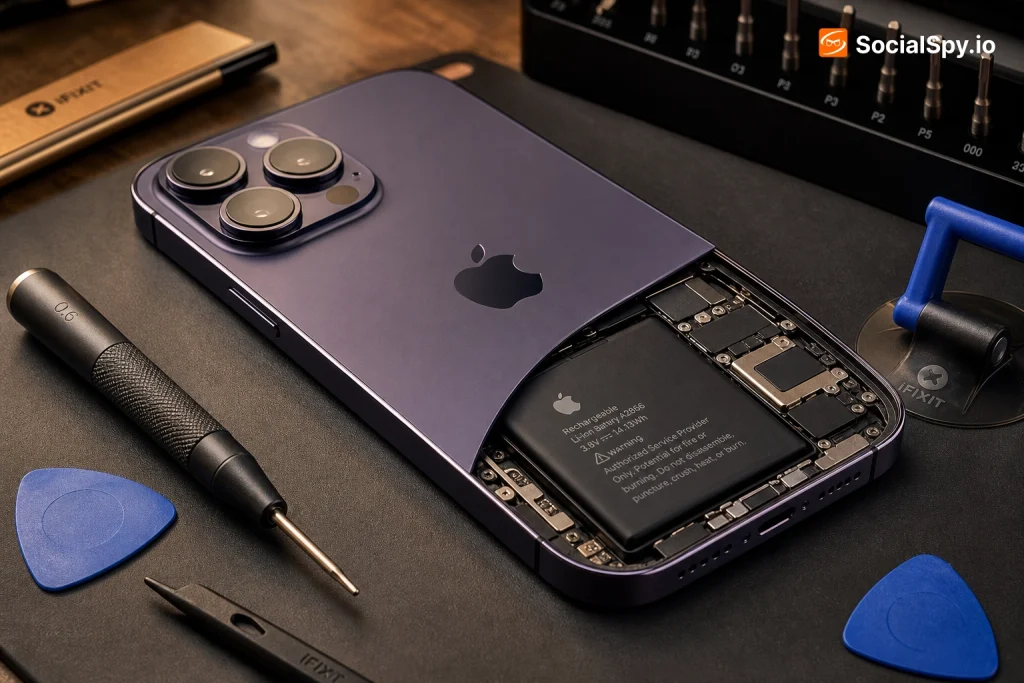
The iPhone 14 series introduced a redesigned internal chassis specifically to make battery service faster — a detail Apple doesn’t advertise much but that repair technicians noticed immediately. Unlike the iPhone 13 line, the 14 Pro Max’s rear glass can be removed and the battery accessed without desoldering as many components.
Here’s the general repair sequence at an authorized service location:
- Diagnostic check — Technician runs Apple’s diagnostic software to confirm battery health and rule out other causes of the symptoms.
- Back glass removal — The rear panel is heated and lifted using specialized suction tools, since it’s adhesive-mounted rather than screwed in.
- Battery disconnection — The battery connector is unplugged from the logic board before physical removal to prevent short circuits.
- Adhesive strip pull — New iPhones use stretch-release adhesive strips; pulling these correctly is the single biggest factor in a clean, damage-free removal.
- New battery installation and pairing — The replacement battery is seated, reconnected, and paired with the logic board so Battery Health data displays correctly going forward.
- Back glass resealing — New adhesive is applied and the back glass is pressed back into place, sometimes with clamps or weighted fixtures during curing.
- Software verification — A final check confirms the phone recognizes the new battery and reports 100% health with no service warnings.
A properly executed repair should leave zero trace of a “genuine parts” warning banner in Settings > Battery — if you see that message after a third-party repair, it means the new battery didn’t pair correctly with the logic board’s authentication chip.
This pairing step is unique to iPhones from the XS generation onward, and it’s the reason some third-party repairs trigger a persistent “Unknown Part” notification even when a perfectly good battery was installed. It’s cosmetic and doesn’t affect charging or performance, but it’s worth asking your repair shop about before you commit.
Is It Worth Repairing vs. Buying a New iPhone?
This is the real financial question most people are actually asking. At $99, a battery swap is almost always the better value compared to upgrading, provided the rest of your phone is functioning well.
Consider the math:
- A new iPhone 16 Pro Max starts at $1,199.
- A used or refurbished iPhone 14 Pro Max in good condition typically sells for $550-$700 depending on storage and carrier lock status.
- A $99 battery replacement restores your existing phone to near-original performance for roughly 8-15% of the cost of a new device.
The math changes only if your phone has other significant issues — a cracked screen needing $329 out-of-warranty repair, water damage, or a camera module failure. In those cases, stacking multiple repairs can approach the resale value of the device itself, and trading in toward a newer model starts to make more sense.
It’s also worth comparing this to older models in Apple’s lineup, since battery degradation timelines follow a predictable pattern across generations. Owners of an iPhone 11 Pro Max, for instance, are now several years past the typical 2-3 year mark where battery replacement becomes necessary, and many are choosing between one more $99 repair or finally upgrading.
Here’s a rough framework for deciding:
- Repair if: the phone is otherwise fully functional, you like the camera system and size, and you plan to keep it 1-2 more years.
- Upgrade if: you’re also dealing with storage limitations, a damaged screen, or you want newer features like Apple Intelligence support that older A16 Bionic chips can’t fully run.
- Sell and upgrade if: your current resale value is still strong (typically within 2 years of a device’s release) and a trade-in credit would meaningfully offset a new purchase.
Conclusion
A battery replacement on the iPhone 14 Pro Max is one of the rare tech repairs where the economics are genuinely straightforward: $99 through Apple buys you a warrantied fix that can extend the phone’s useful life by years, at a fraction of what a new device costs. The bigger decision isn’t whether to repair — it’s where.
If you have AppleCare+, get the free replacement through Apple without hesitation. If you’re paying out of pocket and want speed and savings, an Apple Authorized Service Provider like uBreakiFix offers a strong middle ground, using genuine or Apple-sourced parts at prices below the Apple Store while still keeping your Battery Health reporting accurate. Reserve DIY kits for people genuinely comfortable working around lithium-ion cells and adhesive-mounted glass, since a punctured battery pouch is a real fire risk, not just a repair inconvenience.
FAQ
At an Apple Store or Authorized Service Provider, the repair itself typically takes 30 to 45 minutes if parts are in stock, though you may need to drop the phone off for a few hours during busy periods. Mail-in services take longer, generally 3 to 7 business days including shipping time in both directions.
No, a standard battery replacement doesn’t touch your data, iCloud settings, or installed apps since the repair only involves the battery and internal chassis components. It’s still smart practice to back up via iCloud or a computer beforehand, simply as a precaution in case of any unrelated technical issue during the repair.
Genuine Apple repairs performed by Apple or an Authorized Service Provider preserve Face ID functionality and reapply factory-spec seals to maintain the phone’s water resistance rating. Lower-quality third-party repairs sometimes skip proper adhesive resealing, which can compromise the IP68 water resistance rating even if the battery itself works fine.