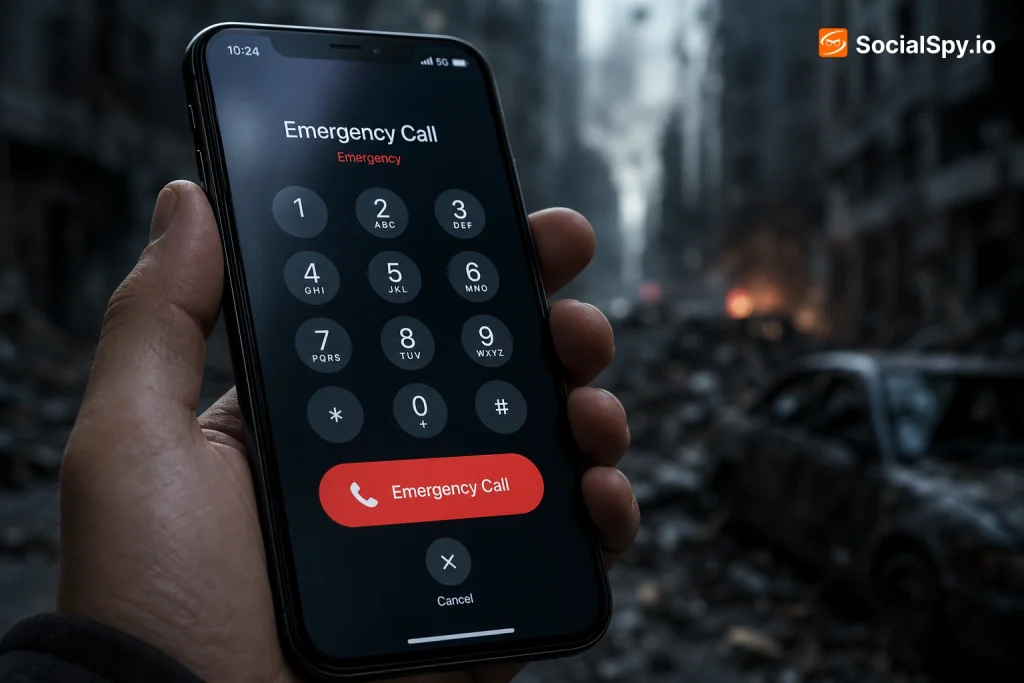
Dial 911 on a phone with no active plan, no SIM card in some cases, and no bars showing on the screen, and it still goes through. This isn’t a glitch or a workaround people have discovered — it’s baked into federal law and how cellular networks are engineered to behave in emergencies. Understanding why reveals a lot about how much invisible infrastructure exists purely to make sure a phone can reach help when someone needs it most.
The Federal Rule That Makes This Possible
The core reason has nothing to do with generosity from carriers. It’s law.
Since the mid-1990s, the Federal Communications Commission has required every wireless carrier operating in the United States to complete 911 calls without checking billing status first. The current version lives in 47 CFR § 20.18, the FCC’s E911 rule set, which explicitly states that carriers “must transmit all wireless 911 calls” to the appropriate emergency dispatch center regardless of whether the caller subscribes to that network.
That means a phone doesn’t need to be on Verizon’s network to call 911 through a Verizon tower. If your carrier is AT&T but you’re standing somewhere with only T-Mobile signal, your phone will still latch onto that T-Mobile tower and push the call through.
- The rule applies to all facilities-based wireless carriers, not just the “Big Three” of AT&T, Verizon, and T-Mobile.
- It covers prepaid phones, expired contracts, and suspended accounts for nonpayment.
- Dispatch centers (called PSAPs, or Public Safety Answering Points) receive these calls the same way regardless of which network routed them.
Industry regulators have described this as one of the few areas of telecom where competitive network boundaries are legally required to dissolve — your phone is allowed to “roam” onto a rival’s infrastructure for exactly one purpose.
How Your Phone Actually Finds a Signal to Use
Every modern phone constantly scans for available cell towers, even ones it isn’t authorized to bill through. This is the same background process that lets your phone show an “SOS” or “Emergency Calls Only” label instead of your carrier’s name when you’ve lost normal coverage.
Here’s what’s happening technically:
- Your phone’s baseband radio continuously searches for network signals in range, not just your home carrier’s.
- If it can’t find your carrier but detects another compatible network, it flags itself as capable of emergency-only service.
- When you dial 911, the phone negotiates a temporary, stripped-down connection to that foreign network solely for routing the call.
- The receiving carrier’s infrastructure recognizes the 911 destination and forwards it to the nearest PSAP based on your approximate location.
This is why you sometimes see “SOS” pop up on an iPhone in a rural dead zone — the device found a distant signal too weak for normal calls or data, but strong enough to push through the higher-priority emergency call.
Interestingly, 911 calls also get priority queuing on cell towers. If a tower is congested during a mass event — a hurricane evacuation, a stadium crowd — emergency calls are designed to jump ahead of ordinary voice and data traffic.
“No Service” Isn’t the Same as “No Signal”
This distinction trips up a lot of people, and it matters because it explains the real limits of the 911 exception.
| Phone status | Can it call 911? | Why |
|---|---|---|
| Active plan, full bars | Yes | Normal network access |
| Suspended account, nonpayment | Yes | Radio still finds a signal; billing status is irrelevant per FCC rule |
| Expired prepaid plan, old device | Usually yes | Works as long as some carrier’s tower is within range |
| Airplane mode | No (unless manually re-enabled) | Radio is deliberately powered off |
| Phone completely dead/off | No | No radio means no connection to anything |
| Truly zero signal from any carrier | No | There’s simply nothing for the radio to latch onto |
The phrase “no service” on your screen usually just means your specific carrier isn’t reachable — it doesn’t mean every tower in the area is out of range. That’s the loophole that makes emergency-only calling possible in the first place.
Rural areas, national parks, and mountainous regions are where this distinction actually fails people. If literally no carrier has infrastructure nearby — a real problem across large stretches of the Mountain West and Alaska — the 911 exception can’t manufacture a signal that doesn’t exist.
Lock Screens, VoIP, and the Location Problem
There’s a security angle here that most people never think about. Phones are designed so the 911 dial pad is always reachable from a locked screen, bypassing PIN codes, fingerprint locks, and passwords entirely.
That’s an intentional trade-off between security and safety. It’s the same tension discussed in the basics of two-factor authentication and why you need it — security layers exist to keep unauthorized people out, but emergency access is treated as important enough to punch a deliberate hole through that protection.
VoIP and Wi-Fi calling complicate the picture further:
- Wi-Fi Calling lets your phone route a 911 call over an internet connection when cellular signal is absent, but only if you’ve previously registered a physical address with your carrier for location purposes.
- Nomadic VoIP services (like a home internet-based phone line you can plug in anywhere) require you to manually update your registered address, or 911 dispatchers may send responders to the wrong location entirely.
- Real-Time Text (RTT) has started replacing old TTY systems for deaf and hard-of-hearing users, letting them text 911 directly through carrier networks in many metro areas.
Because emergency VoIP calls travel over the open internet rather than dedicated carrier infrastructure, the broader question of what’s actually protecting that connection becomes relevant — a topic covered in more general terms in VPN vs antivirus: what you actually need to stay safe online. The emergency call itself isn’t at meaningful risk, but the same Wi-Fi network carrying it is also carrying everything else you do on that device.
The Old-Phone Loophole and Its Unintended Consequences
For decades, a well-known practical use of this rule was the “911-only phone” — an old, deactivated cell phone kept in a car glovebox or given to a child, useful for nothing except dialing emergency services.
Domestic violence shelters and nonprofits have historically collected donated used phones specifically for this purpose, handing them to survivors who needed a way to call for help without a paid line. It worked because the FCC’s rule didn’t originally distinguish between phones with an expired plan and phones that had never had a plan (called “non-service-initialized” devices).
That changed over time. The FCC revisited the rule because non-service-initialized phones became a magnet for abuse:
- Prank callers used never-activated phones knowing they couldn’t be billed or easily traced.
- Dispatch centers reported spikes in false or repeated hoax calls from these untraceable devices.
- Some jurisdictions pushed back on the operational burden this placed on already-strained PSAP staffing.
As of 2026, the emergency-calling requirement for phones with an established (even if lapsed) account remains firmly intact nationwide. The narrower carve-out for phones that were never activated on any network has become inconsistent state to state, and some carriers now block 911 access on devices that show no activation history at all, specifically to curb hoax-call abuse. If you’re relying on an old phone as a backup emergency device, it’s worth confirming it was activated on a real account at some point rather than assuming any old phone works.
Limitations Everyone Should Actually Know
The 911 rule is powerful, but it isn’t magic, and treating it as a guaranteed fallback can create dangerous overconfidence.
- A dead battery kills everything. No amount of regulation makes a powered-off phone reach a tower.
- Location accuracy varies wildly. Indoor calls, calls from VoIP lines, and calls from rural cell sites can produce location estimates off by hundreds of feet to several miles. Advanced Mobile Location (AML) technology, now built into most modern Android and iOS devices, has dramatically improved this by pushing GPS coordinates directly to dispatchers, but it isn’t universal on older hardware.
- Text-to-911 is not available everywhere. Roughly a majority of U.S. counties support it as of 2026, but plenty of rural PSAPs still can’t receive emergency texts, only voice calls.
- Satellite SOS features (Apple, Google Pixel, some newer Android flagships) are not the same system. These route through satellite messaging partnerships, not the traditional cellular 911 pathway, and typically relay through a third-party call center before reaching local dispatch.
- International travelers should not assume US rules apply abroad. Most countries have equivalent obligations (112 across the EU, for instance), but the technical implementation, hoax-call tolerance, and non-activated-device policies differ by country.
Conclusion
The reason you don’t need service to call 911 isn’t a hidden feature or industry goodwill — it’s a decades-old federal mandate that treats emergency access as a public safety utility rather than a commercial product. Carriers are legally obligated to let any phone, on any compatible network, push an emergency call through regardless of who’s paying the bill. That said, the system depends entirely on physical signal availability and a charged, powered-on device; it can’t conjure coverage where none exists, and the old “any dead phone works” assumption is no longer reliably true given tightened rules around never-activated devices. The safest approach is simple: keep at least one phone charged and previously activated on a real account, know that “SOS” mode means you’re on borrowed network access, and don’t assume text-to-911 will work everywhere you travel.
FAQ
In most cases, yes for guaranteed reliability — modern carrier networks are built to authenticate emergency calls through SIM-based device records, and many carriers now restrict 911 access on phones that show no activation history at all. A phone that was previously activated on a real plan, even if that plan has since expired or been suspended, will almost always still be able to reach 911.
“SOS” or “Emergency Calls Only” means your phone can’t find your actual carrier’s network but has detected a signal from a different, compatible carrier’s tower strong enough for a basic emergency connection. It’s a visual cue that you’re on borrowed, limited access rather than your normal cellular service, so data and regular calls likely won’t work even though 911 will.
It depends on whether that phone was ever activated on a real account in the past. If it was, federal rules generally still require carriers to complete the 911 call using any available signal; if the phone has never been activated on any carrier (a “non-service-initialized” device), growing concerns about hoax calls mean some carriers and jurisdictions now block or limit that access, so it’s no longer a guaranteed fallback.