The iPhone X turned six years old in 2023, and its 2,716mAh battery is well past the point where most units still hold a full charge. If your phone is suddenly dying at 40% or throttling performance under load, a battery swap is almost certainly the fix — and it’s far cheaper than most people assume.
Why iPhone X Batteries Degrade So Fast
Apple’s lithium-ion batteries are rated for roughly 500 complete charge cycles before they drop to about 80% of original capacity. For a phone released in November 2017, that threshold isn’t theoretical anymore — most iPhone X units have logged well over 1,000 cycles by now.
You can check your own battery’s health without any tools:
- Go to Settings > Battery > Battery Health & Charging
- Look at the Maximum Capacity percentage
- Anything below 80% is Apple’s own cutoff for “battery service recommended”
- If you see the message “Peak Performance Capability” with a warning icon, iOS has already throttled your CPU to prevent shutdowns
Apple’s internal data shows a battery at 80% capacity delivers noticeably shorter screen-on time and is more prone to sudden shutdowns under heavy load, like gaming or GPS navigation.
The iPhone X is particularly prone to this because its battery is smaller than later models like the iPhone XS Max or iPhone 11 Pro, packed into a tighter chassis around the dual-camera module and Face ID sensor array. Less physical battery capacity means each charge cycle represents a larger percentage swing, which accelerates the chemical wear on the cells.
What Apple Actually Charges
Apple’s official pricing structure hasn’t moved much since 2018, when the company standardized battery service costs across most iPhone models after the “batterygate” controversy over performance throttling.
| Service Type | Cost | Coverage |
|---|---|---|
| Out-of-warranty replacement | $69 | Apple Store or mail-in |
| Under AppleCare+ (capacity below 80%) | $0 | Free replacement |
| Under standard warranty defect claim | $0 | Rare — only if battery is defective, not just worn |
| Apple Store walk-in with appointment | $69 | Same-day in most cases |
The $69 price point applies specifically to the iPhone X, iPhone 8, and iPhone 8 Plus tier. Larger or newer models like the iPhone 14 Pro Max run closer to $99, so the X actually sits on the cheaper end of Apple’s current lineup.
AppleCare+ Changes Everything
If you still have active AppleCare+ coverage on a six-year-old iPhone X, you’ve either paid for extended coverage repeatedly or purchased it as part of a device protection bundle. Under that plan, Apple replaces the battery for free the moment Maximum Capacity drops below 80%, with no service fee.
Most iPhone X owners in 2024 are well past their AppleCare+ window, since Apple only sold extended AppleCare+ terms for up to 3 years past purchase on this model. That means the vast majority of people reading this are looking at the standard $69 out-of-warranty rate.
Apple Store vs. Independent Repair Shops
This is where the real cost-versus-risk decision happens. Apple’s $69 price includes genuine parts, a warranty on the repair, and technicians certified through Apple’s Independent Repair Provider or Apple Authorized Service Provider programs.
Third-party shops — think local repair chains, mall kiosks, or mail-in services like uBreakiFix (which Asurion now owns and which is also an Apple Authorized Service Provider) — often undercut that price.
- Apple Store / Apple Authorized Service Provider: $69, genuine Apple battery, 90-day warranty on parts and labor
- Independent local shop: $40-$60, often aftermarket battery, warranty varies from 30 days to 1 year
- Mail-in third-party services: $45-$70, turnaround of 3-7 business days including shipping
- DIY kits (iFixit, etc.): $25-$35 for the battery itself, no warranty beyond the parts seller’s return policy
A cheaper aftermarket battery isn’t automatically a bad choice — plenty of iPhone X owners have run non-Apple batteries for years without issue. The tradeoff is you lose the battery health percentage display in iOS, since Apple’s software flags non-genuine batteries with an “Unknown Part” warning starting in iOS 13 and later.
That “Unknown Part” message doesn’t disable the phone, but it does remove your ability to see a precise Maximum Capacity number in Settings, which makes it harder to know when the replacement battery itself starts wearing out.
What Actually Happens During the Repair
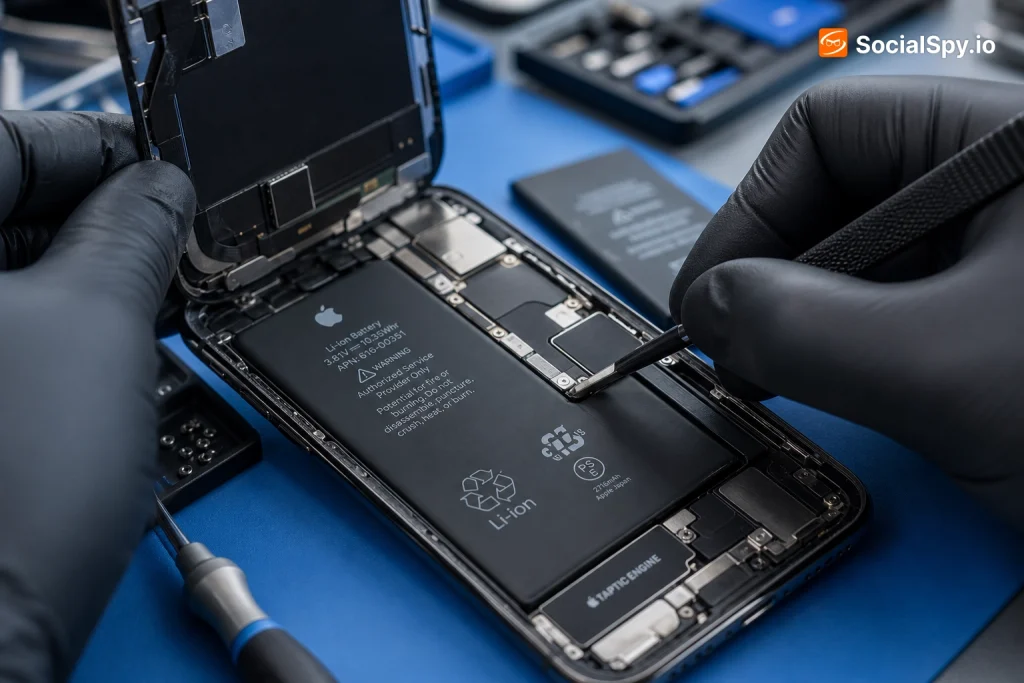
The iPhone X battery replacement is more involved than earlier iPhone models because of the dual-cell L-shaped battery design Apple introduced to maximize capacity inside the notch-era body. It also has adhesive strips instead of a simple slide-out tray.
The Apple Store Process
- You book an appointment through the Apple Support app or apple.com/support, selecting “Battery, Power and Charging” as the issue
- A Genius runs a diagnostic on your device, checking battery health, screen condition, and for any prior unauthorized repairs
- If eligible, the phone is either serviced same-day (roughly 30-45 minutes) or sent to a repair depot, taking 3-5 business days
- Your data isn’t touched — no backup is required since the logic board isn’t replaced
- You get a loaner or your original phone back with a fresh battery and reset Maximum Capacity showing 100%
The Independent Shop Process
Third-party technicians follow a similar physical procedure but without Apple’s diagnostic software:
- Powering down the device and removing two pentalobe screws at the bottom
- Heating the display assembly to loosen adhesive, then lifting it on a hinge (not fully removing it, to protect the Face ID ribbon cables)
- Disconnecting the battery connector immediately to avoid short circuits
- Using adhesive stretch-release tabs (or isopropyl alcohol if tabs fail) to lift the old battery cells without puncturing them
- Installing the new battery, resealing with fresh adhesive strips, and testing Face ID and cameras before handing the phone back
The single biggest risk in this repair is the battery adhesive removal step. Puncturing a lithium-ion cell can cause it to swell, overheat, or in rare cases ignite — which is why reputable shops use proper stretch-release tabs rather than prying with metal tools.
Signs You Actually Need This Repair
Not every battery complaint means you need a full replacement. Here’s how to tell the difference between normal wear and a real problem.
- Sudden shutdowns at 20-30% battery: classic sign of a degraded battery unable to supply peak current
- Phone feels warm during normal use, not just gaming: could indicate a battery holding a poor charge or a failing charging IC — the latter isn’t fixed by a battery swap
- Battery drains fully overnight while off Wi-Fi and idle: check Settings > Battery for a rogue app first, since this is often software, not hardware
- Maximum Capacity reading below 80%: the clearest, most reliable indicator worth acting on
- Phone won’t hold charge above 50% even right after a full charge: strong case for immediate replacement
If your Maximum Capacity is still in the 85-95% range but you’re experiencing shutdowns, the problem might be something else entirely, like a failing charging port or corrosion from previous water exposure — a battery swap won’t fix that.
Is It Worth Fixing a Six-Year-Old Phone?
This is the real question most people are actually asking, and the honest answer depends on what else is going on with the device.
The iPhone X still runs current iOS updates reasonably well up through iOS 16, though Apple has already cut it off from iOS 17 and later, which launched in September 2023. That’s the more important ceiling to consider than the battery itself.
- Worth it if: the screen, cameras, and charging port are all functional, and you plan to use the phone as a backup, gift, or hand-me-down for at least another year
- Worth it if: you rely on iOS 16 features and don’t need the newer software-exclusive capabilities in iOS 17/18
- Not worth it if: you’re also dealing with a cracked screen (another $149-$329 at Apple) or a failing Face ID module, since combined repair costs can approach the price of a used iPhone 12 or 13
- Not worth it if: you need current security patches for banking or work apps, since Apple’s software support window has effectively closed on this model
For a phone with no other issues, spending $69 to get essentially a “new” battery and multiple more years of daily use is one of the best cost-to-benefit repairs in consumer electronics — comparable to putting new tires on a car that’s otherwise mechanically sound.
Conclusion
The math on an iPhone X battery replacement is refreshingly simple compared to most tech repair decisions. Sixty-nine dollars at Apple, or somewhat less at a reputable independent shop, buys you a device that behaves like it did on day one — no more mystery shutdowns, no more anxiously watching the percentage drop, no more carrying a battery pack everywhere.
The bigger question isn’t whether the battery repair is worth it in isolation — it almost always is. It’s whether the iPhone X as a platform still fits your needs given Apple ended iOS 17 support for it. If you’re using it as a secondary device, a kid’s first phone, or you simply don’t need the latest software features, a fresh battery can realistically add 2-3 more years of reliable service to a phone that already cost you nothing new to acquire.
FAQ
Apple charges $69 for an out-of-warranty battery replacement on the iPhone X, whether you go to a physical Apple Store or use their mail-in repair service. If you still have active AppleCare+ coverage and your battery health has dropped below 80% capacity, the replacement is free.
Yes, DIY replacement kits from retailers like iFixit cost roughly $25 to $35 and include the tools needed, but the repair is more delicate than older iPhones due to adhesive strips and a dual-cell battery design near the Face ID components. Most first-time DIYers should budget extra time and expect a real risk of damaging the display’s flex cables if they’re not careful during the opening step.
Yes, if a shop uses an aftermarket battery instead of a genuine Apple part, iOS will display an “Unknown Part” notice in the Battery Health settings menu. The phone still functions normally and charges fine, but you lose the precise Maximum Capacity percentage readout that helps you track future battery wear.