The iPhone 11 Pro turned six years old in 2025, and if yours still gets you through the day without hunting for an outlet by 3 p.m., you’re one of the lucky ones. For most owners, the original 3,046mAh battery has degraded well past the point of comfortable daily use, and a replacement has become less of an option and more of a necessity if you plan to keep the phone in rotation.
Signs Your iPhone 11 Pro Actually Needs a New Battery
Before spending anything, it’s worth confirming the battery is really the problem. Apple builds a diagnostic tool right into iOS that removes most of the guesswork.
Go to Settings > Battery > Battery Health & Charging. That screen shows a “Maximum Capacity” percentage, which compares your current battery’s ability to hold a charge against how it performed brand new.
- Above 85%: Battery is still performing reasonably well; degradation is mild.
- 80% to 85%: Noticeable capacity loss; you’ll likely feel the difference by mid-afternoon.
- Below 80%: Apple’s own threshold for “significantly degraded” — this is the point where a free replacement kicks in under AppleCare+ (more on that below).
- “Peak Performance Capability” showing a warning: Indicates the battery can no longer supply peak power reliably, which can cause unexpected shutdowns even with charge remaining.
Apple’s engineering spec states the iPhone 11 Pro battery is designed to retain up to 80% of its original capacity at 500 complete charge cycles under normal conditions — for most users, that milestone arrives somewhere between two and three years of daily use.
Other tell-tale symptoms include the phone shutting off unexpectedly at 20-30% battery, the device feeling unusually warm during normal use, or a battery percentage that drops in sudden chunks rather than gradually. If you’re seeing any of these alongside a Battery Health reading in the 70s or below, it’s time to replace it rather than keep nursing it along.
How Much Does It Actually Cost?
Pricing varies more than most people expect, and the cheapest option isn’t automatically the best value once you factor in quality control and turnaround time.
| Service Option | Typical Cost | Turnaround |
|---|---|---|
| Apple Store / Genius Bar | $69 | Same day (30-45 min if in stock) |
| Apple Mail-In Service | $69 + shipping | 5-7 business days |
| Independent Repair Provider (Apple-certified) | $65-$89 | Same day |
| Non-certified local repair shop | $50-$80 | Same day, sometimes walk-in |
| iFixit / DIY kit | $45-$70 (parts + tools) | Self-paced, 30-60 min |
Why the price jumped from earlier years
Apple’s out-of-warranty battery service for the iPhone 11 Pro sat at $49 for its first couple of years on the market. Apple raised out-of-warranty repair pricing across its lineup in 2022, pushing the iPhone 11 Pro battery fee to its current $69. That price has held steady since, even as newer iPhone models (like the 15 and 16 series) command $99-$100 for the same service due to more complex internal battery designs.
What that $69 actually includes
Apple’s flat fee covers:
- A genuine Apple battery cell matched to the iPhone 11 Pro’s internal specs.
- Labor and reassembly, including replacement of the stretch-release adhesive strips that hold the battery to the case.
- A fresh IP68 water-resistance seal reapplied around affected components (though Apple doesn’t officially guarantee resealed water resistance).
- A 90-day warranty on the specific repair performed.
What Happens During an Apple Battery Replacement
Walking into an Apple Store without knowing the process can feel like a black box. Here’s the realistic step-by-step.
- Book an appointment. Apple strongly prefers scheduled Genius Bar visits over walk-ins for repair work; you can book through the Apple Support app or apple.com/support.
- Diagnostic check. A technician runs a quick software diagnostic to confirm battery health and rule out other causes (like a bad charging port or software bug draining power).
- Backup reminder. Apple recommends backing up your device beforehand — while battery swaps rarely wipe data, it’s standard precaution before any hardware service.
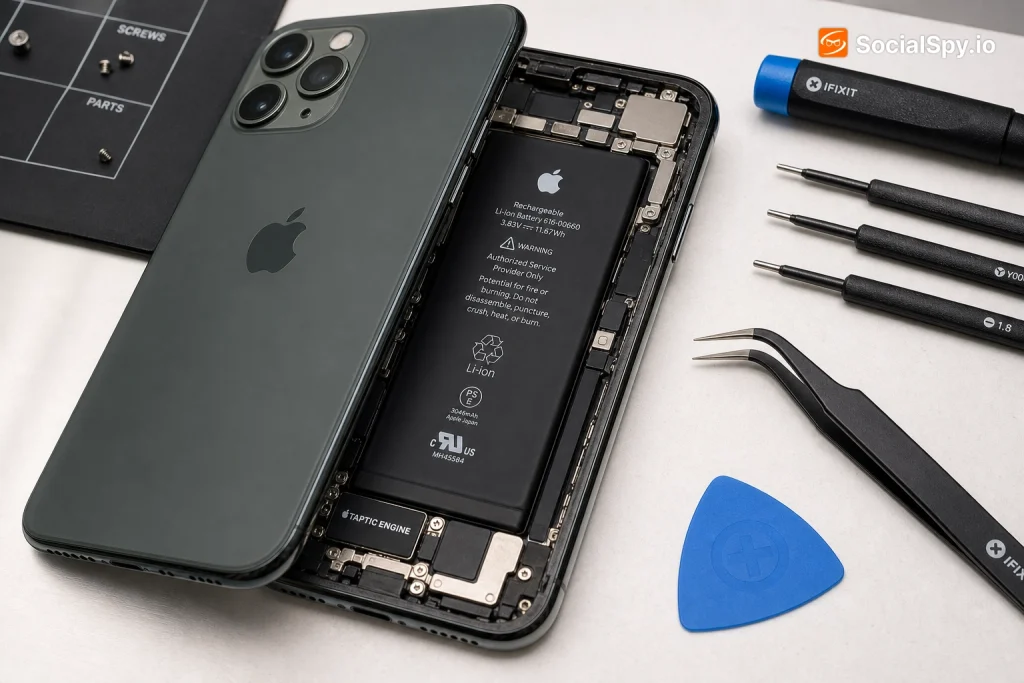
- The repair itself. Technicians remove the two pentalobe screws near the Lightning port, lift the display assembly (which stays connected via a ribbon cable and is propped to the side, not fully detached), disconnect the battery connector, release the adhesive tabs, and slide in the new cell.
- Reassembly and testing. The phone is resealed, powered on, and checked against Apple’s diagnostic suite before being handed back.
For in-stock parts, this whole process typically takes 30 to 45 minutes at an Apple Store. If the specific battery isn’t in stock — which happens more often now that the iPhone 11 Pro is an older model — it gets sent to a repair depot and returned in about a week.
AppleCare+ and Warranty Considerations
This is where a lot of iPhone 11 Pro owners leave money on the table without realizing it.
- If you purchased AppleCare+ for your iPhone 11 Pro and it’s still active (Apple allows AppleCare+ enrollment for up to 60 days after purchase, and some plans can be renewed monthly), Apple will replace a battery that’s dropped below 80% maximum capacity at no additional charge.
- Without AppleCare+, even a battery sitting at 79% capacity gets charged the standard $69 out-of-warranty rate.
- AppleCare+ monthly plans for an iPhone this age are no longer sold new, but if you’re on a legacy plan or extended coverage from a carrier, it’s worth checking before paying out of pocket.
- Apple’s standard one-year limited warranty only covers battery defects, not normal capacity degradation from age and charge cycles — so a six-year-old iPhone 11 Pro almost certainly isn’t covered by the base warranty anymore.
If you’re unsure whether you still have active coverage, check under Settings > General > About > Coverage, or look up the device by serial number at Apple’s official Check Coverage page. It takes two minutes and can save you $69.
DIY Replacement: Is It Worth the Risk?
Sites like iFixit sell iPhone 11 Pro battery kits bundled with the necessary pentalobe screwdriver, spudgers, and adhesive strips for roughly $45 to $70. It’s tempting, especially since the parts themselves aren’t dramatically cheaper than the labor Apple charges.
Reasons people go DIY:
- No appointment wait, no drop-off, no shipping time.
- Slightly lower total cost if you already own basic tools.
- Full control over which battery cell you use (some kits use cells from CATL or other Apple-approved suppliers rather than refurbished originals).
Reasons it can backfire:
- The iPhone 11 Pro’s battery sits under the display assembly and logic board area, and prying too aggressively near the battery can puncture the lithium-ion pouch — a genuine fire risk.
- Adhesive removal requires patience; rushing it can crack the OLED display’s flex cable, turning a $60 job into a $300 screen replacement.
- Installing a non-Apple battery triggers a “Battery Service” or “Unknown Part” notice under Battery Health, which some users find cosmetically annoying even though it doesn’t disable phone functionality on the 11 Pro.
- No workmanship warranty if something goes wrong afterward.
A middle-ground option: Apple’s Self Service Repair Store
Apple actually sells genuine parts, including iPhone 11 Pro batteries, directly to consumers through its Self Service Repair Store. You pay for the part plus a refundable tool-rental deposit (the whole toolkit runs into the hundreds of dollars but is fully refunded once returned within the rental window). For a single battery swap, this ends up being more expensive and more hassle than just paying Apple’s $69 in-store rate — it’s really designed for people doing repeat repairs or repair-business owners, not a one-off battery job.
Aftercare: Getting the Most Out of Your New Battery
Once the new cell is in, a few habits meaningfully extend its lifespan compared to how most people charged the original one.
- Avoid extreme heat. Apple specifies an ideal operating range of 0°C to 35°C (32°F to 95°F); leaving the phone on a dashboard in summer accelerates capacity loss faster than almost anything else.
- Skip charging to 100% constantly. Apple’s Optimized Battery Charging feature (found in the same Battery Health menu) learns your routine and delays finishing the charge past 80% until shortly before you typically wake up.
- Don’t obsess over “topping off.” Frequent short charges are actually gentler on lithium-ion cells than repeated full discharge-to-100% cycles.
- Update iOS regularly. Apple periodically ships battery-management refinements in iOS point updates that improve how the system reports and manages charge curves.
Following these steps, a freshly replaced iPhone 11 Pro battery should comfortably hold above 90% maximum capacity for at least 18 to 24 months of typical use before showing the same gradual decline the original did.
Conclusion
A battery replacement is, dollar for dollar, the single best way to extend the useful life of an iPhone 11 Pro in 2025. Spending $69 to $90 on a new cell is dramatically cheaper than upgrading to a new iPhone, and it solves the two complaints — poor all-day battery life and random shutdowns — that push most people toward buying a replacement phone they don’t actually need. The real decision isn’t whether to replace the battery; it’s where. Apple’s official channel offers the most predictable outcome with genuine parts and a real warranty, certified third-party shops offer nearly the same quality often for less, and DIY only makes sense if you’re comfortable with fine electronics work and accept there’s no safety net if something goes wrong.
FAQ
Apple’s official out-of-warranty price is $69 for a battery replacement on the iPhone 11 Pro, whether done in-store at a Genius Bar appointment or through Apple’s mail-in repair service. If you have active AppleCare+ coverage and your battery has dropped below 80% maximum capacity, the replacement is free.
Yes, it’s technically possible with a kit from a supplier like iFixit for roughly $45 to $70, but it carries real risk — the battery pouch can be punctured if pried too aggressively, and the adjacent display flex cable is easy to damage during disassembly. Most people without prior smartphone repair experience are better served by an Apple Store or a certified third-party shop given the modest price difference.
Check Settings > Battery > Battery Health & Charging — if Maximum Capacity reads below 80%, or you see a “Peak Performance Capability” warning, the battery itself is degraded. If capacity looks fine (above 85%) but you’re still seeing fast drain, the culprit is more likely a background app, a pending iOS update, or a specific feature like Always-On features draining power rather than the battery hardware itself.