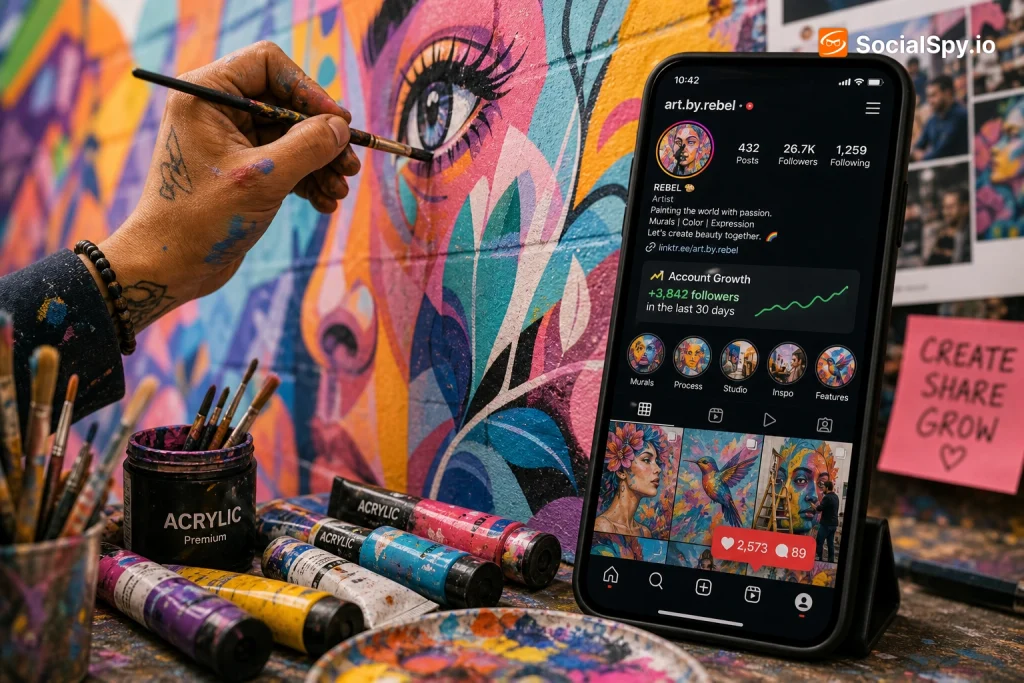
Instagram’s algorithm has quietly become far more forgiving to artists than it was two years ago, but the platform now rewards a completely different skill set than the one that worked in 2021. Follower counts matter less; watch time, saves, and shares now decide whether your painting, illustration, or sculpture reaches 500 people or 500,000. Here’s what’s actually working for visual artists on Instagram right now, based on how the recommendation system and creator tools function in 2025.
Why the Old Instagram Growth Playbook Doesn’t Work Anymore
For years, artists were told to post a finished piece, use 30 hashtags, and engage in “comment pods” to trick the algorithm. That approach is largely dead.
Instagram’s recommendation system, as head of Instagram Adam Mosseri has repeated in his public Q&As throughout 2024 and into 2025, now prioritizes originality, watch time, and shares to DMs over raw engagement metrics like likes. The platform explicitly de-ranks reposted or watermarked content pulled from other apps, which hits artists who used to recycle TikTok-style speed-paint videos without re-editing them.
- Likes matter less — they’re a weak signal compared to shares and saves.
- Shares to Stories/DMs matter most — Instagram treats a share as proof the content is worth spreading.
- Watch time on Reels determines distribution beyond your existing followers.
- Unoriginal content gets suppressed, even if it performs well elsewhere first.
Industry analysts tracking creator-account data through 2024 have noted that accounts under 10,000 followers now regularly out-reach accounts with 100,000+ followers on individual Reels — a structural shift from the old follower-gated model where only large accounts got algorithmic boosts.
This means a brand-new art account genuinely has a shot at going viral without an existing audience, which wasn’t reliably true in Instagram’s earlier years.
The Content Types Actually Getting Distribution
Not all art content performs equally. Instagram’s Reels algorithm favors specific formats, and understanding them is more valuable than posting randomly and hoping.
Process Content Beats Finished Pieces
A flat photo of a completed painting gets maybe 2-3 seconds of attention before someone scrolls. A 20-second Reel showing the messy middle of a painting — mixing colors, correcting a mistake, the “before it looked good” phase — holds attention far longer, and watch time is the single biggest ranking factor for Reels.
- Time-lapse process videos (30-60 seconds) consistently outperform single-image posts for reach.
- “Wrong turn” videos — showing a mistake and the fix — drive unusually high comment counts because viewers relate to struggle, not perfection.
- Sound-on transformations using trending audio at low volume under narration tend to get more algorithmic pickup than silent clips.
- Studio vlogs (5-10 minutes, posted as regular video, not Reels) build parasocial connection that converts casual scrollers into buyers.
Carousels Are Undervalued by Most Artists
Multi-image carousels showing step-by-step progress (sketch → underpainting → final) get strong save rates because people bookmark them as reference material. Saves are weighted heavily in Instagram’s ranking, arguably more than most artists realize, and a carousel someone saves for “art tutorial reference” keeps resurfacing in that person’s Explore recommendations for weeks.
Instagram’s 2025 Creator Tools Artists Should Actually Use
Instagram has rolled out several features over the past year that are underused by artists specifically, mostly because art-account owners assume tools built for meme pages or influencers don’t apply to them. That assumption is costing reach.
| Feature | What It Does | Why Artists Should Use It |
|---|---|---|
| Trial Reels | Posts a Reel only to non-followers first, hiding it from your existing audience | Lets you test a new style or subject without tanking your grid’s engagement rate if it flops |
| Broadcast Channels | One-way messaging list followers opt into | Great for announcing commission openings, print drops, or gallery shows directly |
| Notes | Short text status under the DM inbox | Effective for promoting a “link in bio” for a shop or Etsy without cluttering captions |
| Collab posts | Two accounts share one post to both audiences | Massively effective for artists cross-posting with other artists in adjacent niches |
| Add Yours templates | Sticker-based content prompts in Stories | Useful for “draw this in your style” challenges that spread across art communities |
Trial Reels Specifically Deserve More Attention
Rolled out broadly through 2024, Trial Reels let creators post a Reel that only shows up to people who don’t already follow them. If it performs well among strangers, you can then share it to your main feed for your existing followers. For artists nervous about experimenting with a new medium or subject matter, this removes the risk of an experimental post dragging down your account’s average engagement rate, which the algorithm does track over time.
Hashtags, SEO, and Discoverability in 2025
Instagram search now functions much more like a real search engine, and captions get indexed for keyword matching — a change that’s been rolling out since 2023 and matured significantly by 2025. This changes what “hashtag strategy” even means.
- Write captions like search queries. Instead of “New piece 🎨,” write something like “Watercolor portrait of a golden retriever, painted on 300gsm cold press paper.” Instagram’s search surfaces posts based on caption text, not just tags.
- Use 3-5 specific hashtags, not 30 generic ones. Tags like #watercolorpainting or #digitalportraitart perform better than oversaturated tags like #art or #artist, which have hundreds of millions of posts competing for the same feed slot.
- Include your medium and subject in alt text. Instagram lets you manually edit alt text before publishing — most artists skip this, but it’s an extra indexing signal for the algorithm.
- Geotag when relevant, especially for artists selling at local markets or opening a studio — local discovery is a growing share of Explore page traffic.
- Reply to comments with keyword-rich language rather than just emojis, since comment threads get indexed too.
For artists whose growth strategy overlaps with building a broader personal brand rather than just an art page, the fundamentals covered in how to grow your personal brand on social media apply directly — consistency and a recognizable point of view matter as much for a painter as for any other creator category.
Reels vs. Static Posts vs. Stories: Where to Actually Spend Your Time
Artists have limited time, and Instagram now spans four distinct content surfaces that each behave differently. Spreading effort evenly across all of them is a mistake — Reels should get the majority of your production time in 2025.
- Reels (primary discovery engine): Aim for 4-5 per week, 15-45 seconds, process-focused. This is where non-followers find you.
- Grid posts / carousels (retention and portfolio): 2-3 per week, used to build a cohesive aesthetic that converts a Reels viewer into a follower when they check your profile.
- Stories (community and sales): Daily, low-production, used for polls, “which color should I use,” commission slot announcements, and print restocks.
- Broadcast Channel / Notes (direct conversion): Weekly or event-based, used to push actual sales — commissions open, shop links, gallery dates.
A common early-reviewer observation from creators testing this split through 2024-2025 is that accounts treating Reels purely as a “top of funnel” tool, and reserving the grid for polished portfolio work, grow faster and monetize better than accounts trying to make every single post go viral.
This mirrors a broader shift discussed in comparisons of Instagram Reels vs. TikTok for creators — Reels’ algorithm now behaves more like TikTok’s For You page than Instagram’s old chronological-ish feed, meaning artists need to think in terms of discovery loops, not just posting on a schedule and waiting.
Monetization Paths That Are Actually Live in 2025
Growing followers means nothing if it doesn’t translate to income, and Instagram has expanded artist-specific monetization meaningfully over the past year.
- Instagram Shop integration with third-party platforms like Shopify and Etsy lets artists tag original artwork and prints directly in posts and Reels for in-app checkout.
- Subscriptions (Instagram’s paid-follower tier) let artists offer exclusive process videos, brush/reference packs, or early access to prints for a monthly fee, typically $0.99-$99.99 depending on tier.
- Badges during Instagram Live allow fans to pay during live painting sessions, similar to Twitch bits.
- Branded content deals with art-supply companies (Procreate, Winsor & Newton, Strathmore, Faber-Castell) have expanded their creator partnership programs, often targeting accounts as small as 10,000-20,000 engaged followers rather than only mega-influencers.
- Commission funnels via Broadcast Channels, where artists announce limited commission slots to channel subscribers before posting publicly, creating urgency and reducing time spent fielding DM inquiries from non-serious buyers.
The shift worth noting: brands and platforms increasingly care about engagement rate and niche relevance over follower count. An account with 8,000 followers and a 12% save rate on art-tutorial carousels is often more valuable to an art-supply brand than an account with 80,000 followers and 1% engagement — a dynamic similar to how recruiters and companies now scout niche, engaged communities directly, as seen in cases like a startup sourcing a hire through Instagram DMs rather than traditional channels.
Common Mistakes Slowing Artists Down
Even artists posting consistently often sabotage their own reach with habits that made sense years ago but actively hurt performance now.
- Watermarking every image heavily. A small signature is fine; a large logo across the center of the piece reduces save rates because people won’t screenshot or share cluttered images.
- Posting only finished work. As covered above, this loses the watch-time advantage entirely.
- Ignoring the first 3 seconds of a Reel. If the hook doesn’t show movement, color, or a compelling first brushstroke within 2-3 seconds, Instagram’s system logs it as a low-retention video and stops distributing it.
- Cross-posting TikTok watermarked videos directly. Instagram detects the TikTok watermark and logo and suppresses reach on that content — always export or re-edit without the competing platform’s branding.
- Inconsistent posting cadence. Algorithmic trust builds over weeks of consistent activity; disappearing for three weeks then posting five times in one day resets a lot of that momentum.
- Underusing captions for storytelling. A one-line caption wastes an opportunity — captions with a short narrative (why this piece, what inspired it, how long it took) drive meaningfully higher comment rates.
Conclusion
Growing an art account on Instagram in 2025 has less to do with talent alone and more to do with understanding that the platform now functions as a discovery search engine layered on top of a short-video app. Artists who treat Reels as their audition tape, use tools like Trial Reels to de-risk experimentation, write search-friendly captions instead of generic hashtag walls, and build direct sales funnels through Shop tags, Subscriptions, and Broadcast Channels are outperforming artists who are simply more skilled but posting the way people did in 2019. The technical craft of the art still matters enormously for retention once someone lands on your profile — but getting them there in the first place now depends on production choices, posting cadence, and platform literacy just as much as brush technique.
FAQ
Aim for 4-5 Reels per week focused on process content, supplemented by 2-3 grid posts or carousels weekly and daily Stories for community engagement. Consistency over several consecutive weeks matters more than occasional viral spikes, since Instagram’s algorithm builds distribution trust based on sustained activity.
Yes, but differently than before — use 3-5 specific, niche hashtags (like #inkillustration instead of #art) rather than 20-30 generic ones, since Instagram’s search now indexes caption text and alt text as heavily as tags. Overly broad hashtags with hundreds of millions of posts rarely help a small account get discovered.
Yes — Instagram’s Reels algorithm distributes content based on watch time, shares, and originality rather than existing follower count or account age. Features like Trial Reels specifically test new content against non-followers first, meaning a brand-new account with strong process-driven content has a genuine shot at reaching a large audience without any prior following.