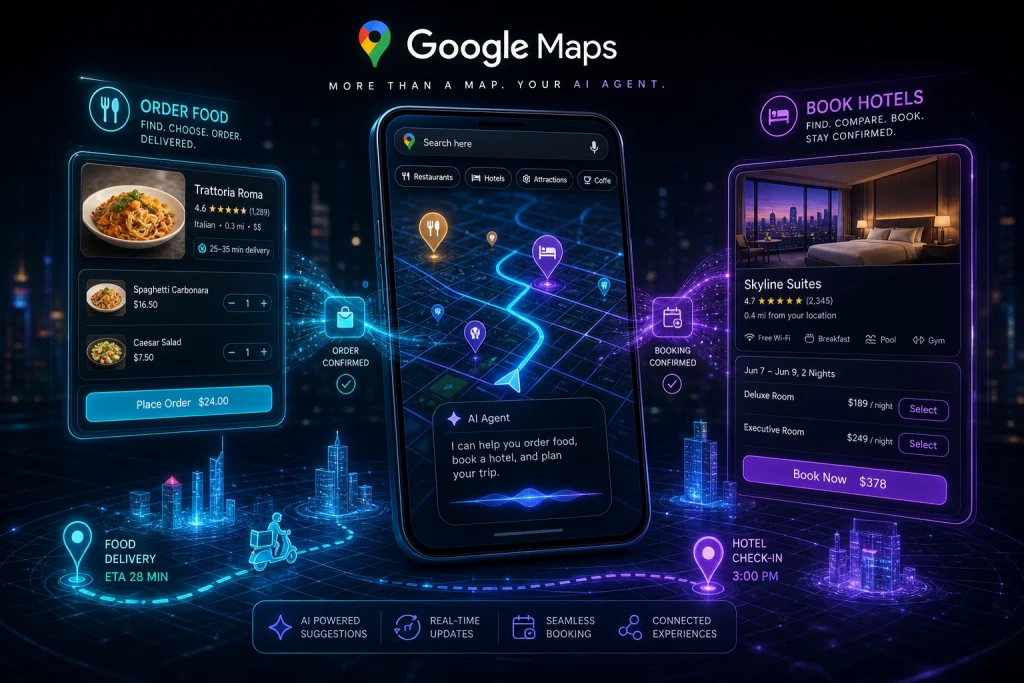
Google Maps is quietly transforming from a navigation tool into something far more ambitious: a digital concierge that can act on your behalf. In its latest rollout, Google has infused Maps with “agentic” artificial intelligence capabilities that allow the app to not just show you where the nearest Thai restaurant is, but actually place your order, complete the checkout, and even book your hotel room for the weekend getaway you just searched for. This shift marks one of the most significant evolutions in how consumers interact with location-based services, and it signals where the broader tech industry is heading as AI agents move from novelty to daily utility.
For years, Google Maps has been a passive information layer — a place to find directions, read reviews, and check business hours. Now, with generative AI models woven directly into the product, Maps is positioning itself as an active participant in the transactions that happen after you find what you’re looking for. Instead of tapping through five different apps to research a restaurant, check its menu, place a delivery order, and then separately book a hotel for your trip, users can theoretically do all of it inside a single, conversational interface.
What “Agentic” Actually Means in Google Maps
The term “agentic AI” has become one of the most overused buzzwords in tech, but in this context it has a fairly concrete meaning. Rather than simply retrieving information (like a traditional search), an agentic system can take multi-step actions on a user’s behalf, adapting as it goes and making decisions within boundaries the user has set.
In Google Maps, this translates into features that let the AI:
- Interpret natural-language requests like “find me a pet-friendly hotel near downtown Austin under $200 a night with free parking” and return curated options that meet every criterion.
- Complete a food order from a local restaurant directly within the Maps interface, without redirecting to a third-party delivery app.
- Reserve a hotel room, pulling availability and pricing in real time and finalizing the booking without the user needing to leave Maps.
- Remember context across a session, so if you ask about restaurants near your hotel, it uses the hotel you just booked as a reference point.
This is a meaningful departure from how Maps has traditionally functioned. Previously, the app served as a discovery layer that handed users off to other services — Grubhub, DoorDash, Booking.com, or a restaurant’s own website — to complete an action. Now, Google is attempting to own more of that transaction lifecycle itself, keeping users inside its ecosystem from search to purchase.
How the Food Ordering Feature Works
The food ordering functionality builds on Google’s existing partnerships with delivery platforms and local businesses, but the experience has been redesigned to feel far more integrated. When a user searches for a restaurant or cuisine type, Maps’ AI can now surface a “order here” prompt that opens an embedded checkout flow rather than bouncing the user to an external app.
Under the hood, this relies on Google’s expanding network of business data, menu integrations, and payment infrastructure through Google Pay. Restaurants that already maintain updated Google Business Profiles with menu items, pricing, and availability are the ones best positioned to appear in these AI-powered ordering flows.
Key aspects of the food ordering rollout include:
- Conversational refinement — users can ask follow-up questions like “make that order for two people” or “swap the fries for a salad,” and the AI adjusts the cart accordingly.
- Direct integration with loyalty programs and saved payment methods tied to a user’s Google account.
- Real-time order tracking that appears as a live map overlay, similar to how ride-share tracking currently works.
- Support for both pickup and delivery, depending on what the restaurant offers and what the user requests.
Analysts note that this move puts Google in more direct competition with dedicated delivery apps. While Google has long taken a “platform” approach — aggregating options from multiple providers — this deeper integration suggests the company wants to reduce the number of steps between intent and transaction, even if that means encroaching on partners’ territory.
Hotel Bookings Get the Agentic Treatment
The hotel booking upgrade follows a similar logic. Google has offered hotel search and price comparison for years through Google Travel, but the new agentic layer in Maps changes how users arrive at and complete a booking. Instead of manually filtering through star ratings, price ranges, and amenities across multiple tabs, users can describe what they want in plain language and let the AI do the filtering and comparison.
For example, a request like “find a beachfront hotel in San Diego for next weekend with a pool and good breakfast reviews” prompts the AI to cross-reference real-time pricing, availability, guest reviews, and amenity data, then present a shortlist. From there, the booking itself — including selecting room type, entering guest details, and finalizing payment — can happen without leaving the Maps app.
This has several implications for travelers and the hospitality industry alike:
- Smaller, independent hotels with strong Google Business Profiles could see increased visibility, since the AI pulls from structured business data rather than favoring only the biggest booking platforms.
- Price transparency improves, as the AI can quickly surface comparisons that might otherwise require checking three or four separate booking sites.
- Booking friction decreases significantly, which could shorten the decision-making window for spontaneous or last-minute travel.
- Traditional online travel agencies (OTAs) like Expedia and Booking.com may face new pressure as Google positions itself as a more direct booking channel rather than just a referral source.
Google has emphasized that these bookings still route through its existing network of hotel and travel partners, meaning properties aren’t necessarily cut out of the loop — but the user experience is designed to feel seamless, almost invisible, compared to the multi-app juggling act travel booking has traditionally required.
Why Google Is Making This Move Now
The timing of this rollout is not accidental. Google has faced mounting pressure from AI-native competitors and from within its own ranks to demonstrate that its massive investment in generative AI translates into tangible consumer value, not just chatbot novelty. Maps, with its billion-plus monthly active users, is one of the most logical proving grounds for agentic AI because it already sits at the intersection of local search, commerce, and real-world action.
There’s also a competitive dimension. OpenAI, Perplexity, and other AI companies have been experimenting with their own shopping and booking agents, while companies like Amazon continue to push agentic shopping assistants. Google has an inherent advantage here: it already owns the map data, the business listings, the review ecosystem, the payments infrastructure, and the search habits of billions of users. Bringing agentic capabilities to Maps lets Google leverage all of these existing assets simultaneously rather than building a standalone agent from scratch.
From a business standpoint, deeper transactional integration in Maps also creates new revenue opportunities. Every food order or hotel booking completed within the app is a transaction Google can potentially monetize through commissions, advertising placement, or premium business listing features — turning Maps from a purely advertising-driven product into more of a direct commerce engine.
What This Means for Users and Businesses
For everyday users, the promise is convenience: fewer apps, fewer steps, and a more conversational way to get things done. Instead of researching, comparing, and executing across multiple platforms, the entire journey — from “I’m hungry” or “I need a place to stay” to a completed transaction — can happen in one continuous flow.
For local businesses, the shift raises both opportunities and questions. Restaurants and hotels that keep their Google Business Profiles accurate and complete stand to benefit from increased visibility in AI-generated recommendations. But businesses will also need to adapt to a world where the AI, not the customer, is often making the first cut of options — meaning strong reviews, clear menu data, and updated pricing become even more critical to being included in the agent’s shortlist.
There are also broader questions about trust and control. Handing over payment and booking decisions to an AI agent, even one operating within user-defined parameters, requires a leap of faith that many users may take gradually rather than all at once. Google will likely need to be transparent about how choices are made, how businesses are ranked, and how users can override or adjust the AI’s decisions.
Conclusion
Google Maps’ expansion into agentic food ordering and hotel booking represents more than an incremental feature update — it’s a strategic bet that AI agents capable of completing real-world transactions will become the default way people interact with local services. By embedding these capabilities directly into an app already used by billions, Google is positioning Maps as a genuine competitor to delivery apps and travel booking platforms, not just a discovery tool that points users elsewhere. Whether this becomes the new normal for how people order dinner and book hotels will depend on how well the AI performs, how much users trust it with their money, and how gracefully local businesses adapt to a search experience increasingly mediated by algorithms rather than manual browsing. What’s clear is that the line between “finding” and “doing” is rapidly disappearing, and Google wants Maps to be the app that erases it.
Frequently Asked Questions
Q: Do I need a special app or subscription to use these new Google Maps features?
A: No separate subscription is required. The agentic features are being integrated directly into the existing Google Maps app, though availability may roll out gradually by region and may require users to be signed into a Google account with payment methods set up through Google Pay.
Q: Will using AI to order food or book hotels through Maps cost more than booking directly?
A: Pricing is generally expected to match what you’d pay through the restaurant or hotel’s own channels or partner platforms, since Google pulls real-time data rather than adding its own markup. However, users should still compare occasionally, as promotional deals on other apps may not always be reflected.
Q: Can I still browse and book manually instead of using the AI agent?
A: Yes. The traditional search-and-browse experience in Google Maps remains available. The agentic features are designed as an additional, faster option layered on top of existing functionality, not a replacement for manual search and comparison.