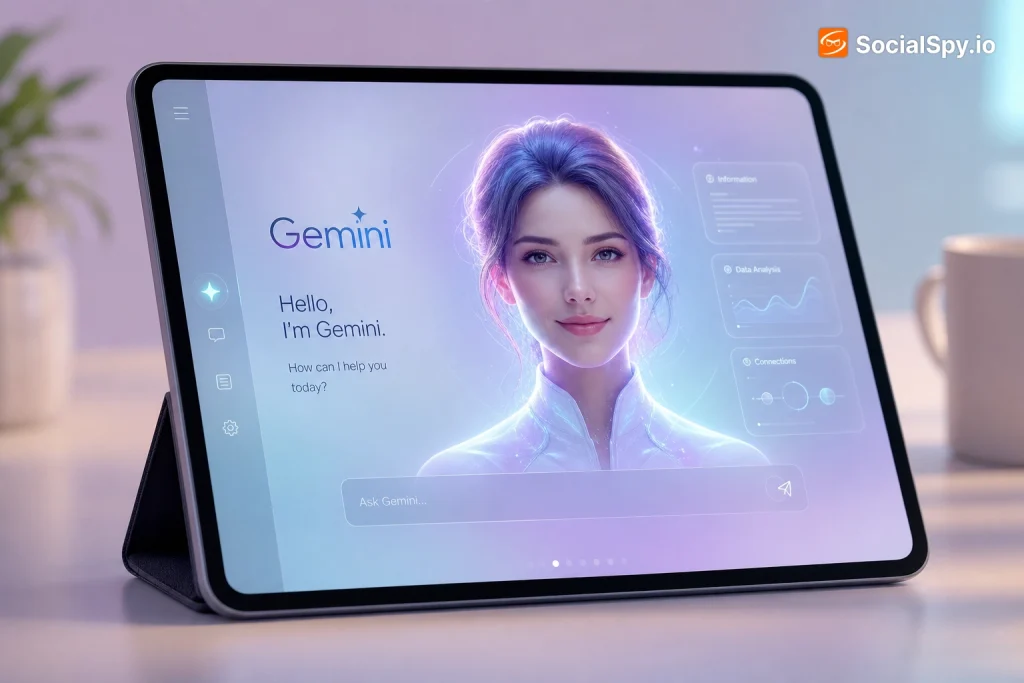
Google’s Gemini has become one of the go-to tools for people trying to design a custom AI “girl” character — whether that means a stylized anime-style image, a consistent virtual persona for a game or social account, or a chatbot companion with a defined personality. Getting good results isn’t about typing “cute anime girl” and hoping for the best; it’s about understanding how Gemini’s image and persona tools actually parse instructions, and where Google draws the line on content.
What “Gemini AI Girl” Prompts Actually Mean in 2025
The phrase gets used for a few different projects, and Gemini handles each one differently. Knowing which one you’re doing changes how you should write the prompt.
- Visual character generation — using Gemini’s built-in image model to create a picture of a girl/woman character (anime, 3D, realistic art styles) for avatars, thumbnails, or concept art.
- Persistent persona chatbots — building a custom “Gem” (Gemini’s saved custom-assistant feature) with a defined name, personality, and speaking style that acts like a consistent character across conversations.
- Image editing/consistency — using Gemini to keep the same character’s face and outfit consistent across multiple generated images, which is now realistic thanks to newer image models.
- Roleplay-style writing — asking Gemini to write dialogue, backstory, or scenes for a fictional female character, which sits closer to creative writing than image generation.
Industry reviewers testing Google’s newest image model in 2025 noted that its biggest leap over prior versions wasn’t raw image quality — it was character consistency, keeping the same face, hairstyle, and outfit across multiple edited images in a single chat thread.
That model, officially Gemini 2.5 Flash Image and nicknamed “Nano Banana” during its viral rollout in August 2025, is the engine behind most current AI-girl image prompting inside the Gemini app. It replaced the older Imagen 3 integration for most conversational image requests and made iterative editing — “now change her hair to red,” “put her in a rainy city street” — far more reliable than it was a year earlier.
The Four-Layer Prompt Structure That Works
Generic one-line prompts produce generic results. Gemini’s image and text models respond much better to layered, specific instructions written almost like an art director’s brief.
- Character description — age range (adult), body type, hair color/style, eye color, distinguishing features, clothing.
- Art style and medium — anime, watercolor, 3D render, Pixar-style, studio photography, pencil sketch, cyberpunk illustration.
- Personality or tone (for chat personas) — confident, shy, sarcastic, mentor-like, playful — this shapes both dialogue and, indirectly, image composition and expression.
- Technical/scene framing — lighting (golden hour, neon, soft studio light), camera angle (close-up, three-quarter view), background setting, color palette.
Example: Weak vs. Strong Prompt
| Weak Prompt | Strong Prompt |
|---|---|
| “Draw a pretty girl” | “Illustrate a young adult woman with short teal hair and freckles, in a soft watercolor anime style, wearing a cropped denim jacket, standing in a neon-lit night market, three-quarter angle, warm rim lighting” |
| “Make me an AI girlfriend chatbot” | “Create a Gem named Aria: witty, curious, speaks in short casual sentences, gives book recommendations, avoids romantic role-play, and always redirects overly personal questions with humor” |
| “Anime girl warrior” | “Digital painting of a female knight character, mid-20s, silver armor with blue trim, windswept dark hair, determined expression, dramatic backlighting, fantasy concept-art style, 4:3 composition” |
The pattern is consistent: specificity beats adjectives. “Pretty” and “cute” are vague and let the model default to generic training-data averages; naming hair color, clothing texture, and lighting narrows the output dramatically.
Building a Consistent Character Persona with Gems
If the goal is a recurring AI girl character — for a Discord bot, a branded social persona, or a personal companion — Gemini’s Gems feature (launched in August 2024 and expanded through 2025) is the right tool, not the image generator alone.
A Gem is a saved, reusable custom instruction set that behaves like a mini-chatbot with memory of its configured personality within a session. Here’s how a well-built persona prompt is typically structured:
- Name and role: “You are Lumi, a friendly study companion.”
- Voice and tone rules: sentence length, slang usage, formality level, emoji habits.
- Boundaries: explicitly state topics to avoid or redirect (romantic/sexual content, medical/legal advice, etc.).
- Knowledge scope: what the character is good at (trivia, coding help, motivational coaching).
- Formatting habits: does it use bullet points, short replies, or long narrative responses?
A practical instruction block might read: “You are Nova. Speak casually, use short sentences, occasionally use one emoji per message, never claim to be human, and always disclose you’re an AI if directly asked.” That last clause matters more than people think — Google’s policies increasingly require AI personas to avoid deceptively claiming sentience or human identity, especially after regulatory scrutiny of companion-AI apps in 2024 and 2025.
For readers weighing Gemini’s persona and prompting tools against competitors like Character.AI, Replika, or custom GPTs, the broader comparison of ChatGPT vs Claude vs Gemini is worth reviewing, since the three platforms handle persona persistence, memory, and content moderation quite differently.
Where Google Draws the Line
This is the part most tutorials skip, and it’s the part that actually determines whether a prompt gets a response or an outright refusal. Google’s generative AI prohibited-use policy applies to Gemini’s image and chat outputs alike, and it is stricter than several rival platforms.
Gemini will generally refuse or heavily filter:
- Sexually explicit or suggestive depictions of any character, regardless of claimed age.
- Any imagery implying a minor, including stylized “young-looking” anime characters without clear adult framing.
- Real, identifiable people depicted in fabricated romantic or intimate scenarios (a named celebrity, for example).
- Content designed to simulate manipulative emotional dependency, which Google has tightened after criticism of companion-app harms.
- Photorealistic deepfake-style images of a specific real person’s face on a different body.
Gemini will generally allow, when framed clearly as fictional/artistic:
- Stylized character art in anime, cartoon, painterly, or fantasy styles.
- Fully clothed character designs for games, comics, or branding.
- Defined-personality chatbot Gems for coaching, tutoring, companionship-lite, or entertainment, provided they disclose AI status.
- Editing and iterating on a previously generated fictional character (changing outfit, background, hairstyle).
A useful mental model: Gemini treats the request less like “is this a girl character” and more like “does this look like it could cause real-world harm, deception, or exploitation.” Prompts framed around art direction and fiction clear review far more often than prompts framed around romance or realism.
Readers who need the character for marketing, branding, or social content rather than personal chat should also look at how to promote using Gemini AI, since brand-safe character generation for campaigns runs into the same policy filters and benefits from the same layered-prompt approach.
Practical Prompt Recipes by Use Case
Different goals call for different prompt shapes. Below are field-tested structures organized by what the character is actually for.
For Social Media Avatars or Branding
- State the platform and purpose upfront: “Instagram profile picture, warm and approachable brand mascot.”
- Specify a square 1:1 aspect ratio explicitly, since Gemini doesn’t always default to it.
- Ask for 2-3 variations in one request to compare tone (e.g., “generate three versions: cheerful, mysterious, professional”).
For Game or Story Concept Art
- Include narrative context: class/role, world setting, time period.
- Request a turnaround or reference sheet if consistency across future images matters (“front view, three-quarter view, and profile for reference”).
- Specify color palette constraints tied to a game’s existing art bible.
For a Chat Companion Gem
- Front-load the disclosure rule: always identify as AI when asked.
- Define conversational boundaries in the first line of the system instructions, not buried at the end.
- Include a fallback behavior for off-limits topics: “If asked about romance or explicit content, redirect warmly to another topic without lecturing the user.”
For Iterative Image Editing (Nano Banana workflow)
- Generate a base character image with full description.
- Use short follow-up prompts referencing “her” or “the character” rather than re-describing everything.
- Lock in details you like by explicitly saying “keep the same face and hairstyle” before requesting outfit or background changes.
- Save the final version’s description as a text template for reuse in future sessions, since Gemini doesn’t always retain visual memory between separate chats.
Common Mistakes That Waste Prompts
Most failed attempts come down to a handful of repeated errors rather than the model simply being incapable.
- Stacking too many conflicting styles in one prompt (e.g., “photorealistic anime watercolor 3D”) confuses the model and produces muddy results.
- Omitting age and context framing, which increases the odds of a policy refusal even for innocuous requests.
- Re-describing the whole character every time during edits instead of referencing the existing image, which causes drift in appearance.
- Vague personality words like “nice” or “cool” for a Gem persona, instead of behavioral rules the model can actually follow.
- Ignoring aspect ratio and resolution needs, then being surprised the output doesn’t fit a banner or profile slot.
Fixing these five issues alone resolves the majority of frustration people report when a “simple” AI girl prompt returns something unusable or gets blocked entirely.
Conclusion
Getting a good “AI girl” result out of Gemini has very little to do with clever wording tricks or workaround phrasing — it comes down to treating the request like a creative brief. Layer in physical description, art style, personality, and technical framing, decide upfront whether you need an image (Nano Banana) or a persistent persona (Gems), and write within Google’s fiction-and-art framing rather than a romance-or-realism framing. Do that, and Gemini consistently produces usable, on-brand, policy-compliant characters — the kind that actually work for avatars, games, brand mascots, or lightweight companion chat, without the trial-and-error most people assume is unavoidable.
FAQ
Gemini’s Gems feature can create a consistent, personality-driven companion persona, but Google’s content policy restricts romantic or sexual role-play content and requires the AI to disclose that it isn’t human when asked. For dedicated romantic companion experiences, users typically turn to platforms specifically built for that purpose, since Gemini is designed primarily as a general-purpose assistant with safety guardrails on emotionally manipulative or intimate simulated relationships.
Nano Banana is the nickname for Gemini 2.5 Flash Image, Google’s image generation and editing model that went viral in mid-2025 for its ability to keep a character’s face, hairstyle, and outfit consistent across multiple edited images in one chat. It matters because earlier Gemini image tools struggled with consistency, meaning a character could look noticeably different from one generated image to the next; Nano Banana largely solved that for iterative character design.
Gemini’s filters are triggered by pattern-matching against categories like sexualization, age ambiguity, and real-person impersonation, so even innocuous wording can get flagged if it resembles a restricted pattern (for example, describing a character as “young” and “cute” together). Rewording the prompt with clearer adult framing, explicit art-style context, and fictional intent usually resolves false-positive refusals without changing the creative intent.