The iPhone 14 Plus packs Apple’s largest non-Pro battery yet into a phone that’s now old enough for its cells to start showing real wear. If your battery health has dipped below 80% or you’re seeing unexpected shutdowns, you’re likely closer to a replacement than you think. Here’s exactly what it costs, where to get it done, and how to decide if it’s even worth it.
How Much Does It Actually Cost?
Apple’s official out-of-warranty price for an iPhone 14 Plus battery replacement is $99, the same rate Apple charges across the entire iPhone 14 lineup. That price hasn’t budged since the phone launched in September 2022, which is notable given inflation across nearly every other repair category.
If your phone is still covered by the original one-year limited warranty, or you have an active AppleCare+ plan, the situation changes dramatically:
- Under standard Apple warranty: Free replacement, but only if Apple’s diagnostic confirms the battery holds less than 80% of its original capacity — a documented defect threshold, not just “it feels weaker.”
- With AppleCare+: Free replacement any time the battery health drops below 80%, no defect argument needed.
- Out of warranty, no AppleCare+: Flat $99 fee at Apple Stores or through mail-in service.
- Third-party repair shops: Typically $60 to $90, depending on region and whether they use OEM-pulled, aftermarket, or Apple-certified parts.
- DIY battery kits: $25 to $45 for the battery plus adhesive strips and basic tools, sold by outlets like iFixit.
Industry repair analysts note that battery replacement remains one of the few Apple repairs where the official price hasn’t increased since launch, even as screen and camera module repairs have crept upward.
For comparison, it’s worth noting how this stacks up against other recent iPhones. The iPhone 14 battery replacement costs the same $99 at Apple, while older models like the iPhone 13 and iPhone 12 Pro sit in a similar $69-$99 range depending on age and promotional pricing.
Signs Your iPhone 14 Plus Actually Needs a New Battery
Not every battery complaint requires a $99 fix. Apple’s Battery Health feature under Settings > Battery > Battery Health & Charging gives you a concrete percentage, and that number matters more than how the phone “feels.”
Reading the Battery Health Percentage
- 100%-90%: Normal wear for a phone under roughly 18 months old; no action needed.
- 89%-80%: Noticeable capacity loss; battery still functions but you’ll see faster drain during heavy use.
- Below 80%: Apple officially classifies this as degraded; the phone may also throttle performance under peak load to prevent shutdowns.
- “Service” warning displayed: The battery isn’t performing within Apple’s normal parameters, regardless of the percentage shown — replace it now.
Behavioral Red Flags
Beyond the percentage, watch for these real-world symptoms:
- Unexpected shutdowns even when the reported charge is above 20%.
- Swelling — a phone that no longer sits flat on a table, or a screen that appears slightly lifted at the edges.
- Charging that stalls partway, particularly with fast chargers above 20W.
- Rapid drain where the phone loses 10%+ battery in under an hour of light use.
- Overheating during normal tasks like scrolling social media or texting.
The iPhone 14 Plus ships with a 4,325 mAh cell — Apple’s biggest battery in a non-Pro iPhone at launch — rated for roughly 26 hours of video playback. Lithium-ion chemistry degrades predictably: Apple designs these cells to retain at least 80% capacity after 1,000 complete charge cycles, which for most people lands somewhere between 18 and 30 months of ownership depending on charging habits.
Apple Store vs. Third-Party vs. DIY: Which Route Makes Sense?
This is the decision that actually matters for your wallet and your data. Each path has real tradeoffs beyond just price.
| Repair Option | Typical Cost | Turnaround | Warranty on Repair |
|---|---|---|---|
| Apple Store (walk-in) | $99 | Same day, ~1-3 hours | 90 days |
| Apple mail-in service | $99 + shipping | 5-8 business days | 90 days |
| Authorized Service Provider | $99 (Apple-set price) | Same day to 2 days | 90 days |
| Independent repair shop | $60-$90 | 30-60 minutes | Varies, often 30-90 days |
| DIY kit | $25-$45 | 1-2 hours (self) | None, or kit-seller warranty only |
Why Apple’s Price Is Fixed at $99
Apple Authorized Service Providers are contractually required to charge the same $99 rate as Apple corporate stores for out-of-warranty battery service. This is genuinely useful if you don’t live near an Apple Store — you get identical pricing at a local authorized shop, often with faster turnaround since they’re smaller operations.
Why Third-Party Shops Undercut Apple
Independent shops source batteries from secondary markets — sometimes genuine Apple cells pulled from salvage devices, sometimes aftermarket cells manufactured to similar specs but without Apple’s battery management chip calibration. This is exactly why third-party replacements can trigger the “Unknown Part” warning in Settings, even when the physical battery works fine.
The DIY Risk Most People Underestimate
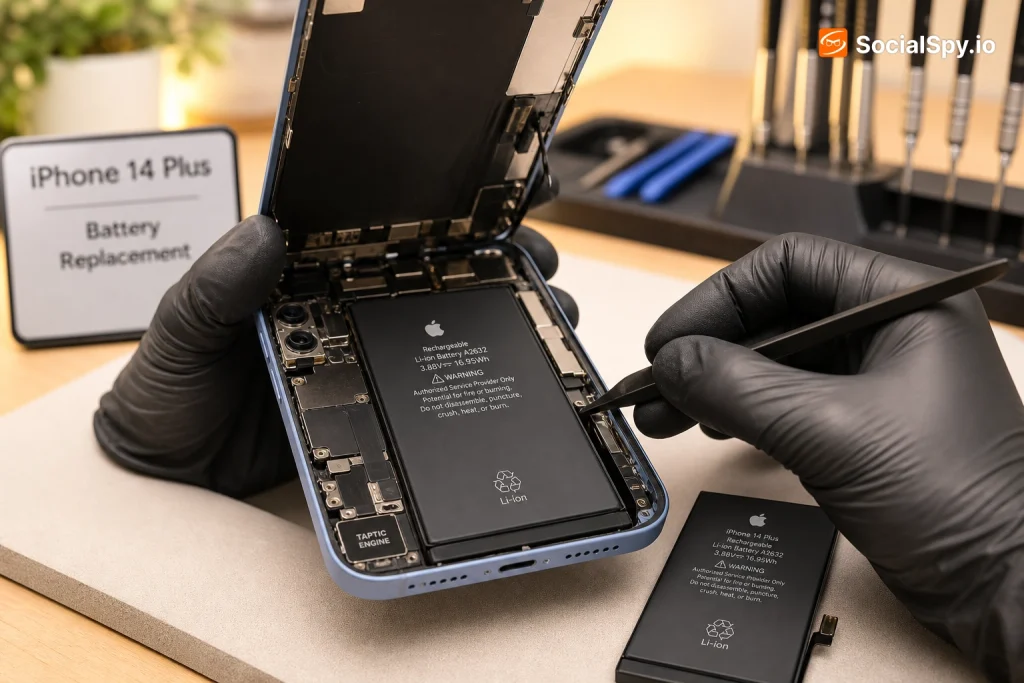
Lithium-ion batteries are genuinely dangerous to mishandle. iFixit and similar kit sellers include this warning for a reason — puncturing a swollen or damaged cell during removal can cause it to combust. The iPhone 14 Plus’s larger chassis actually makes DIY slightly easier than smaller models since there’s more working room around the battery tray, but it still involves:
- Removing the display assembly (held by proprietary screws and strong adhesive)
- Disconnecting the battery cable and display cables in the correct order
- Prying out adhesive-mounted battery cells without bending or puncturing them
- Reapplying waterproofing adhesive strips to maintain the IP68 rating
What Genuinely Changes on the “Unknown Part” Warning
This is the part most articles gloss over, and it’s specific to how Apple has handled battery service since iOS 15.2. When a non-Apple-calibrated battery is installed, the phone displays a persistent notification and removes the Battery Health percentage display entirely, replacing it with a generic warning message.
Here’s what that warning actually does and doesn’t affect:
- Does not disable the phone or brick any features.
- Does not prevent charging or normal battery function.
- Does remove your ability to see a precise battery health percentage in Settings.
- Does appear in Settings > General > About as a permanent notice until a genuine Apple part is installed.
- Can slightly affect resale value, since buyers on the used market increasingly check for this warning before purchasing.
Apple introduced a partial fix through its System Configuration tool, which authorized shops and independent repair providers can now use (following Apple’s 2022 expansion of the Self Service Repair and parts pairing program) to pair third-party or used-genuine parts to the device and restore full battery health reporting. Not every shop has enrolled in this program, so it’s worth asking directly before booking a repair if you want that battery percentage back.
Is It Worth Replacing vs. Upgrading?
The math here depends entirely on how the rest of your phone is holding up. A $99 battery job only makes sense if everything else about the device still meets your needs.
Run through this quick comparison:
- Screen and body condition: If the display is cracked or the frame is bent, a battery alone won’t fix your experience — factor in a possible additional screen repair around $169-$329 depending on whether it’s an Apple screen or third-party.
- Storage capacity: If you’re on the 128GB base model and constantly deleting photos, no battery fix solves that underlying frustration.
- Performance needs: The A15 Bionic chip in the iPhone 14 Plus still handles iOS 18 and most apps smoothly as of 2024-2025, so processing power isn’t typically the bottleneck.
- Resale trajectory: A used iPhone 14 Plus with a fresh, Apple-paired battery and 100% reported health sells for meaningfully more on marketplaces like Swappa than one flagged with degraded health or an “Unknown Part” warning.
A repair costing under 10% of the phone’s current resale value is almost always the financially smart move — and at $99 against a used resale value typically in the $350-$450 range depending on storage and condition, the iPhone 14 Plus clears that bar easily.
Compare that to buying new: even the entry-level current iPhone starts well north of $600, meaning a $99 battery swap extends the phone’s useful life at roughly one-sixth the cost of replacement. For most owners who otherwise like the phone, this is a straightforward call in favor of repair over upgrade — a pattern that holds true across generations, as seen with owners weighing the same decision on devices like the iPhone 13 Pro.
Conclusion
The iPhone 14 Plus sits in a sweet spot for battery repair economics: it’s recent enough that parts and service are widely available, but old enough that a meaningful share of units are now crossing the 80% health threshold where replacement actually matters. At $99 through Apple — with no price increase since 2022 — this remains one of the most predictable, value-dense repairs in consumer electronics, especially when weighed against a $600-plus new phone purchase. The real decision point isn’t whether to fix a degraded battery, it’s choosing the right channel: Apple or an authorized provider if you want the battery health percentage preserved and full parts-pairing support, or a trusted independent shop if you’re comfortable trading that reporting feature for a lower price and faster same-day service.
FAQ
Most walk-in appointments at Apple Stores complete the battery swap in 1 to 3 hours, though same-day availability depends on whether that store has the part in stock. Mail-in service through Apple typically takes 5 to 8 business days including shipping both ways.
No — an Apple or Apple-authorized battery replacement doesn’t affect Face ID, water resistance, or any other feature, and it comes with a 90-day warranty on the repair itself. Third-party repairs can technically void remaining AppleCare+ coverage for unrelated future issues, so check your coverage status before choosing an independent shop.
Occasionally, Apple has run battery replacement promotions tied to specific software issues (as it did in 2018 after the performance-throttling controversy), but no such program currently applies to the iPhone 14 Plus. Outside of AppleCare+ or the standard one-year warranty catching a battery under 80% health as defective, the $99 rate is the standard price you should expect to pay.