Three years after launch, the iPhone 14 is now squarely in the age range where battery degradation becomes noticeable — shorter screen time, unexpected shutdowns, and that nagging “Battery Health” warning under Settings. Replacing the battery is one of the most cost-effective ways to extend a phone’s life, but the price and process vary a lot depending on where you go. Here’s what actually determines the cost, how the repair works, and how to decide if it’s worth doing at all.
Why the iPhone 14 Battery Wears Out Faster Than You’d Expect
The iPhone 14 uses a 3,279mAh lithium-ion battery, rated by Apple to retain at least 80% of its original capacity after 1,000 complete charge cycles. For most people, that’s roughly two to three years of typical use before they start feeling the difference.
Battery chemistry degrades from heat, fast charging habits, and simply the passage of time — not just usage. A phone that sits at 100% charge overnight on a nightstand charger every single day ages faster than one that’s charged in short bursts throughout the day.
- A charge cycle counts as one full 100% discharge, which can be spread across multiple partial charges.
- Heat above 95°F (35°C) is the single biggest accelerant of capacity loss, according to Apple’s own battery documentation.
- iOS deliberately throttles peak performance on severely degraded batteries to prevent unexpected shutdowns, a policy that dates back to the 2017 “Batterygate” controversy.
If your iPhone 14 is nearing its third birthday, especially if you’ve used fast wireless charging regularly or left it plugged in overnight for years, checking Battery Health (Settings > Battery > Battery Health & Charging) is the first step before spending any money.
How Much Apple Charges vs. Third-Party Shops
Pricing for an iPhone 14 battery swap breaks into three tiers, and the gap between them is bigger than most people assume.
| Provider | Typical Cost | Turnaround |
|---|---|---|
| Apple Store / Apple Authorized Service Provider | $99 (or free under AppleCare+) | Same day to 1-3 days |
| Independent repair shop (e.g., uBreakiFix, local shops) | $60–$90 | Same day, often 30-60 min |
| DIY replacement kit (iFixit, third-party) | $25–$50 for parts | 1-2 hours, self-performed |
Apple’s flat $99 rate applies specifically to the iPhone 14, 14 Plus, 14 Pro, and 14 Pro Max — it’s not tiered by model the way some older repairs were. That price has stayed consistent since the phone launched in September 2022, though Apple has occasionally run limited-time discounts through carrier trade-in promotions.
Industry repair-cost trackers have noted that independent shop pricing for iPhone 14 batteries has actually dropped slightly since 2023 as more OEM-grade replacement parts became available on the open market.
For comparison, the pricing pattern tracks closely with what we’ve seen on the iPhone 13 battery replacement and its Pro sibling — Apple’s flat-rate structure hasn’t moved much generation to generation, even as component costs shift.
AppleCare+ Coverage: The Detail Most People Miss
If you bought AppleCare+ with your iPhone 14, or added it within 60 days of purchase, battery service is likely free — but only under a specific condition.
Apple’s AppleCare+ terms state that battery replacement is covered at no charge once the battery’s capacity drops below 80% of original design capacity. If your Battery Health still reads 82% and your phone just feels a little sluggish, Apple can decline the free swap and quote you the standard $99 instead.
- Check exact capacity percentage before booking an appointment — it’s listed directly under Battery Health in Settings.
- AppleCare+ costs roughly $9.99/month or $199 upfront for two years on the iPhone 14 lineup, so factor in whether you’re already paying for it.
- Without AppleCare+, Apple’s Limited Warranty only covers a defective battery, not normal wear — meaning most people past the first year are paying out of pocket regardless.
Bring your phone in for a diagnostic first. Apple Stores run a quick software-based capacity check in minutes, and it costs nothing even if you decide not to proceed.
What Actually Happens During the Repair
The iPhone 14 was the first standard iPhone model redesigned internally for easier battery access — a change Apple made specifically to speed up in-store repairs.
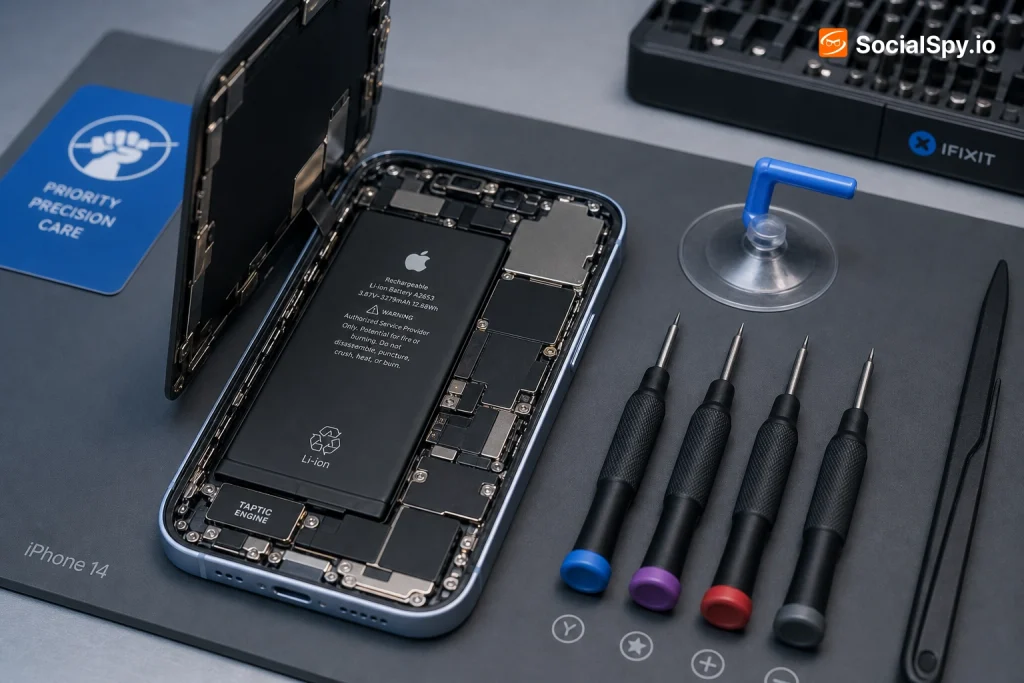
Unlike the iPhone 12 and 13 series, where the battery is glued beneath the screen assembly and requires prying up delicate flex cables, the iPhone 14’s battery sits under the rear glass and is secured with pull-tab adhesive strips accessible after removing the back panel. This was a genuine engineering shift, not a marketing claim.
- The technician backs up data (recommended, not always required) and powers down the device.
- The rear glass panel is heated slightly and lifted off using a suction tool — a process Apple redesigned specifically to avoid full disassembly.
- Pull-tabs release the adhesive holding the battery in place, letting it lift out without prying near the logic board.
- A new OEM battery is seated, adhesive strips reset, and the rear glass is resealed.
- The phone undergoes a calibration cycle and Apple’s diagnostic software verifies genuine-parts recognition.
This redesign is why Apple Store turnaround for the iPhone 14 is often same-day, sometimes under an hour, compared to the multi-day waits common with older screen-glued designs like the iPhone 12 Pro.
Genuine Parts, “Parts Pairing,” and the Warning You’ll See
Here’s the part that trips people up with third-party or DIY repairs: Apple’s software actively checks whether an installed battery is a genuine, serialized Apple part.
If it isn’t — or if it is genuine but wasn’t “paired” using Apple’s proprietary System Configuration tool — you’ll see a persistent “Unknown Part” notification in Battery Health, and the percentage indicator may simply disappear entirely.
- This doesn’t stop the phone from charging or functioning normally.
- It does mean you lose the ability to see battery health percentage at a glance.
- Apple Authorized Service Providers have access to the pairing tool; most small independent shops do not, though some now use software workarounds.
- Apple has faced regulatory pressure over parts pairing, and iOS 17.4 loosened some restrictions for self-repair customers using Apple’s own parts through the Self Service Repair program.
Anyone considering a budget third-party repair should ask directly: “Will this show an Unknown Part warning?” A reputable shop will tell you upfront rather than let you discover it later.
Conclusion
The iPhone 14 battery repair market has matured enough that price is rarely the deciding factor anymore — the real decision is whether you value the certainty of Apple’s diagnostic and pairing tools over the speed and lower cost of an independent shop. Apple’s $99 flat rate buys peace of mind and a battery percentage indicator that keeps working correctly; a $70 independent repair might save $29 but risk an “Unknown Part” flag that some resale buyers find off-putting. Given that the iPhone 14 is likely to remain in service for at least another two to three years for most owners, a properly documented, genuine-part replacement is usually the better long-term investment, especially if you plan to sell or trade in the device eventually.
FAQ
If Battery Health is between 70-85% and the phone otherwise runs well, a $99 replacement is almost always cheaper than upgrading — a new iPhone 16 starts well above $799, while a battery swap restores near-original performance for a fraction of that cost.
Yes, and Apple’s Self Service Repair program even sells genuine parts directly to consumers for this purpose, but you’ll need specific tools, a steady hand for the adhesive removal, and comfort using Apple’s System Configuration software to pair the part and avoid an “Unknown Part” warning.
A genuine new battery effectively resets your degradation clock to 100% design capacity, but it does not reset the phone’s lifetime charge-cycle counter, which is a historical record rather than tied to the physical battery component itself.