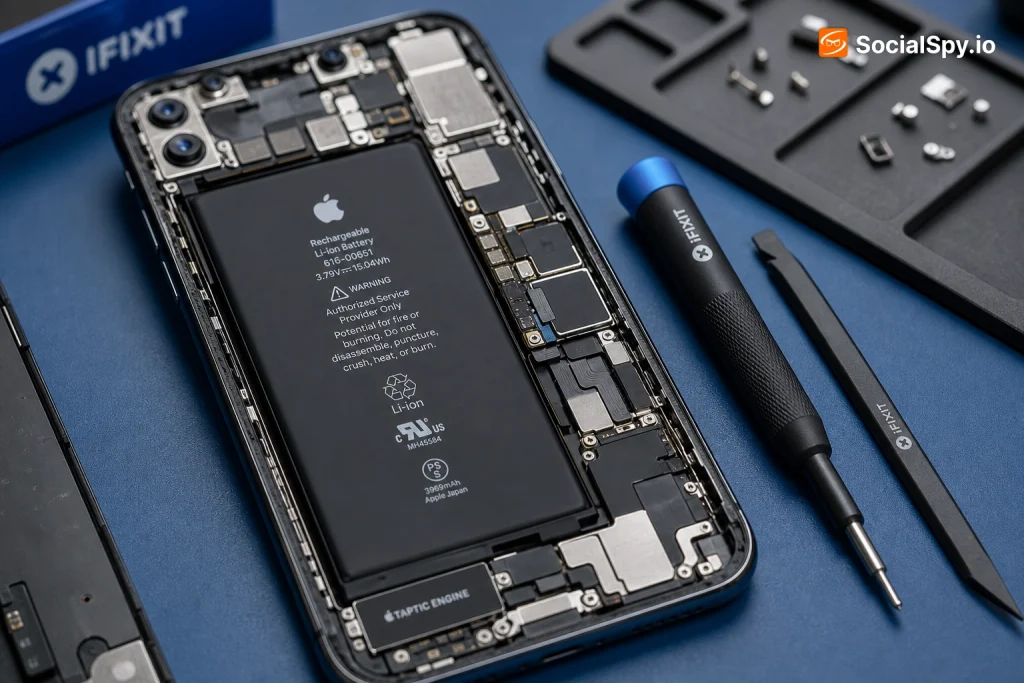
The iPhone 11 Pro Max turns four years old this year, and that means one thing for a huge number of owners: battery degradation is no longer theoretical. Apple’s own lithium-ion cells are rated to hold up to 80% of original capacity at 500 complete charge cycles, and most 11 Pro Max users blew past that milestone long ago. If your phone is dying by 3pm or throttling under load, a battery swap is almost certainly the fix — the question is just how much it costs and what actually happens during the repair.
Why the iPhone 11 Pro Max Battery Wears Out Faster Than You’d Expect
The iPhone 11 Pro Max shipped with a 3,969mAh battery, the largest Apple had put in a phone up to that point, paired with a triple-camera system and a 6.5-inch Super Retina XDR display that both draw serious power. Apple rated it for up to 20 hours of video playback, and it earned a reputation as one of the best-battery-life iPhones ever released.
But lithium-ion chemistry degrades regardless of how well a phone is designed. Every full charge cycle causes microscopic wear in the battery’s internal structure, and Apple itself states that its batteries are designed to retain 80% of their original capacity at 500 complete charge cycles under ideal conditions.
Real-world use accelerates that decline. Several factors specific to how people actually use this phone speed things along:
- Fast charging heat: Charging above 20W with third-party USB-C-to-Lightning chargers generates more heat, which is the single biggest enemy of battery longevity.
- Overnight charging: Leaving the phone plugged in at 100% for 8+ hours daily accelerates chemical aging, even with iOS’s Optimized Battery Charging feature active.
- iOS updates: Newer iOS versions (the 11 Pro Max can run up to iOS 18) often add background processes that older, degraded batteries struggle to support without voltage sag.
- Age alone: Even a phone that’s been sitting in a drawer for two years will show chemical aging, independent of cycle count.
You can check your actual battery health by going to Settings > Battery > Battery Health & Charging. Apple flags anything below 80% maximum capacity as a candidate for replacement, and displays a “Peak Performance Capability” warning if the battery can no longer reliably deliver peak power without unexpected shutdowns.
How Much Does an iPhone 11 Pro Max Battery Replacement Actually Cost?
Pricing varies more than most people expect, and the cheapest option isn’t always the smartest one. Here’s how the main routes stack up:
| Repair Option | Typical Cost | Turnaround | Warranty |
|---|---|---|---|
| Apple Store / Apple Authorized Service Provider | $99 | Same day (1-4 hrs) | 90 days |
| AppleCare+ coverage | Free | Same day | 90 days |
| Third-party chain (uBreakiFix, CPR Cell Phone Repair) | $60-$90 | 30-60 min | 90 days to 1 year |
| Independent local repair shop | $50-$80 | 20-45 min | Varies, often 30-90 days |
| DIY kit (iFixit, Injured Gadgets) | $35-$50 in parts | 45-60 min (your time) | Parts warranty only, 1 year typical |
Industry repair trackers have noted that out-of-warranty battery pricing across Apple’s lineup has stayed relatively flat since 2020, even as inflation pushed up costs for nearly every other consumer repair category — Apple has kept the $99 battery price point specifically to encourage people to fix rather than replace their phones.
Why Apple’s Price Went From $49 to $99
Long-time iPhone owners may remember Apple’s famous $29 battery replacement program launched in late 2017 after the “batterygate” controversy, when Apple admitted to throttling performance on older iPhones with degraded batteries without clearly disclosing it. That discounted pricing expired at the end of 2018, and the standard out-of-warranty rate for iPhones like the 11 Pro Max settled at $99 — a price that’s held steady largely because the battery itself is a relatively low-cost component, and Apple’s margin comes from labor and the authorized-service infrastructure, not the part.
What Actually Happens During the Repair
A battery swap on the 11 Pro Max is more involved than on some older iPhones because of the adhesive strips and the layout around the Taptic Engine, but it’s still considered a moderate-difficulty repair rather than an extreme one.
Here’s the general sequence any technician (or DIYer) follows:
- Power down the device completely and remove the two pentalobe screws at the bottom of the phone next to the Lightning port.
- Heat the screen using a heat gun, heat pad, or iOpener to soften the adhesive holding the display to the frame.
- Pry open the display carefully with suction cups and plastic opening tools, then flip it up like a book — it’s still connected by ribbon cables.
- Disconnect the battery connector first (a critical safety step that prevents short circuits during the rest of the disassembly).
- Remove the adhesive pull-tabs underneath the battery, stretching them slowly at a low angle to release the battery from the chassis without bending or puncturing the cell.
- Install the new battery, reconnect the battery connector, and test the phone before fully resealing it.
- Reseal the display with new adhesive strips and reinstall the pentalobe screws.
The riskiest step by far is pulling the adhesive strips. If a strip snaps and a technician resorts to prying the battery out with a metal tool instead, there’s a real risk of puncturing the lithium-ion pouch — which can cause the battery to swell, smoke, or in rare cases ignite. This is exactly why Apple Stores and most reputable shops use specialized suction and heat tools rather than brute force.
Apple Store vs. Third-Party vs. DIY: Which Should You Choose?
There’s no single right answer here — it depends on your risk tolerance, budget, and whether you care about parts pairing and long-term software compatibility.
Going Through Apple
- Uses genuine Apple batteries with proper battery-health serial number pairing, so you won’t get the “Unknown Part” or “Important Battery Message” warning in Settings.
- Comes with a standard 90-day warranty, or falls under AppleCare+ terms if you have coverage.
- Requires an appointment via the Apple Support app or website; Genius Bar slots can be booked out several days in some cities.
- Free if the battery health has already dropped below 79% capacity while the phone is still under an active AppleCare+ plan, or in some cases if a phone qualifies under a specific battery-related service program.
Going Through a Third-Party Shop
- Chains like uBreakiFix (a subsidiary of Asurion) and CPR Cell Phone Repair now do official Apple-authorized repairs at some locations, meaning genuine parts and Apple-backed warranties are increasingly available outside Apple Stores too.
- Non-authorized independent shops are typically the cheapest and fastest, but may use aftermarket batteries that lack Apple’s battery health serial pairing — this can trigger the “Unable to verify this iPhone has a genuine Apple battery” message in Settings even if the part functions fine.
- Aftermarket cells vary hugely in quality; a reputable shop uses batteries with proper protection circuitry, while the cheapest bulk suppliers sometimes ship cells that degrade within a year.
Doing It Yourself
- iFixit sells a complete battery replacement kit for the 11 Pro Max, typically priced around $40-$50, including the battery, adhesive strips, and all necessary opening tools.
- iFixit’s own repairability documentation rates this job as moderate difficulty, achievable in under an hour by someone comfortable with small screws and ribbon cables.
- The main risks are voiding any remaining warranty, damaging the display ribbon cables during the pry-open step, or puncturing the battery.
- You’ll also get the “Unknown Part” battery warning in iOS afterward, since DIY kits use aftermarket cells without Apple’s pairing — purely cosmetic, but worth knowing before you commit.
Signs You Actually Need a Battery Replacement (Not a New Phone)
Before spending anything, it’s worth confirming the battery is really the problem — plenty of 11 Pro Max slowdowns are software-related, not hardware.
Watch for this combination of symptoms:
- Battery Health percentage below 80% in Settings > Battery > Battery Health & Charging.
- A “Peak Performance Capability” notice stating the battery can no longer supply maximum power.
- The phone shutting down unexpectedly at 20-30% remaining charge, even though the percentage indicator shows plenty left.
- Noticeable lag or stutter during camera use or gaming that resolves temporarily right after a full charge.
- The device feeling warmer than normal during light tasks like scrolling or texting.
- A swollen back panel or lifting screen — this is a physical safety issue, and the phone should stop being used and charged immediately until serviced.
If you see a visibly bulging screen or the phone won’t sit flat on a table anymore, that’s a swollen battery — a fire and chemical burn risk, not just an inconvenience. Stop charging it and get it serviced immediately rather than waiting for a scheduled appointment slot.
Is It Worth Replacing the Battery on a 4-Year-Old iPhone?
This is the real financial question for most 11 Pro Max owners in 2024 and 2025, and the math generally favors repair.
A used iPhone 11 Pro Max in good condition currently resells for roughly $180-$280 depending on storage size and condition, while a comparable new mid-range Android phone or an iPhone SE starts around $430-$600. Against that backdrop, a $99 battery replacement that restores near-original performance and another 1-2 years of solid use is a strong value, especially since the 11 Pro Max still runs the latest iOS updates and supports Apple’s most current software features.
The math changes if other components are also failing — a cracked screen, a worn-out charging port, or camera issues stack up quickly, and at a certain point cumulative repair costs approach the price of buying a newer used iPhone (like an iPhone 13 or 14) instead. As a rough guideline, if total repair costs exceed roughly 40-50% of what a comparable used replacement phone costs, it’s usually smarter to upgrade rather than keep sinking money into an aging device.
Conclusion
The iPhone 11 Pro Max remains a genuinely capable phone in 2025 — it has a great camera system, a display that still holds up, and full compatibility with current iOS releases — which is exactly why a $99 battery swap is one of the best repair-dollar-for-value decisions an iPhone owner can make right now. The device’s biggest weakness isn’t its processor or its screen, it’s a four-year-old lithium-ion cell that was never designed to last forever. For most owners, going through Apple or an Apple-authorized provider is worth the extra cost over the cheapest independent shop, simply to avoid the “unknown part” warning and to get a battery with proper long-term protection circuitry. But if you’re comfortable with a screwdriver and some patience, a $40 iFixit kit and 45 minutes of careful work can deliver essentially the same real-world result for less than half the price.
FAQ
Check Settings > Battery > Battery Health & Charging — if Maximum Capacity has dropped below 80%, or you see a “Peak Performance Capability” warning, that’s a strong signal your battery is degraded. Unexpected shutdowns at 20-30% charge and noticeable slowdowns that improve right after charging are additional confirmation signs.
A quality aftermarket battery from a reputable supplier will perform nearly identically to a genuine Apple part, though you’ll see a harmless “Unknown Part” message in Settings since it lacks Apple’s serial pairing. The real risk isn’t the brand, it’s quality control — cheap, unbranded cells from unreliable suppliers can degrade faster or, in rare worst cases, pose safety risks, so it’s worth choosing a shop or kit with good reviews rather than the absolute lowest price.
For a phone with only battery issues, replacement is almost always cheaper — $99 through Apple versus $400+ for even a budget replacement phone. It only makes financial sense to upgrade instead if the 11 Pro Max has multiple other problems (cracked screen, failing charging port, camera damage) that would push combined repair costs close to half the price of a comparable used replacement device.