Watch batteries seem simple until yours dies at the worst possible moment – right before a job interview or during a hike with no backup. The truth is that battery life varies wildly depending on the type of watch, the battery chemistry, and even how you store the watch when you’re not wearing it.
What Actually Determines Battery Lifespan
A watch battery’s lifespan isn’t a fixed number stamped at the factory – it’s the result of several interacting factors. The battery chemistry itself matters most, but the watch’s power draw and your daily habits shift the outcome by years in either direction.
- Battery chemistry: Silver oxide batteries generally outlast alkaline ones by 2-3x in watch applications.
- Number of functions: A basic three-hand analog watch sips power, while a chronograph, alarm, or perpetual calendar drains it faster.
- Movement type: Standard quartz movements use a stepping motor that ticks once per second; sweeping quartz movements (which mimic mechanical smoothness) consume noticeably more energy.
- Backlight and complications: Illuminated dials, date wheels with quickset correction, and moon phase indicators all add parasitic drain.
- Storage conditions: Extreme heat or cold accelerates chemical degradation even when the watch sits unworn.
Industry watchmakers estimate that roughly 80% of “dead battery” complaints brought into repair shops are actually watches with functioning batteries but corroded contacts or a stuck stepping motor – a distinction that matters before you spend money replacing something that isn’t broken.
Battery Life by Watch and Battery Type
Not all watch batteries are created equal, and the difference between button cell chemistries is bigger than most people assume. Here’s how the common types stack up in real-world use.
| Battery/Watch Type | Typical Lifespan | Best For |
|---|---|---|
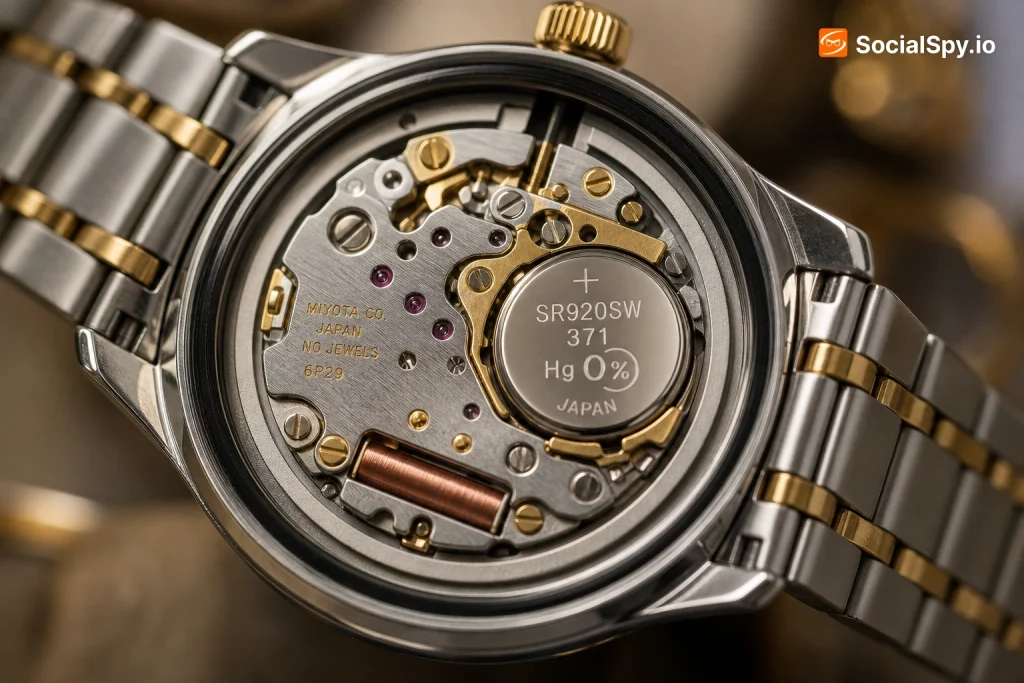
| Silver oxide (SR626, SR920, etc.) | 2-5 years | Most analog quartz watches |
| Alkaline (LR44, AG13, etc.) | 1-2 years | Budget fashion watches, novelty items |
| Lithium (CR2032, CR2025) | 3-10 years | Watches with larger cases and low-drain movements |
| Smartwatch lithium-ion (rechargeable) | 1-2 days per charge, 2-3 years total battery health | Apple Watch, Wear OS, Galaxy Watch |
| Solar-powered (capacitor, no replacement) | 6 months to years on stored charge; capacitor itself lasts 10-20 years | Citizen Eco-Drive, Seiko Solar |
| Automatic/kinetic (self-winding) | No disposable battery; capacitor or mainspring stores energy | Seiko Kinetic, mechanical automatics |
Silver oxide is the industry standard for a reason – it maintains a steadier voltage output as it depletes, which matters for accuracy. Alkaline batteries are cheaper but their voltage curve drops off unevenly, which is why cheap watches sometimes start losing time noticeably before the battery is fully dead.
Why Lithium Batteries Last So Much Longer
Lithium coin cells like the CR2032 show up in watches with bigger cases because they physically hold more capacity than the tiny SR-series cells. A CR2032 can store roughly 220 mAh compared to an SR626’s 28 mAh, which is why watches using lithium cells can stretch replacement intervals to a decade in low-drain designs.
Analog Quartz vs. Digital vs. Smartwatch
The category of watch you own changes everything about how you should think about “battery life,” because the term means something different depending on the technology inside.
- Analog quartz watches use a single button-cell battery to power a stepping motor. Expect 2 to 5 years per battery, with most watchmakers recommending replacement at the first sign of a slowing second hand.
- Digital watches (Casio-style LCD watches) often sip even less power than analog quartz because there’s no motor – just a display refresh. Many digital watches, including classic Casio F-91W-style models, run 7 to 10 years on a single CR2016 or similar cell.
- Smartwatches operate on an entirely different scale. Devices like the Apple Watch Series 11 or Galaxy Watch 7 need daily or near-daily charging, and the rechargeable lithium-ion cell inside them degrades over roughly 2 to 3 years of daily charge cycles before it noticeably loses capacity – similar to a phone battery.
This is the single biggest point of confusion for people switching from a traditional watch to a smartwatch. A digital Casio can sit in a drawer for years and still work; a smartwatch left uncharged for a few weeks will be completely dead and may even require a firmware reset when you finally plug it back in.
Solar, Kinetic, and Automatic: The “No Dead Battery” Options
If you’re tired of battery replacements altogether, three watch technologies solve the problem in different ways.
- Solar-powered quartz (Citizen’s Eco-Drive line, many Seiko Solar models) uses a photovoltaic cell under the dial face to charge an internal capacitor. Fully charged, these can run 6 months to over a year in total darkness, and the capacitor itself typically lasts 10 to 20 years before needing professional replacement.
- Kinetic watches (Seiko Kinetic) convert wrist motion into electricity via a rotor, storing it in a capacitor rather than a traditional battery. A fully charged kinetic watch runs about 6 months without wear before it stops.
- Automatic mechanical watches have no battery at all – a mainspring wound by wrist motion or a manual crown powers the movement entirely mechanically, so “battery life” is a non-issue, though the watch will stop within 36 to 70 hours if left unworn (its “power reserve”).
The tradeoff is upfront cost and, in the case of mechanical automatics, accuracy – a quartz movement is accurate to within seconds per month, while even a well-regulated mechanical movement can drift by several seconds per day. For someone who values convenience over heritage watchmaking, solar quartz arguably offers the best of both worlds: quartz-level accuracy with none of the battery-replacement hassle.
Signs Your Watch Battery Is Dying (and What’s Actually Wrong)
Batteries rarely die instantly – there’s usually a warning period, and recognizing it can save you a trip to the jeweler for the wrong problem.
- Second hand jumping in 2-4 second increments instead of once per second – this is the universal “low battery” signal on quartz watches, built in deliberately by movement manufacturers like Miyota and Seiko.
- Dimming or flickering backlight on digital watches.
- Slow or inconsistent timekeeping that wasn’t present before.
- Complete stop with the hands frozen at one position.
- Smartwatch charging to less than 100% even after hours on the charger, or the battery percentage dropping unusually fast – a sign of lithium-ion degradation rather than a simple depleted cell.
If your quartz watch stops but shows none of the second-hand jump warning first, it’s worth having a jeweler check for a stuck movement or moisture damage before assuming it’s just the battery. A watch that got wet and then stopped is a different repair entirely – often involving movement cleaning or replacement rather than a $10 battery swap.
Battery Replacement: Cost, Timing, and DIY Risks
Replacing a watch battery is one of the cheapest repairs in the accessory world, but the price and difficulty vary more than people expect.
| Service Option | Typical Cost (2026) | Turnaround |
|---|---|---|
| Big-box jewelry counter (mall kiosks) | $10-$20 | Same day, 10-15 minutes |
| Independent watch/jewelry shop | $15-$35 | Same day |
| Brand service center (Rolex, Omega, etc.) | $50-$150+ | 1-3 weeks, often includes pressure test |
| DIY replacement kit | $8-$15 for tools + battery | 15-30 minutes |
Doing it yourself is tempting, especially with iFixit-style kits and cheap case-back openers widely available, but there are real risks. Opening a water-resistant watch without resealing the gasket properly can void that water resistance permanently, even if the watch looks fine afterward.
A common mistake DIYers make is touching the new battery with bare fingers – skin oils can cause micro-corrosion on the battery terminals, shortening its life before it’s even installed. Professionals handle replacement batteries with plastic tweezers for exactly this reason.
For watches under warranty or with screw-down crowns (common on dive watches rated 100m or more), it’s almost always worth paying a professional to preserve the water-resistance rating with a proper gasket reseal and pressure test.
Conclusion
The “how long does a watch battery last” question really has three different answers depending on what’s on your wrist. A basic analog quartz watch with a silver oxide cell is a low-maintenance, multi-year commitment – set it, forget it, and expect a replacement notice roughly every 2 to 3 years when the second hand starts jumping. Digital watches stretch that even further thanks to lower power draw, sometimes lasting the better part of a decade on one cell.
Smartwatches flip the entire equation, trading years of battery life for daily features and requiring nightly charging like a phone. And if replacement batteries are simply a hassle you’d rather avoid altogether, solar and kinetic watches have quietly solved the problem for the past two decades, storing energy in a capacitor that only needs professional attention once every 10-20 years. Choosing the right category for your lifestyle – not just the right brand or style – is what actually determines how often you’ll be thinking about batteries at all.
FAQ
Watch the second hand before it stops completely – if it starts jumping in 2-4 second increments rather than moving smoothly every second, that’s the movement’s built-in low-battery signal, and a simple replacement will fix it. If the watch stopped abruptly with no warning jump, especially after water exposure or a drop, there may be movement damage that a battery swap alone won’t resolve.
Yes, for basic non-water-resistant watches with a snap-back case, a $10-$15 DIY kit works fine and takes about 15 minutes. For dive watches, screw-down crowns, or anything with a meaningful water-resistance rating, it’s worth paying $15-$35 at a jeweler so they can reseal the gasket and pressure-test the case afterward.
Smartwatches like the Apple Watch or Galaxy Watch run a full processor, display, and wireless radios that draw far more power than a simple quartz stepping motor, so they use a rechargeable lithium-ion battery designed for daily charging rather than a long-life button cell. That lithium-ion cell also degrades over roughly 2-3 years of daily cycles, similar to a smartphone battery, meaning even a well-maintained smartwatch will eventually need a battery health check or replacement.