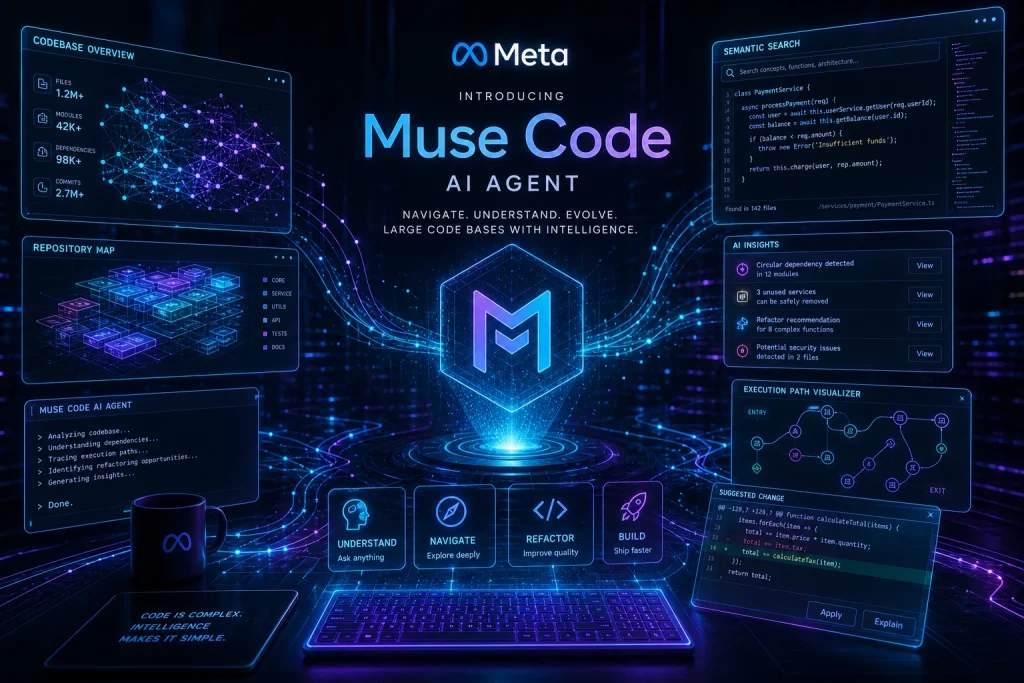
In a groundbreaking advancement in the field of software development, Meta has introduced Muse Code, an AI-powered agent designed to revolutionize how developers interact with large code bases. As software systems grow increasingly complex, Muse Code aims to simplify the way developers manage, understand, and optimize their code, potentially transforming the landscape of programming.
The Evolution of AI in Software Development
Artificial Intelligence has been making significant inroads into software development over the past few years. From automating repetitive tasks to predicting code errors, AI tools have become indispensable in modern programming environments. Meta, known for its innovative approach and commitment to AI research, has taken a bold step with the introduction of Muse Code.
Unlike traditional code management tools, Muse Code leverages machine learning algorithms to provide insights and recommendations that are contextually aware of the code’s architecture and domain. This advancement signifies a shift from basic automation to intelligent assistance, where AI not only executes tasks but also comprehends the broader scope of the projects it assists with.
Features of Muse Code
Muse Code is equipped with several features designed to enhance the efficiency and effectiveness of software development processes.
- Intelligent Code Analysis: Muse Code scans entire code bases to identify inefficiencies, security vulnerabilities, and potential bugs, offering solutions based on best coding practices.
- Contextual Recommendations: The AI agent provides personalized suggestions by understanding the specific context and requirements of the project, thus ensuring that recommendations are relevant and actionable.
- Automated Documentation: Muse Code can generate comprehensive documentation, making it easier for developers to understand and maintain large code bases without spending excessive time writing comments and manuals.
- Seamless Integration: Muse Code integrates with popular development environments and repositories, facilitating smooth adoption without disrupting existing workflows.
Implications for Developers and Organizations
The introduction of Muse Code is likely to have profound implications for both individual developers and organizations. For developers, especially those working on large-scale projects, Muse Code can significantly reduce the cognitive load associated with understanding and maintaining vast amounts of code. This allows developers to focus more on creative and strategic aspects of software development.
For organizations, Muse Code presents a competitive edge by streamlining development processes and reducing the time and costs associated with debugging and code optimization. By improving code quality and accelerating time-to-market, companies can enhance their software offerings and respond more rapidly to market demands.
Challenges and Considerations
While Muse Code offers numerous benefits, there are challenges and considerations that need to be addressed. One of the primary concerns is the reliance on AI for critical code analysis, which requires a high degree of accuracy to avoid introducing new errors. Additionally, the integration of AI tools into existing workflows can be a daunting task for some organizations, necessitating careful planning and training.
There are also ethical considerations related to the use of AI in software development, particularly concerning dependency and the potential reduction of human oversight. Ensuring that developers maintain a critical role in decision-making processes is essential to prevent over-reliance on AI-generated outputs.
Conclusion
Muse Code represents a significant leap forward in the integration of AI into software development. By providing intelligent code analysis, contextual recommendations, and automated documentation, Meta’s AI agent offers a comprehensive solution for managing large code bases. While challenges exist, the potential benefits for developers and organizations alike are substantial, promising to enhance productivity and code quality across the board.
As AI continues to evolve, tools like Muse Code will likely become standard in the software development toolkit, driving innovation and efficiency in the industry. The key to success will be balancing AI capabilities with human expertise, ensuring that technology serves as an aid rather than a replacement.
FAQ
Muse Code is an AI-powered agent developed by Meta, designed to assist developers in managing large code bases. It uses machine learning algorithms to analyze code, provide contextual recommendations, and automate documentation, thereby enhancing efficiency and code quality.
Yes, Muse Code is designed to seamlessly integrate with popular development environments and code repositories. This ensures that developers can adopt the tool without disrupting their existing workflows.
While Muse Code offers numerous benefits, potential risks include over-reliance on AI for critical code analysis and the challenge of integrating AI into existing workflows. Ensuring accurate AI outputs and maintaining human oversight in decision-making processes are essential to mitigating these risks.