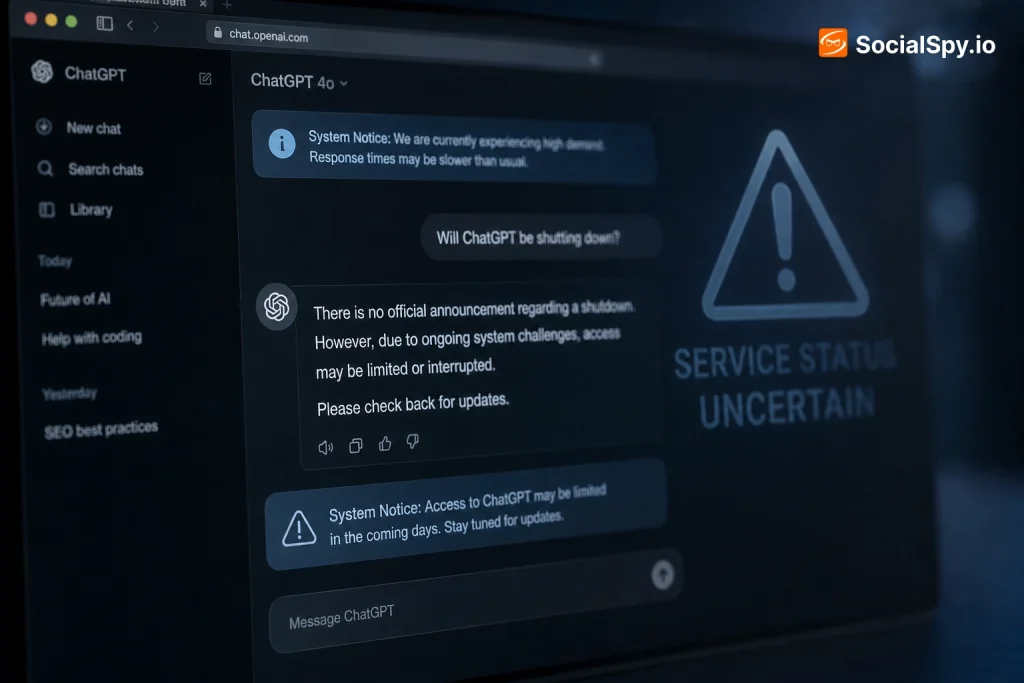
Every few weeks, a new wave of panicked social posts and Google searches asks the same question: is ChatGPT shutting down? The rumors usually trace back to a temporary outage, a viral screenshot, or a misread headline about OpenAI’s finances, but the actual answer requires separating platform hiccups from genuine business risk.
Why This Rumor Keeps Resurfacing
Shutdown rumors around ChatGPT tend to follow a predictable pattern. Something breaks or changes, screenshots circulate on X and Reddit, and within hours “ChatGPT down” or “ChatGPT shutting down” starts trending as a search term.
Several distinct triggers have fueled this cycle over the past two years:
- Outages: OpenAI has had multiple multi-hour outages, including a significant one in June 2025 tied to a broader cloud infrastructure issue affecting Cloudflare and other services, and another in late 2024 linked to a bad configuration change.
- Model deprecations: When OpenAI retired older models like GPT-4 (the original version) from ChatGPT’s model picker in 2025, some users assumed the entire product was being discontinued rather than just one model version.
- Financial headlines: Reports about OpenAI’s massive compute spending commitments — including a reported $1.4 trillion in cumulative infrastructure obligations to partners like Oracle, AMD, and Nvidia — get misinterpreted as signs the company is running out of money.
- Executive turnover: Departures of high-profile researchers and safety staff, including several from OpenAI’s alignment and superalignment teams in 2024, get read as evidence of internal collapse.
- Satirical or clickbait content: Fake “OpenAI announces shutdown” posts occasionally go viral before being debunked.
None of these individually amounts to evidence the service is closing. But stacked together in a news feed, they create an impression of instability that doesn’t match what’s actually happening inside the company.
What OpenAI’s Actual Numbers Say
The financial picture is genuinely complicated, and it’s worth being honest about the tension rather than dismissing it outright. OpenAI is spending at a scale few companies in history have attempted, and it is not yet profitable.
Industry analysts tracking OpenAI’s disclosures estimate the company lost several billion dollars in 2024 alone, even as revenue climbed toward an annualized run rate north of $10 billion by mid-2025.
Here’s the contrast that actually matters for whether ChatGPT itself disappears:
| Metric | Figure (approximate) |
|---|---|
| Weekly active ChatGPT users | 800 million+ (late 2025) |
| Annualized revenue run rate | $10 billion+ (mid-2025) |
| Valuation in recent funding rounds | $500 billion (late 2025 tender offer) |
| Committed compute spending (multi-year) | $1.4 trillion+ |
| Paying business customers | 1 million+ (mid-2025) |
A company burning cash while scaling revenue and user base this fast isn’t a company about to switch off its flagship product. It’s a company in an aggressive growth phase, similar to Amazon’s early years or Uber’s pre-IPO decade, where losses are a deliberate strategic choice tied to land-grab dynamics in a new market, not a sign of imminent failure.
The bigger risk isn’t OpenAI going dark — it’s whether the current spending pace is sustainable without further massive funding rounds, and whether pricing or free-tier access changes over time. Neither of those scenarios means “ChatGPT shutting down.”
The Difference Between an Outage and a Shutdown
This distinction gets lost constantly, and it’s the single biggest source of confusion driving the shutdown searches. An outage is a temporary, technical failure. A shutdown is a permanent business decision to end a product.
Consider how differently these two categories actually play out:
- Outages are measured in minutes or hours, get status updates on status.openai.com, and are almost always resolved same-day.
- Feature removals happen when OpenAI deprecates a specific model or tool (like the original Code Interpreter naming or older API endpoints) while the core ChatGPT product keeps running.
- Regional restrictions occur when OpenAI pauses access in specific countries for regulatory reasons — Italy’s temporary 2023 ban over GDPR concerns is the clearest example — without affecting the global service.
- A true shutdown would mean OpenAI formally announcing it is discontinuing ChatGPT entirely, shutting down its API, and refunding subscribers. This has never happened and there is no indication it is being planned.
OpenAI actually publishes a live status page, and checking it directly is far more reliable than trusting a trending hashtag. If ChatGPT is acting up right now, status.openai.com will show whether it’s a known, tracked incident or something isolated to your device or network.
What Would Actually Have to Happen for ChatGPT to Shut Down
It’s useful to think through the realistic scenarios, because “shutting down” isn’t a binary switch — there are gradations of risk worth understanding separately.
Business Failure Scenario
This is the doomsday version people imagine, and it’s currently the least likely. OpenAI would need to run out of funding options entirely, which seems improbable given:
- A late-2025 tender offer valuing the company at roughly $500 billion, among the highest private valuations ever recorded.
- Continued backing from Microsoft, which has invested over $13 billion and integrated OpenAI’s models into Azure, Copilot, and Windows.
- New capital partners including SoftBank, Thrive Capital, and sovereign wealth funds participating in recent funding rounds.
A company with that valuation and that many strategic partners has enormous incentive — and enormous ability — to keep the product alive even through rough financial quarters.
Acquisition or Restructuring Scenario
A more plausible, though still not imminent, scenario involves OpenAI restructuring its nonprofit-to-for-profit corporate structure (which it has already been doing since 2024) or being folded into a larger entity’s product line following financial pressure. Even in this case, ChatGPT as a brand would very likely survive, similar to how Instagram kept its name and app after Facebook’s acquisition rather than being shut down.
Regulatory Shutdown Scenario
Governments could theoretically force ChatGPT offline in specific jurisdictions over data privacy, copyright, or AI safety concerns. This has already happened briefly:
- Italy temporarily banned ChatGPT in 2023 over GDPR data-processing concerns before OpenAI made changes and access was restored weeks later.
- China blocks ChatGPT entirely through its national firewall, and it has never been officially available there.
- The EU AI Act, phased in through 2025 and 2026, imposes new transparency and risk-assessment obligations that could force product changes, though not a full shutdown.
These are localized and product-adjusting events, not global shutdowns of the service.
Competitive Displacement Scenario
The most realistic long-term threat isn’t OpenAI going bankrupt — it’s ChatGPT losing dominance to Google’s Gemini, Anthropic’s Claude, or Meta’s AI products, the way Yahoo lost search dominance to Google without Yahoo “shutting down” for years afterward. Even in a slow-decline scenario, ChatGPT would likely remain operational for a long time as a smaller but still functioning product.
Practical Steps If You’re Worried About Losing Access
If your concern isn’t really “is the company dying” but rather “what happens to my data and workflow if something changes,” there are concrete things worth doing now regardless of shutdown rumors.
- Export your conversation history regularly. OpenAI allows account data exports through Settings, and this is worth doing periodically even if you also read how to do a full data extraction from ChatGPT for a step-by-step walkthrough.
- Don’t rely on chat history as permanent storage. Treat ChatGPT like a tool, not an archive — copy important outputs into a document or notes app immediately.
- Diversify your AI tools for critical work. Businesses running significant workflows through ChatGPT should have a fallback like Claude or Gemini configured, the same way IT teams avoid single points of failure with any cloud vendor.
- Understand your actual spending exposure. If you’re a business user, knowing your real usage costs matters more than shutdown rumors; see how much it really costs to run ChatGPT for a small business for a breakdown of API versus subscription pricing.
- Periodically clean up old data. If privacy is your underlying worry rather than shutdown risk, learning how to delete ChatGPT history addresses that directly without needing the service to disappear.
None of these steps assume ChatGPT is going away. They’re just sound digital hygiene for depending on any third-party cloud service, the same advice that applied to Google Docs users or Dropbox users a decade ago.
Conclusion
The “ChatGPT shutting down” search spike says more about how information spreads in 2025 than about OpenAI’s actual trajectory. A viral screenshot, a routine outage, or a headline about compute spending gets stripped of context and reassembled into a scarier story within hours. Meanwhile, the underlying business — 800 million weekly users, a $500 billion valuation, and deep infrastructure ties to Microsoft, Oracle, and Nvidia — looks nothing like a company preparing to pull the plug. The realistic risks are narrower and slower-moving: regulatory friction in specific countries, gradual market share erosion to rivals, or corporate restructuring that changes ownership without killing the product. If you want a genuinely useful signal instead of a rumor, check status.openai.com during an outage and watch OpenAI’s actual funding and revenue disclosures over time — those tell you far more than any trending hashtag ever will.
FAQ
No. There is no announcement, filing, or credible reporting indicating OpenAI plans to discontinue ChatGPT. The company continues to raise capital at record valuations, expand its user base past 800 million weekly users, and sign massive multi-year infrastructure deals, all of which point toward continued operation rather than closure.
Temporary outages happen because ChatGPT runs on complex cloud infrastructure shared with services like Microsoft Azure, and issues ranging from server overload to third-party cloud provider failures (like the June 2025 Cloudflare-linked disruption) can cause short downtime. These incidents are typically resolved within hours and are tracked publicly on OpenAI’s status page, which is a much more reliable source than social media speculation.
Regularly export your conversation history through OpenAI’s account settings, copy important outputs into a separate document or note-taking app, and avoid treating chat history as permanent storage. It’s also smart for business users to have a backup AI tool configured and to understand their actual usage costs so a sudden pricing or access change doesn’t catch them off guard.