The iPhone 15 Pro introduced a titanium frame, a USB-C port, and a battery removal system Apple hadn’t used before — and all three of those changes affect what a battery swap costs and how it’s done in 2024 and beyond. Whether your battery health has dropped into the red zone or you’re just planning ahead, here’s what actually happens and what you’ll pay.
What Makes the iPhone 15 Pro’s Battery Different
Apple redesigned how the back glass attaches to the chassis on the iPhone 15 Pro, and it directly changed battery service. Instead of only relying on pull-tab adhesive strips, Apple engineered the rear glass with an electrically-debonding adhesive that releases its grip when a low-voltage current — as little as 9 volts, roughly what a standard 9V battery provides — is run through it for about a minute.
That sounds like a small engineering detail, but iFixit’s teardown of the device highlighted it as a genuinely significant repairability shift. It means technicians can pop the back glass off without cracking it, which was one of the most common failure points in older repair jobs.
- Battery capacity: 3,274 mAh (up slightly from the iPhone 14 Pro’s 3,200 mAh)
- Chemistry: Lithium-ion with fast-charge support (up to 50% in about 30 minutes with a 20W+ adapter)
- Rated cycle life: 80% capacity retained at 1,000 complete charge cycles under normal use, per Apple’s own spec
- Frame material: Grade 5 titanium, which is more rigid and harder to flex open than the aluminum used on non-Pro models
- iFixit repairability score: 4 out of 10 — better than some prior iPhones for battery access, but still not a beginner-friendly repair
The titanium frame is actually a mixed blessing here. It resists bending during disassembly better than aluminum, but it’s also stiffer to pry apart, meaning tools and technique matter more than they did on older models.
How Much Does the Repair Actually Cost?
Pricing depends heavily on where you go, and the gap between options is bigger than most people expect. Here’s how the main paths stack up.
| Repair Option | Typical Cost | Turnaround | Genuine Parts? |
|---|---|---|---|
| Apple Store / Apple Authorized Service Provider | $99 | Often same day | Yes |
| AppleCare+ (battery health under 80%) | $0 | Same day | Yes |
| Mail-in Apple Repair | $99 + shipping time | 5–7 business days | Yes |
| Third-party chain (uBreakIFix, CPR, etc.) | $70–$100 | 30–60 minutes | Usually, varies by location |
| Independent local repair shop | $50–$90 | 20–45 minutes | Not guaranteed |
| Apple Self Service Repair (DIY) | ~$71–$89 for the part, plus a refundable tool kit rental | Depends on the repairer | Yes |
Apple Store or Authorized Service Provider
Apple’s flat-rate, out-of-warranty battery replacement for the iPhone 15 Pro is $99, which is $10 more than the $89 Apple charges for standard and mini models. That premium reflects the Pro line’s part costs, not extra labor complexity. Apple Stores generally keep 15 Pro batteries in stock, so a walk-in appointment booked through the Support app or website often gets same-day service.
Third-Party and Independent Repair Shops
Chains like uBreakIFix (an Asurion company partnered with Samsung, but also servicing iPhones) and CPR Cell Phone Repair typically quote $70 to $100 for an iPhone 15 Pro battery, depending on region and part sourcing. Independent local shops can undercut that, sometimes to $50–$60, but there’s a real tradeoff worth understanding before you save that $30.
Non-Apple-sourced batteries can trigger a persistent “Unknown Part” or battery health warning in iOS because of Apple’s parts-pairing system, even if the replacement functions perfectly fine physically.
That warning doesn’t brick the phone, but it does permanently hide the accurate battery health percentage in Settings unless the phone is later serviced with a genuine, Apple-paired part.
DIY With Apple’s Self Service Repair Program
Apple’s Self Service Repair storefront sells the genuine battery component for around $71 to $89 depending on promotions, plus a tool kit that requires a refundable rental deposit (previously priced around $49 for a week, with a deposit of roughly $1,200 that’s refunded once the kit ships back). This route only makes financial sense if you’re already comfortable with electronics repair or you’re doing multiple devices — for a single iPhone 15 Pro, it rarely beats a $99 Apple Store visit once you factor in the deposit hassle and shipping windows.
Signs Your Battery Actually Needs Replacing
Not every dip in battery performance means you need a new cell. iOS gives you the tools to check before you spend money.
- Open Settings > Battery > Battery Health & Charging. Look at “Maximum Capacity” — this compares your battery’s current capacity to when it was new.
- Watch for the 80% threshold. Apple’s one-year limited warranty guarantees the battery retains at least 80% capacity at 1,000 charge cycles; dropping below that is the industry-standard trigger point for replacement.
- Check for “Peak Performance Capability” messages. If iOS has throttled your CPU to prevent unexpected shutdowns, you’ll see a notice here explaining it.
- Track unexpected shutdowns. If your phone dies at 20-30% battery remaining, especially in cold weather, that’s a classic aging-cell symptom.
- Notice charging speed changes. A battery that used to fast-charge to 50% in 30 minutes but now takes 45+ minutes has likely degraded internal resistance.
Most iPhone 15 Pro owners won’t see meaningful degradation until somewhere between 18 and 30 months of regular daily charging, though heavy 5G use, gaming, and frequent fast-charging can accelerate that timeline.
What Happens During the Repair (Step by Step)
Whether you go to Apple or a certified third-party shop, the physical process looks broadly the same now that Apple’s electrical-release adhesive is standard across the 15 lineup.
- Check-in and diagnostic. The technician runs a quick battery health and hardware diagnostic to confirm the battery — not the charging port, software, or another component — is actually the issue.
- Powering down and disassembly. The phone is powered off, and the two Pentalobe screws near the charging port are removed to access the internals.
- Adhesive release. A low-voltage current is applied to the rear glass adhesive strips for roughly 60-90 seconds, allowing the back glass to lift off cleanly without heat guns or suction cups in most cases.
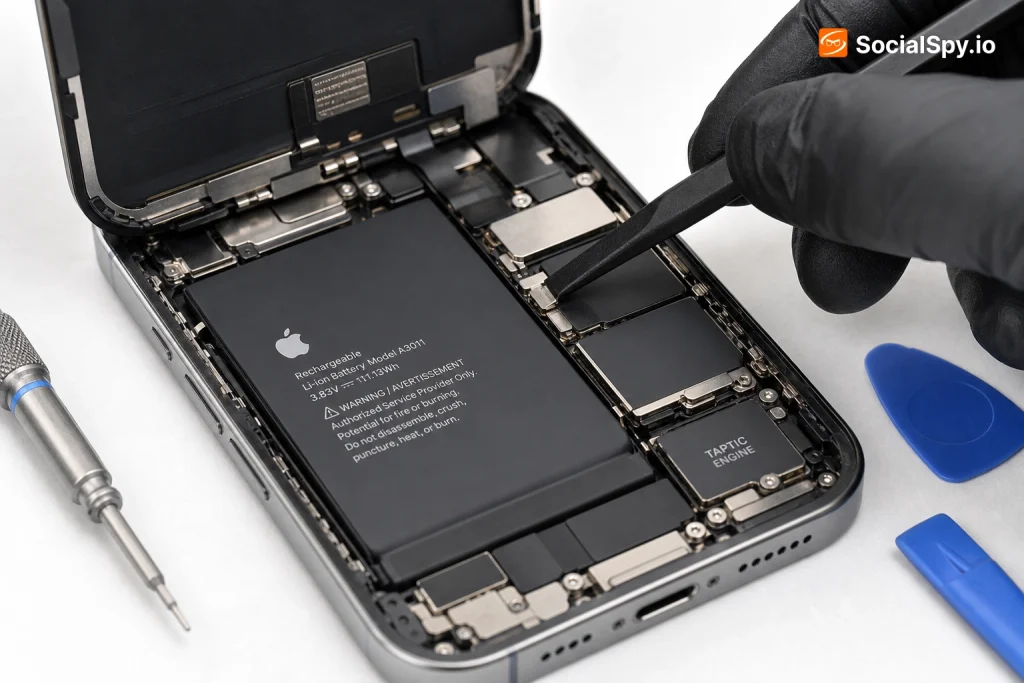
- Battery disconnection and swap. The old battery is disconnected from the logic board, unmounted, and replaced with the new cell, which is reconnected and adhered in place.
- Reassembly and calibration. The back glass is resealed, and the phone is powered on to confirm the new battery is recognized and calibrated correctly.
- Software verification. The technician checks Settings > Battery to confirm no “Unknown Part” warning appears and that Battery Health reads 100% on the new component.
For an experienced technician, the whole job typically takes 30 to 45 minutes for the physical swap. Apple Stores often ask you to leave the device for a few hours or return same-day, mainly due to scheduling and queue volume rather than repair complexity.
If you’re comparing this to how older Pro models handled the same job, it’s worth noting how much has changed generation to generation — see our breakdowns of the iPhone 14 Pro battery replacement process and the iPhone 13 Pro Max battery replacement process for context on how much faster and less destructive Apple’s adhesive redesign has made this repair.
AppleCare+, Warranty, and When It’s Actually Free
This is where a lot of people either overpay or miss out on a repair they’re already entitled to.
- Standard one-year limited warranty: Covers battery replacement for free only if the battery has degraded to less than 80% of original capacity due to a manufacturing defect — but Apple rarely triggers this outside AppleCare+ unless the drop happens very early and unusually fast.
- AppleCare+: Covers unlimited battery service for free anytime the battery’s health falls below 80%, for as long as your AppleCare+ plan is active (up to 3 years from purchase in the extended plans). This is the single biggest reason AppleCare+ pays for itself for anyone who keeps a phone 2+ years.
- AppleCare+ with Theft and Loss: Same battery coverage terms apply; the extra premium is for the theft/loss protection, not battery service.
- No AppleCare+, out of warranty: Flat $99 fee applies regardless of how degraded the battery is, as long as no other damage (cracked screen, water damage) complicates the repair.
- Prior unauthorized repairs: If someone other than Apple or an authorized provider has previously opened the phone, Apple may still service it, but they’ll disclose that non-genuine parts were found, and pricing can be affected if other components were damaged during that earlier repair.
If you’re on the fence about AppleCare+ for a new device, the battery clause alone is often the deciding factor — a single out-of-warranty swap at $99 already covers a meaningful chunk of a multi-year AppleCare+ premium, and most people replace at least one battery over a 3-year ownership period.
Conclusion
The iPhone 15 Pro’s redesigned adhesive system genuinely made battery service faster and less risky than on any previous titanium or stainless-steel iPhone, but it didn’t make the repair free or trivial. Your realistic options come down to three tiers: $0 through AppleCare+ if your health has dropped below 80%, $99 through Apple for a guaranteed genuine part and no software warnings, or $70–$100 at a reputable third-party shop if you’re willing to accept a small risk around parts-pairing messages. For most owners planning to keep their 15 Pro for three-plus years, the smartest move is checking Battery Health today, budgeting for the $99 Apple price point around the 18-24 month mark, and treating AppleCare+ as a hedge against that cost if you haven’t already skipped the window to buy it.
FAQ
No, a standard battery replacement doesn’t require erasing the device, and technicians at Apple Stores and most certified repair shops don’t need your passcode to complete the swap. That said, it’s smart practice to back up via iCloud or a computer beforehand in case any unrelated issue is discovered during diagnostics.
Generally no — Apple’s parts-pairing system detects when a battery isn’t cryptographically paired to your specific logic board and will show an “Unknown Part” or similar notice in Settings > Battery, even if the replacement works fine physically. The notice doesn’t disable the phone, but it does prevent iOS from displaying an accurate maximum capacity percentage until the part is properly calibrated by Apple.
For most people, no — the genuine part costs roughly $71 to $89, and the required tool kit rental involves a sizable refundable deposit and a shipping window that adds hassle for a single repair. It only makes sense if you’re already experienced with phone teardown work or plan to repair multiple devices, since a $99 Apple Store visit is usually faster and less risky for a one-time fix.