Tesla and SpaceX are reportedly teaming up on one of the most ambitious semiconductor projects in the history of American manufacturing: a $16.8 billion chip fabrication facility in Texas that insiders have already nicknamed the “Terafab.” The project, which is expected to be built near the companies’ existing operations in the Lone Star State, signals a major shift in how Elon Musk’s business empire plans to secure its future supply of advanced silicon amid an industry-wide chip crunch that has rattled everything from automakers to AI startups.
For years, Tesla and SpaceX have relied on third-party chipmakers like Samsung and TSMC to produce the custom silicon that powers everything from Full Self-Driving computers to Starlink satellite terminals. That dependency has become a growing liability as geopolitical tensions, export restrictions, and skyrocketing global demand for AI-grade chips have made semiconductor supply chains increasingly fragile. The Terafab appears to be Musk’s answer: build the capacity in-house, on American soil, and control the entire pipeline from design to fabrication.
Why Tesla and SpaceX Are Betting Big on Chips
The scale of this investment is staggering, even by Musk-company standards. $16.8 billion would place the Terafab among the largest single semiconductor investments ever made in the United States, rivaling mega-projects from Intel, TSMC, and Samsung that have already reshaped the domestic chip landscape. But unlike those companies, Tesla and SpaceX aren’t traditional chipmakers — they’re end users trying to vertically integrate their supply chain in a way few companies have attempted.
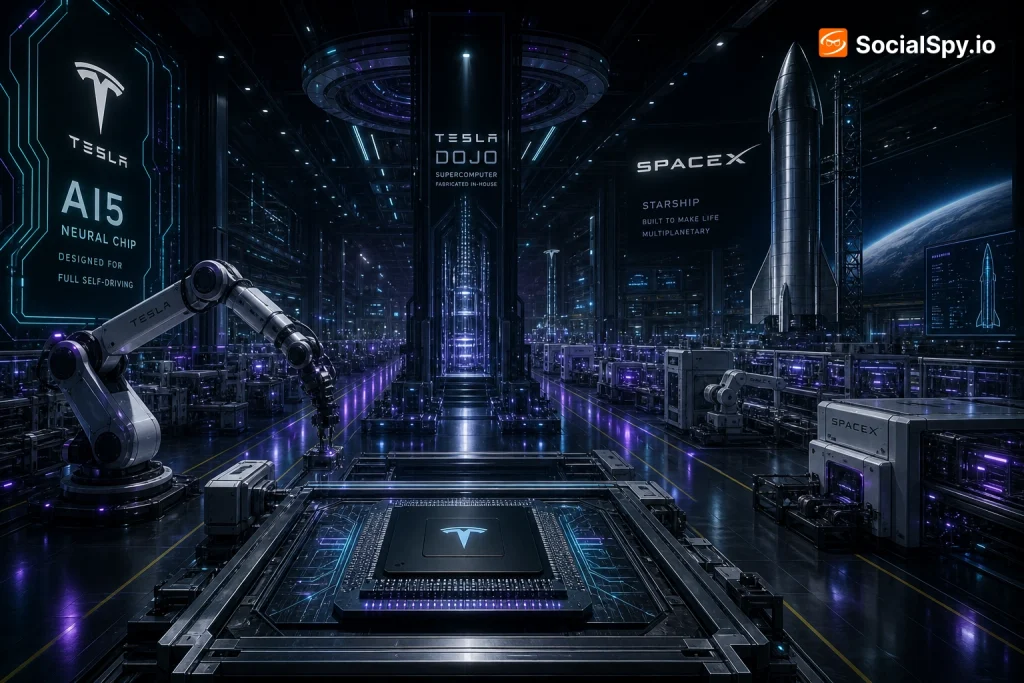
Tesla’s need for chips has exploded well beyond its vehicles. The company’s Dojo supercomputer, its humanoid robot Optimus, and its ever-expanding fleet of AI-powered driver-assistance systems all require enormous quantities of custom silicon. SpaceX, meanwhile, needs radiation-hardened, high-throughput chips for Starlink satellites, Starship avionics, and its growing constellation of orbital hardware. Both companies have reportedly struggled at times to secure enough allocation from external foundries, especially as AI giants like Nvidia and Microsoft gobble up available capacity.
- Tesla requires chips for FSD computers, Dojo AI training hardware, and Optimus robotics
- SpaceX needs specialized chips for Starlink terminals, satellites, and Starship guidance systems
- Both companies face growing competition for foundry capacity from AI and cloud computing giants
- Export controls and geopolitical risk make offshore chip reliance increasingly precarious
By building a dedicated fab, Musk’s companies would theoretically insulate themselves from these pressures while gaining the flexibility to design chips specifically optimized for their own workloads — something that’s difficult to do when leasing capacity from a foundry serving hundreds of other clients.
What “Terafab” Actually Means
The name “Terafab” is said to reference the facility’s projected output — potentially trillions of transistors’ worth of silicon capacity annually, aimed at supporting the next generation of Tesla’s AI training clusters and SpaceX’s expanding satellite network. While official specifications haven’t been fully disclosed, industry watchers believe the facility would focus on advanced logic chips and AI accelerators rather than legacy or commodity semiconductors, positioning it closer to a cutting-edge foundry than a basic assembly plant.
Texas has become the epicenter of Musk’s business operations over the past several years. Tesla relocated its headquarters to Austin, SpaceX’s Starship program is based at Starbase near Boca Chica, and both companies have cultivated close relationships with state officials eager to attract high-tech manufacturing jobs. A Terafab built in this corridor would likely benefit from tax incentives, a friendly regulatory environment, and proximity to existing Tesla and SpaceX infrastructure, allowing for tighter integration between chip design teams and fabrication engineers.
It’s also worth noting that Musk has previously floated the idea of Tesla building its own chips rather than relying entirely on partners. The company’s in-house design of the D1 chip for Dojo and its custom FSD computer chips were early signals of this ambition. A dedicated fab would represent the natural next step — moving from designing chips to actually manufacturing them at scale.
The Broader Chip Manufacturing Landscape
This move doesn’t happen in a vacuum. The U.S. government has spent the past several years aggressively courting semiconductor manufacturers back to American soil through initiatives like the CHIPS and Science Act, which allocated tens of billions of dollars in subsidies to companies willing to build advanced fabs domestically. TSMC, Samsung, Micron, and Intel have all announced major U.S. expansion projects in response, many of them also concentrated in Texas and Arizona.
Tesla and SpaceX entering this arena as builders rather than customers is a notable departure from how most tech companies typically operate. Apple, Nvidia, and Qualcomm all design their own chips but outsource fabrication almost entirely to TSMC. Even Amazon and Google, despite designing custom AI silicon, don’t own their own fabs. If the Terafab project moves forward as reported, Musk’s companies would be entering a far more capital-intensive and technically demanding business than chip design alone.
- Semiconductor fabs require billions in specialized equipment, much of it from Dutch company ASML
- Building advanced fabs typically takes 3-5 years from groundbreaking to production
- Talent acquisition for fab engineers and technicians remains a major bottleneck industry-wide
- Water and power requirements for large fabs can strain local infrastructure
Analysts point out that operating a fab is fundamentally different from building cars or rockets. The precision required in semiconductor manufacturing — measured in nanometers — demands specialized talent, extreme cleanroom conditions, and equipment sourced from a small handful of global suppliers, most notably ASML, the Dutch company that holds a near-monopoly on the extreme ultraviolet lithography machines needed for cutting-edge chip production. Securing that equipment alone can take years and cost hundreds of millions of dollars per machine.
What This Means for Investors and the Tech Industry
For Tesla shareholders, the Terafab announcement adds another massive capital commitment to a company already juggling ambitious spending on Optimus robotics, the Cybercab robotaxi rollout, and global Gigafactory expansion. Skeptics will likely question whether Tesla — a company that has repeatedly missed self-imposed deadlines on Full Self-Driving and other projects — has the bandwidth and expertise to pull off a semiconductor fab on this scale, especially given how different chip manufacturing is from automotive or aerospace engineering.
SpaceX, as a private company, faces less public scrutiny over its capital allocation, but the partnership raises interesting questions about how costs and output would be shared between the two companies. Given that Musk serves as CEO of both, some industry observers speculate this could evolve into a jointly-owned entity or a separate silicon-focused subsidiary designed to supply chips to both businesses — and potentially to outside customers as well, similar to how Tesla has sold battery technology and energy storage systems to non-automotive clients.
There’s also a national security and policy angle worth watching. Lawmakers on both sides of the aisle have expressed strong interest in reducing America’s reliance on Taiwan-based chip manufacturing, given the geopolitical risks surrounding China-Taiwan tensions. A Musk-backed fab focused on AI and aerospace-grade silicon could attract political support, and possibly federal incentives, even beyond what’s already available through existing CHIPS Act funding structures.
- Could reduce Tesla and SpaceX’s reliance on Taiwan-based foundries like TSMC
- May qualify for additional federal or state semiconductor incentives
- Could position Musk’s companies as chip suppliers to other AI and aerospace firms
- Adds significant execution risk given the technical complexity of fab operations
A High-Stakes Bet on American Silicon
The reported $16.8 billion Terafab investment represents a bold, if risky, wager that Tesla and SpaceX’s futures are inseparable from owning their own chip supply chain. Success would give Musk’s companies unprecedented control over the silicon powering their most ambitious projects — from self-driving cars to Mars-bound rockets — while insulating them from the volatility that has plagued the broader semiconductor industry in recent years.
Failure, however, could saddle both companies with a costly, half-finished facility and yet another example of Musk overpromising on timelines. Given the technical difficulty of standing up a leading-edge fab from scratch, even well-funded and well-intentioned projects have historically taken longer and cost more than initially projected. Whether the Terafab becomes a landmark achievement in American manufacturing or a cautionary tale of overreach will likely become clear only after ground is broken and the first chips roll off the line — an event that, if reports are accurate, could still be several years away.
Frequently Asked Questions
Q: What exactly is the “Terafab” project?
A: The Terafab refers to a reported $16.8 billion semiconductor fabrication facility that Tesla and SpaceX plan to build in Texas, aimed at producing advanced chips for AI computing, autonomous vehicles, and satellite systems in-house rather than relying on external foundries like TSMC or Samsung.
Q: Why would Tesla and SpaceX need their own chip factory?
A: Both companies have growing chip demands for projects like Dojo AI training, Optimus robots, Full Self-Driving computers, and Starlink satellites. Building their own fab would reduce dependence on third-party foundries, mitigate supply chain risk, and allow for custom-optimized chip designs.
Q: When could the Terafab become operational?
A: Specific timelines haven’t been officially confirmed, but advanced semiconductor fabs typically take three to five years to move from groundbreaking to full production, meaning any output from the Terafab likely wouldn’t arrive before the latter half of this decade.