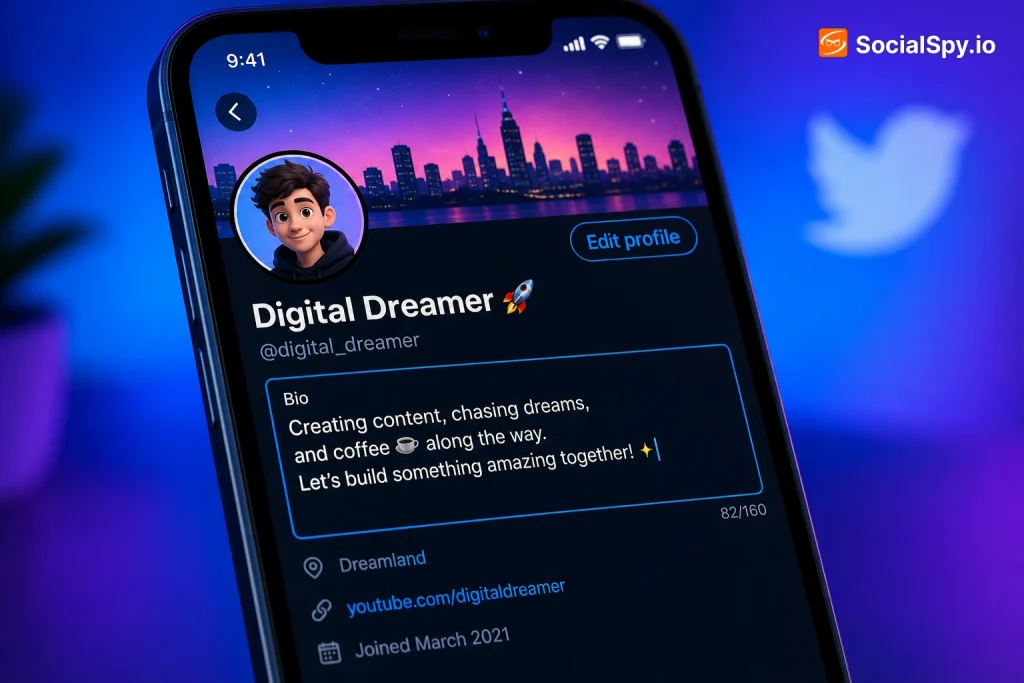
Your X (formerly Twitter) bio is 160 characters of prime real estate, and most people waste it on vague adjectives or a string of emojis nobody reads. In 2026, with the platform more crowded than ever and algorithmic discovery favoring profiles that signal clear value, a well-structured bio template can be the difference between a follow and a scroll-past. This guide breaks down exactly what to include, how to format it, and gives you copy-paste-ready templates for different goals.
Why Your Bio Actually Matters More in 2026
X’s algorithm and search function now weight profile bios more heavily than they did a few years ago. When someone searches a keyword on X, or when the “For You” recommendation system decides whether to surface your account to a stranger, your bio text gets scanned as a signal of relevance.
That means a bio isn’t just a first impression for humans anymore — it’s metadata the platform’s ranking systems parse.
- The character limit is still 160 characters, unchanged since the platform’s earliest days.
- X now supports bio links (up to 3 additional links beyond your primary website field for verified/subscribed accounts).
- Bios are indexed for X’s native search, so keyword-relevant phrasing helps you surface in searches beyond just your username.
- Premium and Premium+ subscribers get a longer-form “About” section on some profile layouts, but the core 160-character bio remains the primary hook.
Industry analysts tracking platform engagement note that profiles with a clear value proposition in the first 40 characters see meaningfully higher follow-through rates from profile visits — because most users decide whether to follow within seconds of landing on a page.
This dynamic has become even more pronounced as the broader social landscape has fragmented. As detailed in Why Threads and Bluesky Are Competing for Twitter’s Old Audience, users now split attention across multiple platforms, so your X bio often has to do double duty as a cross-platform business card, pointing people to where else they can find you.
The Anatomy of a High-Converting Bio Template
Every effective bio, regardless of niche, tends to follow the same underlying skeleton. Think of it as four modular blocks you can mix, reorder, and trim depending on your character budget.
- Identity line — who you are or what role you play (e.g., “Product designer” or “Mom of 3, coffee addict”).
- Value line — what you do, help with, or talk about (e.g., “Helping SaaS founders write better landing pages”).
- Credibility line — a number, brand, or result that builds trust (e.g., “Ex-Google, 40K subscribers, featured in Forbes”).
- Action/personality line — a call-to-action, link reference, or personal touch that adds warmth (e.g., “New thread every Tuesday 👇” or “Dog dad. Terrible at golf.”).
You don’t need all four in every bio, but the strongest professional bios usually hit at least three of them.
Formatting Tricks That Punch Above Their Weight
- Use a vertical bar ( | ), middle dot ( · ), or line break to visually separate sections instead of cramming everything into one run-on sentence.
- Lead with the most important phrase — X search and skimming users both weight the front of the bio more heavily.
- Limit emojis to 1-3 max; more than that reads as cluttered and can actually hurt perceived credibility for business accounts.
- Avoid starting with “I am” or “I’m” — it wastes characters and rarely adds information.
- If you’re multilingual, pick the language your target audience actually uses, not the one you’re most comfortable with.
Copy-Paste Templates by Use Case
Different goals call for different structures. Below are ready-to-adapt templates across the most common account types on X in 2026.
For Personal Branding / Creators
- `[Niche] creator | [Topic] tips for [audience] | [Proof: X followers/downloads] | New post every [day]`
- Example: `Fitness coach | Home workouts for busy parents | 1.2M views on my last reel | New routine every Monday 💪`
For Founders / Entrepreneurs
- `Founder @[Company] | Building [product/mission] | Ex-[notable company] | [Personal detail]`
- Example: `Founder @Loopscale | Making invoice financing instant for freelancers | Ex-Stripe | Coffee > sleep`
For Job Seekers / Career-Focused Accounts
- `[Job title] with [X] years in [industry] | [Skill] + [Skill] | Open to [role type] | DMs open`
- Example: `Marketing manager, 6 yrs in B2B SaaS | Content strategy + SEO | Open to remote roles | DMs open`
For Businesses / Brands
- `Official account of [Brand] | [What you sell/do] | Support: [link or hours] | #[Hashtag]`
- Example: `Official account of Northline Coffee | Small-batch roasts shipped nationwide | Support 9-5 EST | #NorthlineCrew`
For News, Commentary, or Niche Aggregator Accounts
- `[Topic] news & analysis | [Frequency] updates | Not financial/legal advice | Run by [X]`
- Example: `Crypto market news & analysis | Daily updates, no hype | Not financial advice | Run by two former analysts`
Here’s a quick comparison of how the emphasis shifts by account type:
| Account Type | Lead With | Avoid |
|---|---|---|
| Creator | Content niche + proof | Overly formal tone |
| Founder | Company + mission | Buzzword soup (“synergy,” “disruptive”) |
| Job seeker | Title + years experience | Vague terms like “passionate professional” |
| Brand | Product category + support info | Corporate-speak with no personality |
| News/aggregator | Topic clarity + disclaimer | Clickbait phrasing that erodes trust |
Common Bio Mistakes That Quietly Kill Growth
Most underperforming bios don’t have an obvious problem — they just leak small amounts of trust and clarity in ways people don’t notice until they compare against a good one.
- Vague self-description. “Entrepreneur | Dreamer | Hustler” tells a visitor nothing about what you actually do.
- No proof or specificity. Numbers, company names, and concrete outcomes convert far better than adjectives.
- Outdated info. A bio still referencing a job you left two years ago or an event that already happened undermines credibility instantly.
- Emoji overload. Five to seven emojis in a row often reads as spam-adjacent, especially to newer users unfamiliar with older Twitter conventions.
- Missing link strategy. If you have a newsletter, portfolio, or Linktree-style hub, failing to reference it in the bio (even briefly) wastes a conversion opportunity.
- Copy-pasted templates with zero personalization. Generic templates work as scaffolding, not as a finished product — always swap in your specific numbers and voice.
If you’re rebuilding a bio after a career change, rebrand, or platform pivot, it’s worth auditing your entire profile at once rather than just the bio text. Profile picture, header image, pinned post, and bio should all tell a consistent, updated story — a mismatch between an old header image and a fresh bio is a subtle credibility killer that a lot of people overlook.
Optimizing for X’s Search and Algorithm in 2026
Beyond human readability, your bio plays a role in discoverability. X’s internal search has become more sophisticated, increasingly resembling a lightweight version of a search engine for finding relevant accounts.
Here’s what that means practically:
- Include your niche keyword naturally. If you’re a “freelance copywriter,” write that phrase out rather than a vaguer synonym like “wordsmith.”
- Match the language your audience searches in. If most searches for your niche use “AI tools” rather than “artificial intelligence,” lean toward the more commonly searched phrasing.
- Keep your location field accurate if you serve a local audience — X still uses this for local relevance in some search and ad contexts.
- Update your pinned post to reinforce bio keywords. The algorithm appears to weigh consistency between bio, pinned content, and recent posts when deciding topical relevance.
- Refresh your bio when your focus shifts. An account that pivoted from “web3 commentary” to “AI commentary” but never updated the bio confuses both the algorithm and human visitors.
A useful mental model: treat your bio less like a diary entry and more like a one-line SEO meta description for a human being who has three seconds to decide whether you’re worth following.
This is especially relevant for accounts trying to build authority in a specific niche, since a bio without a clear topical anchor makes it harder for X to know which timelines and search results to surface you in.
Advanced Bio Strategies for Businesses and Power Users
Once the basics are locked in, there are a few more advanced moves worth considering, especially for brand accounts or creators monetizing through X.
Using the Multi-Link Feature Strategically
X now allows verified accounts to display up to four links total (the primary website field plus three additional links) directly on the profile. Instead of dumping all of them with no context, label them clearly:
- Link 1: Main website or storefront
- Link 2: Newsletter or email list signup
- Link 3: Latest product launch or campaign page
- Link 4: A “link in bio” aggregator if you need overflow space
A/B Testing Your Bio Like a Landing Page
Treat your bio the way a marketer treats a landing page headline — test variations and track results.
- Track follower growth rate over 1-2 week windows after each bio change.
- Compare click-through on your bio link before and after wording changes.
- Note whether DM volume or mention volume shifts after adding a clearer call-to-action.
- Avoid changing multiple elements at once (bio + header + pinned post) if you want clean data on what worked.
Seasonal and Campaign-Based Bio Tweaks
Brands increasingly treat the bio as a rotating asset rather than a static one. A retailer might add “🎄 Holiday shipping deadlines: Dec 18” for a few weeks, then revert. A creator launching a course might temporarily front-load “Cohort 4 open now →” for a two-week enrollment window, then return to their evergreen bio. This kind of temporary, campaign-driven bio editing has become common enough that it’s worth building into your marketing calendar rather than treating the bio as a one-and-done setup task.
Conclusion
A Twitter/X bio template isn’t about finding one magic sentence — it’s about consistently applying a structure (identity, value, proof, action) and adapting the wording to your specific goals, audience, and moment. The accounts that grow fastest in 2026 treat their bio as a living asset: reviewed quarterly, tested like a landing page, and kept tightly aligned with whatever they’re currently building or promoting. Start with one of the templates above, swap in your real numbers and voice, and revisit it the next time your focus shifts — a stale bio is one of the easiest, lowest-effort fixes available to anyone trying to grow on the platform.
FAQ
Your bio can use up to 160 characters, but the most effective bios typically use 100-150 of those characters, leaving a little breathing room with spacing or separators like “|” so the text doesn’t feel cramped and remains easy to skim on both mobile and desktop.
Yes, but sparingly — one to three relevant emojis can help visually separate sections of your bio and add personality without undermining credibility, while five or more tends to read as cluttered or spam-like, especially for business and creator accounts trying to build trust.
Review it at least every three to six months, and update it immediately after any major change like a new job, product launch, or shift in your content niche, since an outdated bio referencing old roles or expired events quietly damages credibility even if the rest of your profile looks active.