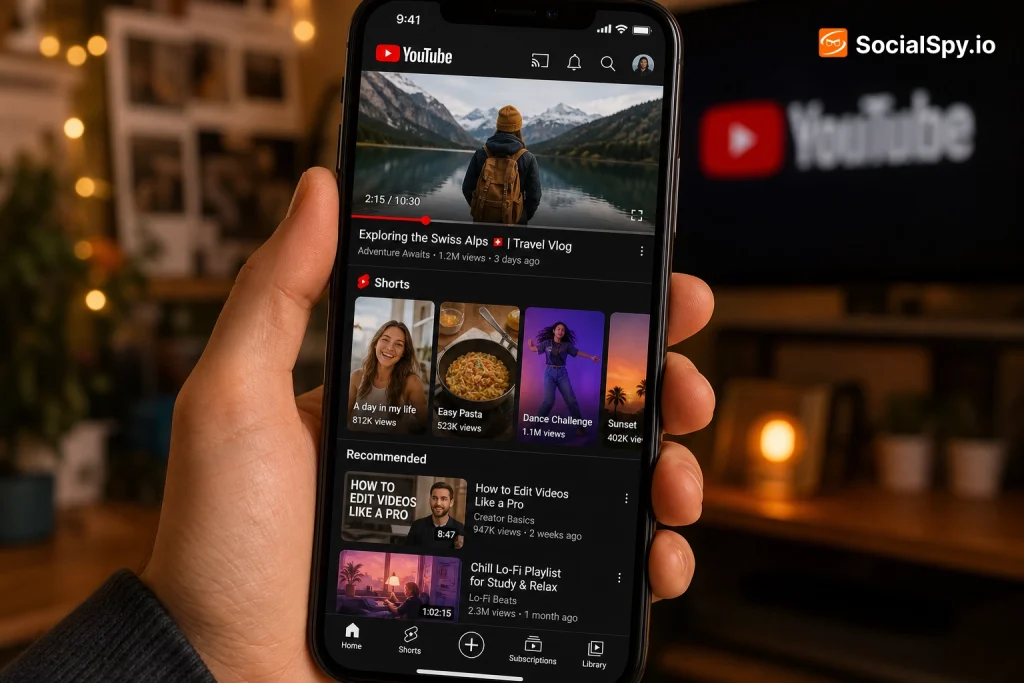
YouTube gets left out of a lot of “social media” conversations because people still think of it as a video hosting site, not a platform where creators build followings and audiences argue in comment sections. But with Community posts, Shorts, live chat, subscriptions, and a recommendation engine that behaves a lot like TikTok’s, the line between YouTube and the rest of the social media landscape has basically disappeared.
What Actually Defines “Social Media” (And Why YouTube Qualifies)
Academics and industry researchers generally agree on a working definition: social media is any platform that lets users create profiles, generate and share content, and interact with a network of other users through likes, comments, and follows. That definition doesn’t mention video length, editing style, or whether the content is “professional” — it’s about the interaction layer, not the format.
YouTube checks every box on that list, and has for years.
- Profiles/Channels — every user gets a customizable channel with an avatar, banner, and “About” page, functioning identically to a Facebook or Instagram profile.
- Follows — subscriptions are YouTube’s version of following, complete with notification bells and subscriber counts displayed publicly.
- User-generated content — over 500 hours of video are uploaded to YouTube every minute, according to figures YouTube itself has published in recent transparency reports.
- Engagement mechanics — likes, dislikes (now hidden publicly), comments, replies, and community polls all mirror mechanics found on Instagram and X.
- Algorithmic distribution — YouTube’s home feed and “Up Next” recommendations are driven by machine learning models, not chronological posting, exactly like the feeds on TikTok and Instagram.
Pew Research Center’s ongoing social media usage surveys have included YouTube as a tracked platform since 2018, placing it in the same category as Facebook and Instagram rather than treating it as a separate “video hosting” bucket. That’s a meaningful signal — researchers who study platform behavior for a living don’t consider this an open question.
The Historical Confusion: Why People Still Doubt It
The skepticism isn’t irrational. YouTube launched in 2005 as a video-sharing utility, three years before Instagram existed and a full year before Twitter. Its original pitch was closer to a searchable video library than a social network, and for its first several years, that’s mostly what it was.
That legacy branding stuck. Many people’s mental model of YouTube was formed watching cat videos and music clips in 2007, long before subscriptions, comments threading, or the algorithm existed in their current forms. Compare that to platforms like Instagram or TikTok, which were built social-first from day one.
Industry analysts tracking platform evolution note that YouTube’s transformation was gradual rather than a single relaunch — meaning most users never experienced a distinct “before and after” moment the way they did when Instagram added Stories or TikTok exploded in 2019.
There’s also a categorization habit at play: people tend to separate “video platforms” (YouTube, Netflix, Twitch) from “social platforms” (Facebook, Instagram, X) simply because video takes longer to consume. But runtime isn’t part of any formal definition of social media — it’s a content format, not a category distinction.
The Features That Make YouTube Undeniably Social in 2025
If the historical argument doesn’t convince you, the current feature set should. YouTube has spent the last five years aggressively adding tools that have nothing to do with hosting video and everything to do with community-building.
Shorts changed everything
YouTube Shorts, launched in 2021 as a direct response to TikTok’s rise, now generates over 70 billion daily views, according to figures Google has shared with advertisers. Shorts behaves exactly like a short-form social feed: vertical scroll, algorithmic sorting, sounds and trends, duets-style remixing, and a comment section built for rapid-fire interaction rather than long-form discussion.
Community features built for interaction, not viewing
- Community tab — lets creators post text, images, polls, and GIFs directly to subscribers’ feeds, no video required.
- Live chat — real-time commenting during livestreams, including Super Chat monetized messages, functions like a hybrid of Twitch chat and Instagram Live comments.
- Membership tiers — subscription-based perks (badges, emojis, exclusive posts) mirror Patreon and Twitch Subs.
- Notes and comment pinning — creators moderate and shape discussion the same way page admins do on Facebook.
- Stories (discontinued in 2023) — YouTube even tried an Instagram Stories clone for two years before folding the feature into Community posts.
The algorithm is the real tell
YouTube’s recommendation system doesn’t just suggest what to watch next — it actively shapes what gets seen at all, prioritizing watch time, session duration, and click-through rate over subscriber notifications. That’s the same underlying logic that powers Instagram’s Explore page and TikTok’s For You feed. If you’ve ever felt like the app “knows” what you want to watch before you search for it, that’s the social media algorithm doing its job — the same mechanics covered in Understanding Social Media Algorithms: What Actually Gets You Views.
How YouTube Compares to Other Social Platforms
Putting YouTube side-by-side with platforms nobody questions makes the classification pretty clear.
| Feature | YouTube | TikTok | |
|---|---|---|---|
| User profiles/channels | Yes | Yes | Yes |
| Follow/subscribe system | Yes (subscriptions) | Yes (followers) | Yes (followers) |
| Algorithmic feed | Yes (Home, Shorts) | Yes (Explore, Reels) | Yes (For You) |
| Short-form video | Yes (Shorts) | Yes (Reels) | Yes (native) |
| Long-form video | Yes (native) | No | Limited |
| Live streaming | Yes | Yes | Yes |
| Direct messaging | Limited | Yes | Yes |
| Comments/replies | Yes | Yes | Yes |
| Creator monetization | Yes (AdSense, memberships) | Yes (bonuses, gifts) | Yes (Creator Fund) |
The only real gap is direct messaging — YouTube’s DM feature is limited and underused compared to Instagram’s or TikTok’s, and that’s genuinely one area where it still feels less “social” in a peer-to-peer sense. But one weaker feature doesn’t disqualify a platform from the category any more than X’s lack of long-form video disqualifies it.
Where YouTube arguably beats its competitors is longevity of relationship. Subscriber relationships on YouTube tend to run for years, not weeks, and creators cite audience retention rates far higher than on faster-churning platforms — a dynamic tied to posting consistency covered in Is Posting Every Day Actually Bad for Your Social Media Growth.
Why This Classification Actually Matters for Creators and Marketers
This isn’t just a semantic debate — how YouTube gets classified has real consequences for budgets, strategy, and platform choice.
- Ad budget allocation. Marketers who mentally silo YouTube as “video advertising” rather than “social advertising” often under-invest in community-building tactics like comment engagement and Community posts, missing organic reach that costs nothing.
- Influencer partnership structuring. Brands negotiating YouTube deals sometimes still price them like TV-style media buys instead of social collaborations, missing opportunities for authentic, subscriber-driven content that performs better than pre-roll ads.
- Platform diversification strategy. Creators treating YouTube as separate from their “social media presence” often fail to cross-promote Shorts to TikTok/Reels audiences and vice versa, leaving reach on the table.
- Analytics and reporting. Agencies that report YouTube metrics separately from “social” KPIs can undercount total audience engagement when pitching campaign results to clients.
- Content strategy for personal brands. Anyone building an audience needs to treat YouTube subscribers with the same nurturing as Instagram followers — comment replies, community polls, and consistent posting cadence all matter, a strategy central to How to Grow Your Personal Brand on Social Media in 2026.
There’s a financial dimension too. YouTube reported over $36 billion in advertising revenue in 2023, per Alphabet’s public earnings filings, putting it firmly in competition with Meta’s ad business for brand dollars — money that flows specifically because YouTube functions as a social advertising environment, not a static content library.
The AI Layer Is Making YouTube Even More “Social”
Recent additions push YouTube further into social media territory rather than away from it. AI-generated dubbing, auto-translated captions, and AI-assisted comment summarization are all designed to increase cross-audience interaction — the same trend reshaping every major platform, discussed in depth in How AI Is Transforming Content Creation on Social Media.
- Auto-dubbing lets a creator’s video reach non-English-speaking subscribers automatically, expanding the social graph across language barriers.
- AI comment highlights surface the most relevant discussion threads, similar to X’s “Top” replies sorting.
- Generative thumbnails and title testing help smaller creators compete for algorithmic attention the same way social media managers A/B test captions on Instagram.
These aren’t hosting features. They’re engagement and distribution features — the defining characteristics of a social platform, not a video library.
Conclusion
The “is YouTube social media” question mostly persists because of branding inertia, not because there’s a genuine functional case against it. A platform with 2.7 billion logged-in monthly users, algorithmic feeds, subscriber networks, live chat, and a Shorts feature pulling 70 billion daily views isn’t a video archive with some extra features bolted on — it’s a full social ecosystem that happens to specialize in video. Treating it otherwise, whether you’re a marketer allocating ad spend or a creator building an audience, means missing half the reason the platform works as well as it does.
FAQ
Yes. Pew Research Center has tracked YouTube alongside Facebook, Instagram, and TikTok in its social media usage surveys since 2018, and it meets the standard academic definition of social media through profiles, follows, user-generated content, and algorithmic engagement features.
The biggest functional gap is direct messaging, which is far less developed on YouTube than on Instagram or TikTok. Content length is the other major difference — YouTube supports long-form video natively, while Instagram and TikTok are built primarily around short-form content, though YouTube Shorts has closed much of that gap.
Yes, meaningfully. Creators who treat YouTube purely as a hosting platform tend to neglect Community posts, comment engagement, and cross-promotion with other social apps, all of which the algorithm rewards, while creators who engage with it as a social network typically see stronger subscriber retention and higher recommendation reach.