The iPhone 12 Pro Max shipped in October 2020 with a 2,687mAh battery that Apple never officially disclosed in mAh terms, preferring to talk about “up to 20 hours of video playback.” Four years on, most of those batteries have degraded well past Apple’s 80% health threshold, and owners are weighing whether to pay Apple, use a third-party shop, or attempt a DIY swap themselves.
How to Tell Your Battery Actually Needs Replacing
Apple doesn’t make you guess. The iPhone 12 Pro Max has a built-in battery health diagnostic buried in Settings that tells you almost everything you need to know before spending a dime.
Here’s where to check it and what the numbers mean:
- Go to Settings > Battery > Battery Health & Charging
- Maximum Capacity below 80% is Apple’s official cutoff for recommending replacement
- A message reading “Your battery’s health is significantly degraded” means Apple itself flags it as due for service
- Peak Performance Capability warnings indicate the phone has already throttled CPU speed to prevent shutdowns
- Cycle count, visible only through third-party apps like CoconutBattery (Mac) or by connecting to a diagnostic tool, tells you how many full charge cycles the battery has endured — Apple rates the 12 Pro Max battery for 500 complete cycles before falling to 80% capacity
Beyond the numbers, real-world symptoms matter just as much. If your phone drops from 30% to 5% in ten minutes, shuts down in cold weather, or feels noticeably warm during normal use, the battery is likely the culprit even if the software hasn’t flagged it yet.
A battery that reports 82% health but still causes random shutdowns is arguably in worse shape than one sitting at 76% that performs consistently — the percentage alone doesn’t tell the whole story.
Apple’s Official Replacement Options
Apple offers three paths to a battery swap, and the price difference between them can be significant depending on your coverage status.
If You Have AppleCare+
Battery replacement is free under AppleCare+ once capacity drops below 80%, which is exactly why the plan tends to pay for itself on a phone this old. Apple won’t replace a battery under AppleCare+ if it’s still above 80%, even if you’re experiencing symptoms — the software threshold is the gatekeeper.
If You’re Out of Warranty
Without AppleCare+, Apple charges a flat $99 for the iPhone 12 Pro Max battery replacement, plus tax. This price has held steady since the phone launched and covers:
- A genuine Apple battery with matching serial-number pairing to your logic board
- Full diagnostic check of charging components and battery connector
- A software reset that restores accurate battery health reporting to 100%
- Same-day service in most cases if done at an Apple Store, versus 3-5 business days for mail-in service
Apple Store vs Mail-In Service
If you live near an Apple Store or an Apple Authorized Service Provider, walk-in service is almost always faster. Mail-in requests through Apple’s website require you to ship the device, wait for diagnostics, then wait again for the return shipment — a process that commonly takes a full week.
DIY Replacement: What’s Actually Involved
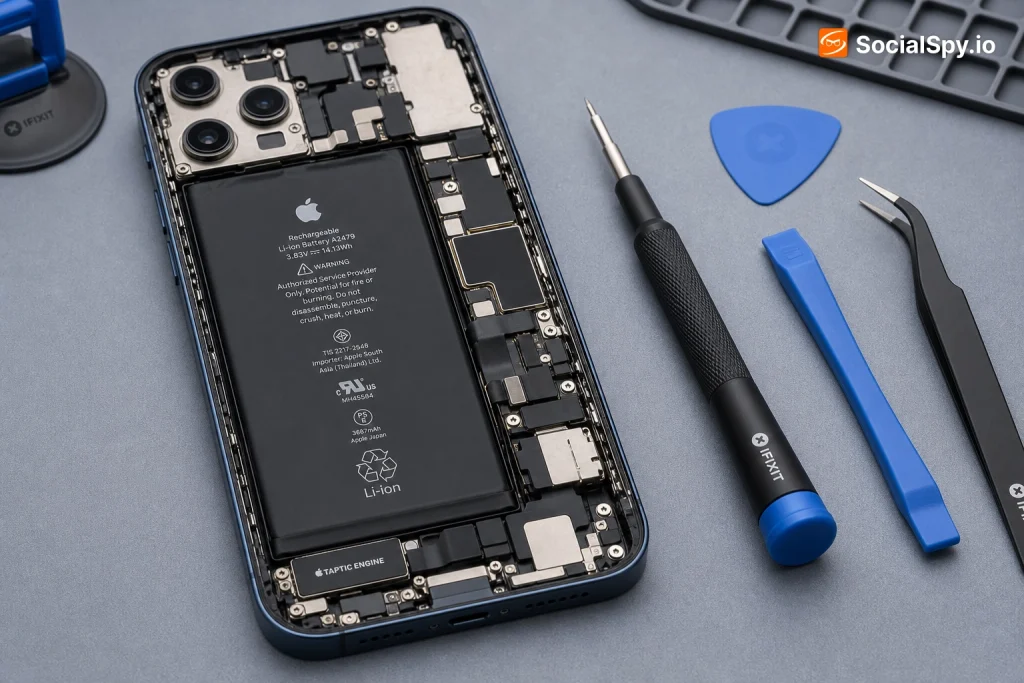
iFixit sells a complete battery replacement kit for the iPhone 12 Pro Max for around $34.99-$44.99, and gives the repair a difficulty rating that reflects real complexity, not marketing fluff.
Here’s what the kit typically includes and what the job demands:
- A new battery cell with pre-installed adhesive strips
- Pentalobe and Y000 screwdrivers, since Apple uses proprietary screw heads
- Suction cup and opening picks to separate the screen from the frame
- Spudgers for disconnecting the delicate battery connector without tearing the flex cable
- A heat mat or iOpener to soften adhesive before prying
The process itself runs roughly 45 minutes to 90 minutes for a first-timer, and the riskiest step by far is disconnecting the battery cable near the display connectors — bend that flex cable wrong and you can lose Face ID or True Tone functionality permanently.
- Pros of DIY: cheapest option, can be done same-day at home, no waiting for appointments
- Cons of DIY: voids any remaining warranty, triggers persistent software warnings, risk of water-seal gasket damage since the 12 Pro Max has an IP68 rating that’s compromised once opened
iFixit’s own repairability documentation rates the iPhone 12 Pro Max battery swap as moderate difficulty — manageable for someone comfortable with small electronics, but not a five-minute job like older iPhone models.
Third-Party Repair Shops: The Middle Ground
Chains like uBreakiFix by Asurion and countless independent local shops offer battery replacement without Apple’s price tag or the DIY risk. Pricing typically lands between $60 and $90, depending on region and whether the shop uses OEM-pulled batteries or aftermarket cells.
The tradeoff worth understanding is quality tiers:
| Battery Type | Typical Cost | Health Reporting Accuracy |
|---|---|---|
| Apple Genuine (Apple Store) | $99 | Fully accurate, no warnings |
| OEM Pull (third-party, salvaged Apple part) | $70-$90 | Usually accurate but may show “Unknown Part” |
| Aftermarket/Generic Cell | $50-$65 | Often inaccurate, frequently triggers warnings |
Since iOS 15.2, Apple’s software checks whether the battery’s microcontroller is paired correctly with the logic board. If it isn’t — which happens with most non-Apple batteries — you’ll see a permanent message in Battery Health stating “Unable to verify this iPhone has a genuine Apple battery,” and the Maximum Capacity percentage disappears entirely.
This doesn’t disable the phone or stop it from charging. It does mean you lose the ability to monitor degradation going forward, which matters if you plan to resell the device eventually.
What Happens After the Replacement
A successful battery swap resets more than just your runtime — it changes how the phone reports itself for the rest of its life.
Expect these outcomes depending on who did the work:
- Apple-performed replacement: Battery Health resets cleanly to display 100% Maximum Capacity, cycle count resets to zero, no warning messages appear
- Third-party OEM part: Health percentage often displays correctly, but Apple may still show a service message noting the battery wasn’t installed by Apple
- DIY or generic part: Maximum Capacity reading frequently vanishes from Settings, and you’ll rely on physical battery performance rather than software confirmation
- Resale impact: Buyers on platforms like Swappa and eBay specifically search listings for “genuine battery, no warnings” — a flagged battery can shave $20-$40 off resale value
There’s also a practical performance note worth knowing: a freshly replaced battery needs 2-3 full charge cycles before the phone’s power management software accurately calibrates percentage displays. Don’t panic if the battery seems to drain unevenly in the first day or two.
Conclusion
The math on an iPhone 12 Pro Max battery replacement in 2024 comes down to how long you plan to keep the phone and whether you care about resale value. If you’re holding onto it for another year or two and don’t mind a software warning, a $60-$90 third-party swap or a $35 DIY kit gets you most of the practical benefit — longer runtime, no more surprise shutdowns — for a fraction of Apple’s price. But if you’re on AppleCare+, the choice is obvious: it’s free, so use it before the plan expires. And if resale value matters or you want the phone to report its health accurately for years to come, the $99 Apple Store option remains the only path that avoids the “Unknown Part” flag entirely. Given that a brand-new iPhone 15 Pro Max starts north of $1,199, spending under $100 to extend a phone you already own by another two years of daily use is still one of the better value repairs in consumer electronics right now.
FAQ
Most users see Maximum Capacity fall to somewhere between 75% and 85% after three to four years of regular daily charging, assuming around 300-500 charge cycles. Dropping below 80% is when Apple itself recommends replacement, and going much lower than that typically brings noticeably shorter runtime and occasional unexpected shutdowns under heavy load.
If your iPhone 12 Pro Max is already out of its original one-year warranty and doesn’t have active AppleCare+, a third-party battery won’t void anything meaningful since there’s no warranty left to void. However, it can trigger a permanent “Unable to verify genuine Apple battery” message in Settings, and if you ever try to use AppleCare+ or sell the phone through Apple’s trade-in program, that message can complicate the process or lower the trade-in valuation.
For most people still happy with their iPhone 12 Pro Max’s camera, screen, and performance, yes — a $99 battery replacement is dramatically cheaper than upgrading to a new $1,000+ iPhone and effectively resets the device’s usable lifespan for another two to three years. The calculus changes only if you’re also missing newer features like the Dynamic Island, satellite connectivity, or USB-C, in which case the battery cost becomes just one factor in a bigger upgrade decision.