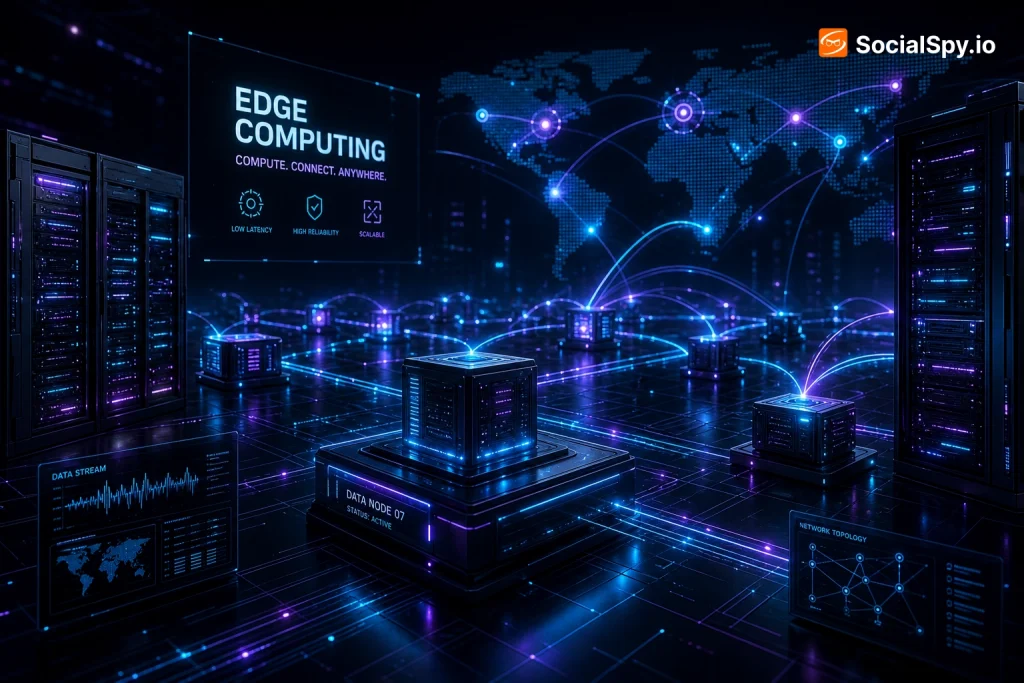
Every time you unlock your phone with a glance, ask a smart speaker for the weather, or watch a video that never seems to buffer, you’re benefiting from a quiet infrastructure shift happening behind the scenes. That shift is called edge computing, and even though most people have never heard the term, it’s rapidly reshaping how the apps we use every day actually work. Instead of sending every request on a long round trip to a distant data center, edge computing processes information closer to where it’s actually needed — on your device, at a nearby server, or somewhere in between. The result is faster, smarter, and more reliable apps, often without users ever noticing the technology making it possible.
As 5G networks expand, smart devices multiply, and consumers demand instant responsiveness from everything they touch, edge computing has moved from a niche enterprise concept to a mainstream necessity. Understanding what it is — and why it matters — helps explain some of the biggest performance improvements happening in the apps on your phone right now.
What Edge Computing Actually Means
For decades, most computing followed a simple model: your device sends a request, that request travels to a centralized cloud server (often hundreds or thousands of miles away), the server processes it, and the response travels all the way back. This works fine for many tasks, but it introduces latency — the delay between asking for something and getting a response. For simple web pages, a few hundred milliseconds of latency is barely noticeable. For real-time applications, it can be the difference between a smooth experience and a frustrating one.
Edge computing flips this model by pushing computation closer to the source of data. Instead of relying solely on massive, centralized cloud data centers, processing happens at or near the “edge” of the network — meaning:
- On the device itself (your smartphone, smartwatch, or smart speaker)
- On a local hub or gateway (like a smart home router or IoT controller)
- At a regional micro data center closer to your geographic location, rather than one centralized hub
Think of it like the difference between mailing a letter across the country versus handing it to someone standing next to you. The closer the “compute” happens to you, the faster the response — and often, the more private and efficient the process becomes.
Why Edge Computing Matters for the Apps You Use Every Day
It’s easy to assume edge computing is purely an enterprise or industrial concern — something relevant to factories, self-driving cars, or telecom companies. In reality, it’s already embedded in consumer technology most Americans interact with daily.
Here’s where edge computing quietly powers everyday experiences:
- Voice assistants: Devices like Amazon Echo and Google Nest increasingly process wake-word detection and basic commands locally, rather than sending every syllable to the cloud. This reduces lag and improves privacy.
- Video streaming: Services like Netflix and YouTube use edge servers (content delivery networks, or CDNs) positioned near users to cache and deliver video, minimizing buffering and improving load times.
- Mobile gaming and AR apps: Augmented reality apps, like those used in retail try-on features or navigation overlays, need near-instant processing to overlay digital elements onto the real world convincingly.
- Smart home devices: Security cameras, doorbells, and thermostats often analyze video or sensor data on-device or on a local hub, only sending relevant alerts to the cloud instead of constant raw data streams.
- Wearables and health apps: Fitness trackers and smartwatches process heart rate, motion, and sleep data locally in real time, syncing summarized insights to the cloud periodically rather than streaming everything constantly.
In each case, the shift toward edge processing isn’t just a technical curiosity — it directly improves the user experience by cutting delay, saving bandwidth, and reducing dependence on a constant, high-quality internet connection.
The Core Benefits Driving the Shift
Edge computing isn’t replacing the cloud — it’s complementing it. Cloud data centers remain essential for heavy-duty processing, long-term storage, and training complex AI models. But for time-sensitive or bandwidth-intensive tasks, edge computing offers advantages that centralized cloud architecture simply can’t match.
- Lower latency: By processing data closer to the user, edge computing dramatically reduces the delay between action and response — critical for gaming, video calls, and AR/VR applications.
- Reduced bandwidth costs: Sending raw data (like continuous video feeds) to the cloud is expensive and slow. Edge devices can filter, compress, or analyze data locally, sending only what’s necessary.
- Improved reliability: Apps that rely on edge processing can often continue functioning — at least partially — even when internet connectivity is spotty or temporarily lost.
- Better privacy: Processing sensitive data (like voice recordings or biometric information) locally, rather than transmitting it to a remote server, can reduce exposure to data breaches and give users more control.
- Scalability for IoT growth: With billions of connected devices generating data, it’s simply not feasible to route everything through centralized cloud servers. Edge computing distributes the load.
This combination of speed, efficiency, and privacy is why companies from Apple to Amazon to Tesla have invested heavily in edge-based architecture, even if they rarely use the term “edge computing” in consumer-facing marketing.
Real-World Examples Already Shaping Consumer Tech
The abstract concept of edge computing becomes much clearer when you look at specific, familiar examples already in use.
Apple’s on-device AI processing is one of the clearest illustrations. Features like Face ID, Siri’s on-device request handling, and photo analysis in the Photos app increasingly run directly on the iPhone’s Neural Engine chip rather than sending data to Apple’s servers. This means faster results and sensitive biometric data that never has to leave your device.
Autonomous and driver-assist vehicles represent one of the most demanding edge computing use cases. A self-driving system cannot afford the latency of sending sensor data to a cloud server and waiting for instructions — a delayed response could mean a missed pedestrian or a failed braking maneuver. Instead, these vehicles use powerful onboard computers to process camera, radar, and LiDAR data in real time, at the edge, within milliseconds.
Retail and augmented reality shopping apps also lean heavily on edge processing. When you use a furniture app to visualize a couch in your living room, or a beauty app to preview makeup shades on your face, the app needs to render augmented elements instantly and convincingly. Any lag breaks the illusion and the user experience.
Smart city infrastructure, including traffic light systems, public safety cameras, and environmental sensors, increasingly uses edge nodes to process data locally — enabling faster responses to changing traffic patterns or emergency situations without waiting on centralized systems.
Even everyday cloud gaming services, which stream high-end games to phones and low-power devices, rely on regional edge servers to minimize the round-trip time between a player’s input and the game’s response — a delay that can make or break competitive gaming.
What This Means for the Future of Everyday Apps
As more devices come online and users expect near-instant responsiveness, edge computing will likely become invisible infrastructure — much like Wi-Fi or cloud storage today. Developers building the next generation of apps, especially those involving AI, AR/VR, or real-time collaboration, will increasingly design with a “hybrid” approach: heavy lifting in the cloud, time-sensitive tasks at the edge.
For everyday users, this evolution should translate into apps that feel faster, work more reliably in areas with weak connectivity, and offer stronger privacy protections since more personal data can be processed locally rather than transmitted and stored remotely. It also sets the stage for more ambitious applications — real-time language translation during video calls, instant AR navigation overlays, and smart home systems that react in milliseconds rather than seconds.
Ultimately, edge computing represents a fundamental rebalancing of where digital intelligence lives. Rather than treating the cloud as an all-powerful, all-knowing hub, the industry is recognizing that some decisions need to happen right here, right now, wherever “here” happens to be. That shift — subtle as it may seem — is quietly making the apps millions of Americans use every day noticeably better.
Frequently Asked Questions
Is edge computing the same as cloud computing?
No. Cloud computing centralizes processing and storage in large, remote data centers, while edge computing distributes processing closer to the end user or device. Most modern systems use both together, relying on the cloud for heavy computation and long-term storage while using edge nodes for real-time, latency-sensitive tasks.
Do I need special hardware to benefit from edge computing?
Not necessarily. Many modern smartphones, smart speakers, and wearables already include dedicated chips (like neural processing units) designed specifically for on-device edge computing. If you’re using a relatively recent device, you’re likely already benefiting from edge processing without realizing it.
Does edge computing make apps more secure?
It can improve privacy and reduce certain security risks, since sensitive data often doesn’t need to travel to remote servers. However, it also introduces new security considerations, since data is processed across more distributed points, each of which needs proper protection.