Frame-by-frame scrubbing sounds like a niche editing trick, but it’s one of the most useful skills for anyone who watches YouTube critically — video editors, sports analysts, gamers studying frame data, animators, or anyone trying to figure out exactly what happened in a viral clip. YouTube actually has this built in, along with a couple of lesser-known tricks for even finer control. Here’s every method that works in 2026, from keyboard shortcuts to third-party tools when YouTube’s native controls fall short.
The Fastest Way: Keyboard Shortcuts on Desktop
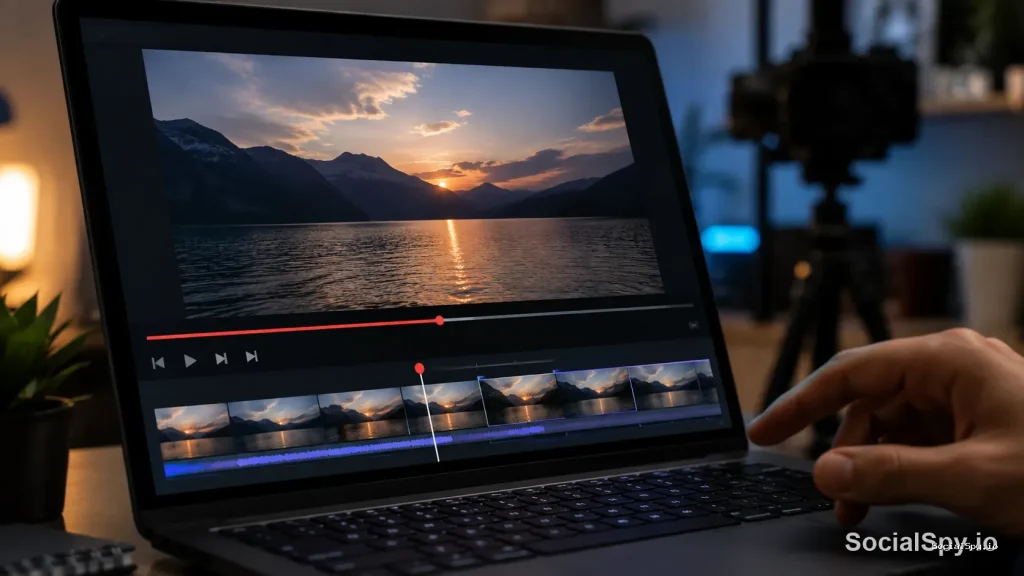
YouTube built frame-by-frame navigation directly into its player years ago, but most people never discover it because it’s not listed in any visible menu. It only works on desktop browsers — Chrome, Firefox, Edge, and Safari all support it identically.
Here’s the exact process:
- Open any YouTube video in a desktop browser (not the app).
- Click on the video player once to make sure it has focus, or hover your mouse over it.
- Press the spacebar to pause the video at the moment you want to inspect.
- Press the comma key (,) to move backward exactly one frame.
- Press the period key (.) to move forward exactly one frame.
Each press moves the video by a single frame based on its native frame rate — so a 30fps video moves in increments of roughly 33 milliseconds, while a 60fps video moves in 16-millisecond steps. This is the same shortcut system YouTube uses for its 5-second and 10-second skip controls (arrow keys), just scaled down to the smallest possible increment.
Industry video editors often call this the single most underused feature on YouTube — it’s the same logic professional NLE software like Premiere Pro or DaVinci Resolve uses for scrubbing, just simplified into two keys.
A few caveats worth knowing:
- The shortcut only works when the video is paused. Pressing comma or period while playback is active does nothing.
- It works in fullscreen mode too, as long as the player has keyboard focus.
- It does not work inside embedded YouTube players on third-party websites unless the embed gives the iframe focus first.
- Live streams and premieres often don’t support frame-stepping until the broadcast has fully ended and converted into a standard VOD.
Why Frame Rate Matters More Than You’d Think
Not every YouTube video steps the same way, and understanding why will save you a lot of confusion when frame-by-frame doesn’t behave as expected.
YouTube doesn’t force a single frame rate — creators upload at whatever their source footage was shot or rendered in, and YouTube preserves that rate (with some re-encoding) up to a point. The most common rates you’ll encounter:
| Frame Rate | Common Source | Frame-Step Increment |
|---|---|---|
| 24fps | Cinematic footage, film-style edits | ~41.7 ms per frame |
| 30fps | Standard vlogs, most smartphone video | ~33.3 ms per frame |
| 60fps | Gaming, sports, action content | ~16.7 ms per frame |
| 120fps+ | Slow-motion capture (often re-encoded down) | Varies |
This matters practically because a 60fps gameplay video gives you double the granularity of a 30fps vlog when you’re stepping through frames. If you’re trying to catch the exact frame a goal crosses the line, or the precise moment a fighting-game combo lands, a 60fps upload will show you meaningfully more detail than the same moment recorded at 30fps.
It also explains why some videos feel “choppier” to step through than others — you’re not imagining it, you’re literally seeing fewer unique images per second of footage.
Slowing Down Playback Before You Step
Frame-stepping is precise but slow if you’re trying to locate a specific moment in a five-minute video. The smarter workflow combines YouTube’s playback speed controls with frame-stepping.
Here’s the approach most experienced YouTube power-users actually use:
- Click the gear icon (Settings) in the bottom-right of the player.
- Select Playback speed.
- Choose 0.25x for maximum slow-motion detail, or 0.5x as a middle ground.
- Let the video play at reduced speed until you’re near the moment you want.
- Pause, then use comma/period to nail the exact frame.
This two-step method is dramatically faster than trying to frame-step through 10+ seconds of footage one press at a time. It’s especially useful for:
- Analyzing sports replays where the key action happens in under a second
- Studying dance choreography or martial arts technique
- Reviewing animation timing and in-between frames
- Catching Easter eggs or hidden text that flashes briefly on screen
- Fact-checking viral clips that may be edited or taken out of context
Worth noting: 0.25x speed doesn’t change the underlying frame data, it just gives your brain and your fingers more reaction time before you need to switch to manual stepping.
What About Mobile? The Honest Answer
This is where YouTube quietly falls short, and it’s a common source of frustration. The official YouTube app for iOS and Android has no built-in frame-by-frame feature. There’s no hidden gesture, no long-press trick, no menu option buried in settings — it simply isn’t there.
Mobile users generally have three workarounds:
- Switch to a mobile browser: Open YouTube in Safari or Chrome on your phone, request the “Desktop site” version, and the comma/period keyboard shortcuts technically exist — but without a physical keyboard, triggering them is impractical unless you connect a Bluetooth keyboard.
- Use a third-party video player app: Apps that support frame-stepping (common in video editing and film-analysis apps) can sometimes open YouTube links directly or work with downloaded footage.
- Download the clip locally: Some users save the video to their device (where permitted) and use a dedicated frame-accurate player like VLC, which has excellent native frame-stepping via the E key on desktop or on-screen controls on mobile.
That last option raises an obvious question about permissions and content restrictions, which becomes especially relevant with sensitive or age-gated content — a topic covered in more depth in this breakdown of whether you can download age-restricted videos on YouTube. The short version: YouTube’s terms restrict downloading in most cases, and age-restricted content adds an extra layer of complication, so frame-accurate analysis of that kind of footage is best done through legitimate tools or by staying within the browser player.
Alternative Tools When You Need More Control
Sometimes YouTube’s native comma/period stepping isn’t precise enough, especially for professional use cases like esports coaching, video forensics, or shot-by-shot animation breakdowns. Several established tools go further.
Browser Extensions
- Enhancer for YouTube (Chrome/Firefox): Adds a dedicated frame-step button to the player UI, plus additional speed increments below YouTube’s default 0.25x floor.
- Video Speed Controller: A lightweight extension that works across most video sites, not just YouTube, adding customizable keyboard shortcuts for speed and frame navigation.
Dedicated Frame-Analysis Software
- VLC Media Player: If you download or have local access to a file, VLC’s frame-by-frame key (E on Windows/Linux, the equivalent shortcut on Mac) is frame-accurate and works regardless of source frame rate.
- DaVinci Resolve (free version): Overkill for casual viewing, but if you’re actually editing a reaction video or breakdown, importing footage into Resolve gives you a full scrubbable timeline with frame counters.
- Kinovea: A free tool built specifically for sports and biomechanics analysis, popular among coaches who study technique frame by frame.
The tradeoff is straightforward: browser extensions are convenient and keep you inside YouTube’s interface, while dedicated software gives you frame-accurate timestamps, side-by-side comparisons, and annotation tools that YouTube simply doesn’t offer.
Practical Use Cases Worth Knowing About
Frame-by-frame viewing isn’t just a curiosity — it solves real problems people run into constantly.
- Content creators fact-checking their own uploads: Reviewing exported footage frame by frame catches sync issues, stray watermarks, or frames where captions overlap awkwardly, before or after publishing through a workflow like the one described in this guide on how to post videos on YouTube.
- Analysts scrubbing footage for reaction videos or breakdowns: Precise timestamps matter when referencing a specific frame in a video essay or commentary track.
- Gamers studying frame data: Fighting game and speedrun communities rely heavily on frame-by-frame review to study input timing down to single frames.
- Researchers and journalists verifying footage: Frame inspection can reveal editing artifacts, cuts, or splices that aren’t visible at normal playback speed.
- Channel operators auditing their own catalog: Combined with exported analytics — the kind covered in this guide on getting your YouTube channel data as a CSV — frame-level review helps identify exactly where viewer retention drops during a specific scene.
Each of these use cases benefits from the same underlying skill: knowing that YouTube is a genuinely capable platform for frame-level video analysis, not just a place to press play and watch passively — a distinction that connects to the broader question of whether YouTube functions as social media or as something closer to a video utility platform, addressed in more detail in this piece on whether YouTube counts as social media.
Conclusion
Frame-by-frame navigation on YouTube isn’t hidden behind a paywall or a Premium subscription — it’s a free, built-in feature that most viewers simply never stumble across because there’s no button for it. The comma and period keys, combined with the 0.25x playback speed option, cover the vast majority of everyday use cases, from catching a blink-and-you-miss-it Easter egg to breaking down a sports replay. Where the native tools fall short — mainly on mobile, or when you need true frame-accurate export and annotation — extensions like Video Speed Controller and standalone software like VLC or Kinovea fill the gap. Once you know the shortcut exists, it’s hard to imagine watching detailed footage without it again.
FAQ
Yes, but with a caveat — the comma and period shortcuts work if you open the Short in the standard desktop web player rather than the vertical Shorts feed interface, since the feed’s swipe-based UI doesn’t register keyboard focus the same way the standard player does.
The most common cause is that the video player doesn’t have keyboard focus — click directly on the video once before pressing the keys. It can also happen on live streams that haven’t finished processing into an on-demand video yet, since frame-stepping requires a fixed, fully rendered file.
Yes, the native comma/period shortcut works on any publicly viewable YouTube video regardless of who uploaded it, since it’s a playback control rather than an editing feature. You don’t need to download anything — it works directly in the browser player on the video’s original watch page.