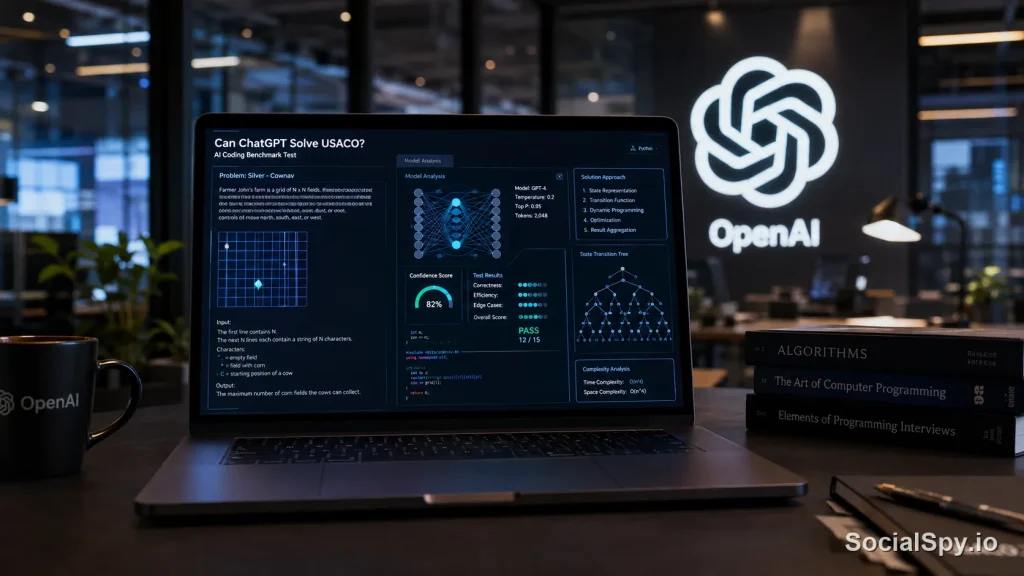
Competitive programming has become one of the toughest benchmarks for large language models, and the USA Computing Olympiad (USACO) sits near the top of that difficulty curve. Ask ten competitive programmers whether ChatGPT can crack these problems, and you’ll get ten different answers depending on which division and which model they mean. The real story is more nuanced than a simple yes or no.
What USACO Actually Tests
USACO isn’t a leetcode-style interview quiz — it’s a four-tier competitive programming ladder (Bronze, Silver, Gold, Platinum) used by thousands of US high schoolers, many aiming for the USA Computing Olympiad training camp and eventually the International Olympiad in Informatics (IOI). Problems combine algorithmic knowledge with tight time limits and adversarial test cases designed to break brute-force or near-correct solutions.
- Bronze: simulation, basic data structures, brute force with light optimization
- Silver: greedy algorithms, binary search, basic graph traversal, prefix sums
- Gold: dynamic programming, shortest paths, segment trees, more complex graph theory
- Platinum: advanced DP optimizations, heavy-light decomposition, suffix structures, flows, and problems that require inventing a new approach on the spot
The jump between Gold and Platinum is where most human competitors also stall out — and it’s exactly where language models tend to fall apart too. Researchers studying LLM coding performance have repeatedly used this exact division structure because it maps cleanly onto increasing reasoning complexity rather than just increasing syntax difficulty.
Early benchmark studies (including one widely cited evaluation from a Princeton-affiliated research group) found that GPT-4-class models solved roughly 7% of the hardest Platinum problems zero-shot, compared to over 90% of easier Bronze-tier tasks.
How Model Generations Have Actually Performed
The gap between “ChatGPT can’t do competitive programming” and “ChatGPT is now genuinely good at it” is mostly a story about which model you’re testing. GPT-3.5 was nearly useless on anything past Bronze. GPT-4 made Silver and some Gold problems tractable. The real shift came with reasoning-focused models that spend extended “thinking” tokens before answering.
Here’s a rough breakdown based on public benchmark work and community-run evaluations on the USACO problem archive:
| Model generation | Bronze solve rate | Silver | Gold | Platinum |
|---|---|---|---|---|
| GPT-3.5-era | ~55% | ~15% | ~3% | ~0% |
| GPT-4 (2023-2024) | ~90% | ~55% | ~20% | ~7% |
| GPT-4o / early reasoning tools | ~95% | ~70% | ~35% | ~12% |
| GPT-5-class reasoning models (2026) | ~97%+ | ~85% | ~55–65% | ~20–30% |
These numbers vary a lot depending on whether the model gets one shot, multiple attempts, or access to a code execution sandbox to test and iterate. That last variable — execution feedback — turns out to matter more than raw model size.
Why Execution and Iteration Change Everything
A model that just writes code once, blind, and never runs it performs dramatically worse than one that can submit, see a runtime error or wrong-answer verdict, and revise. This is the single biggest lever in whether “ChatGPT can solve USACO” is true in practice.
When people test this themselves — say, pasting a Gold-division problem into a plain ChatGPT chat window and asking for a solution — they’re testing the weakest configuration. The stronger setup looks like this:
- Give the model the full problem statement, constraints, and sample input/output exactly as USACO formats them
- Let it write an initial solution and explain its algorithmic approach before coding
- Run the code against the sample cases (and ideally stress-test with random inputs against a slow brute-force reference)
- Feed back the actual verdict — compile error, wrong answer, or time limit exceeded — rather than just “it didn’t work”
- Let the model revise up to 3-5 times
This loop is essentially how tools like ChatGPT’s Code Interpreter / Advanced Data Analysis mode and coding-agent products (Cursor, Replit Agent, GitHub Copilot Workspace) get their edge. If you’ve ever experimented with letting a model actually run a game with ChatGPT code, you already know the execution loop is what turns “plausible-looking code” into “code that actually works.”
Constraint checking is another underrated factor. USACO test cases go up to 10^5–10^6 elements with tight time limits (often 2-4 seconds), so a model needs to reason about time complexity — O(n log n) versus O(n²) — not just get the logic right on small examples.
Where GPT-5-Class Models Genuinely Struggle
It’s worth being specific about failure modes rather than vaguely saying “hard problems are hard.” The actual breakdown patterns are fairly consistent across evaluations:
- Novel insight problems: Platinum problems frequently require spotting a non-obvious transformation (e.g., turning a graph problem into a segment tree over Euler tour indices) that isn’t a memorized pattern
- Long-horizon state design: DP problems where the state space itself needs clever compression (bitmask DP, digit DP with unusual constraints) trip up models more than execution-heavy tasks
- Off-by-one and edge cases at scale: models often get the core algorithm right but fail on edge cases like empty input, all-equal values, or maximum constraint boundaries
- Time limit exceeded on correct logic: a correct but unoptimized approach (say, O(n²) instead of required O(n log n)) still scores zero — models frequently produce logically sound but too-slow solutions
- Overconfidence: models tend to assert a solution is correct without actually stress-testing it against adversarial cases, unlike top human competitors who deliberately try to break their own code
Interestingly, these are close to the same mistakes ambitious high school competitors make in their first year of Gold division — models and humans are converging on similar failure boundaries, just for different underlying reasons.
Practical Ways to Use ChatGPT for USACO Prep
Whether or not ChatGPT can fully “solve” USACO on its own, it’s become a legitimately useful training partner for students actually preparing for contests. The trick is using it correctly rather than as an autopilot.
As a Tutor, Not an Autopilot
Students who improve fastest tend to use ChatGPT to explain why an approach works rather than just requesting a finished solution. Asking it to walk through the greedy exchange argument or the DP transition logic in plain English builds the intuition that actually transfers to a live contest, where no AI assistance is allowed.
As a Test-Case Generator
One of the highest-value uses has nothing to do with solving problems at all — it’s generating stress-test scripts that create random small inputs, run both a brute-force and an optimized solution, and diff the outputs. This is exactly the kind of debugging workflow competitive programmers use manually, and ChatGPT can scaffold it in seconds.
As an Editorial Explainer
USACO officially publishes analysis editorials after each contest, but they’re often terse and assume background knowledge. Pasting an editorial into ChatGPT and asking for a step-by-step breakdown, with a simpler example walked through line by line, is one of the more effective (and less controversial) study techniques.
- Use it to explain unfamiliar terms (e.g., “what is heavy-light decomposition, explain with a small example”)
- Use it to convert pseudocode into clean, commented C++ or Python
- Use it to generate 10-20 similar practice problems at a given difficulty tier
- Avoid using it to skip straight to a full solution during active practice — that’s the fastest way to plateau
If you’re managing a lot of back-and-forth problem-solving sessions, it’s also worth knowing how to keep your workspace clean — periodically learning how to delete ChatGPT history can help students separate “practice mode” conversations from ones where they actually want a fully worked solution, avoiding contamination between the two.
The Bigger Picture: What This Says About AI and Reasoning
USACO has become a favorite benchmark precisely because it’s hard to game. Unlike many coding benchmarks scraped from public repositories, competition problems are graded on hidden test cases specifically designed to catch subtly wrong logic — there’s no partial credit for code that “looks right.”
Researchers building coding agents and reasoning models increasingly cite Platinum-tier solve rates as a meaningful signal of genuine algorithmic reasoning, not just pattern memorization from training data. That’s part of why solve rates on Bronze and Silver improved so quickly (those problem types and their solution patterns are heavily represented in training data) while Platinum lagged for years — those problems demand synthesis of multiple techniques in combinations that don’t show up often, if ever, verbatim online.
- Bronze/Silver gains are driven mostly by pattern recognition and code fluency
- Gold gains come from improved multi-step reasoning and self-correction ability
- Platinum gains are the real frontier — they require something closer to research-level algorithmic creativity
This mirrors a broader trend in how people evaluate whether AI tools are actually gaining new capabilities versus just getting better at looking capable — the same skepticism that comes up in discussions about ChatGPT bringing unlimited text chats to free users and what that access actually unlocks for everyday use versus genuinely hard problems.
Conclusion
The honest answer is a graded one, not a binary one: ChatGPT with a modern reasoning-focused model can now handle the overwhelming majority of Bronze and Silver USACO problems in a single pass, gets more than half of Gold problems right with an execution-feedback loop, and still solves only a minority of Platinum problems — the tier specifically designed to separate strong competitors from elite ones. That gap is narrowing every model cycle, but it hasn’t closed, and the problems where it still fails are the same ones that separate good high school programmers from Olympiad-bound ones: novel insight, tight complexity bounds, and self-verification under pressure. For students, the more valuable move right now isn’t asking “can AI just solve this for me” — it’s using the model as a tireless practice partner for explanations, stress-testing, and editorial breakdowns, while saving the actual problem-solving reps for your own brain, since that’s still the only thing allowed in the contest room.
FAQ
Not reliably. Current GPT-5-class reasoning models solve roughly 20-30% of Platinum problems in typical evaluations, and a perfect contest would require getting every problem right on the first or second attempt, which hasn’t been demonstrated in public benchmarks as of 2026.
USACO contests themselves prohibit any AI or outside assistance during the actual timed contest, but using ChatGPT during practice — for explanations, generating test cases, or reviewing editorials — is widely considered a legitimate study technique as long as students still write and debug their own solutions during timed practice rounds.
General-purpose ChatGPT with a strong reasoning model handles explanation and tutoring extremely well, but coding-focused agent tools that can actually execute and iterate on code (like Code Interpreter mode or dedicated coding agents) tend to produce higher solve rates on Gold and Platinum problems because they can test and self-correct rather than guessing blind.